
This checklist is for Disco Flight shoppers assembling gear for live music, DJ work, or creator setups. Use it to review the role each item may play in your setup and identify the details to confirm before you buy.

Get audio and creator gear delivered free with Prime
- Fast, free delivery on millions of items
- Prime Video, Amazon Music and more included
- Member-only deals all year
The sections are organized by gear category, from portable sound and microphones to controllers, recording, and monitoring. Each section pairs the named pick—or advice where no product is listed—with practical checks to make against your needs.
Start with your setup requirements: who will use the gear, what it needs to connect to, and where it will be used. Treat the checklist as a prompt to verify fit and compatibility with the manufacturer’s product information and your existing equipment.
Portable PA Speaker
A portable PA speaker can be a central piece of a live setup, so first consider how it needs to fit into your events and transport routine. The listed pick is the Electro-Voice Everse 8 Battery-Powered Weatherized PA Speaker (Black). Its name identifies it as a battery-powered, weatherized PA speaker; confirm the details that matter for your use directly in the product information before deciding it suits your setup.
A common buying mistake is choosing by category name alone without checking the connections and operating details needed for your sources and other equipment. Make a list of what you plan to connect, how you expect to position and transport the speaker, and what conditions it may encounter. Verify each point against the product specifications rather than assuming a connector, accessory, or capability from the category.
For fit, consider the space available in your vehicle, storage area, and performance location. Check the speaker’s dimensions and weight, plus any handling or placement requirements, using the manufacturer’s information. If several people will set up the system, consider whether its form and setup process work for them. Confirm that the chosen speaker fits the rest of your signal path before purchase.
What to look for:
- Confirm the inputs and connections match your planned audio sources.
- Check dimensions and weight against your transport and storage space.
- Review battery details for your expected use.
- Verify weatherization guidance for the conditions where you plan to use it.
- Confirm required cables, stands, and accessories for your setup.
Electro-Voice Everse 8 Battery-Powered Weatherized PA Speaker (Black)

The Electro-Voice EVERSE 8 is the brand’s first battery-powered, weatherized portable PA loudspeaker, delivering pro-audio performance with up to 121 dB max SPL and 100° x 100° coverage from an 8" woofer and titanium tweeter. It features Bluetooth streaming, an onboard mixer, studio-quality effects, QuickSmart Mobile app control, and up to 12 hours of run time from a custom Li-ion battery pack.
Pros:
- True wireless operation with up to 12 hours of battery run time
- Weatherized IP43-rated design suitable for outdoor use
- Pro-level sound quality with 121 dB max SPL in a compact, lightweight form
- All-in-one feature set: Bluetooth, onboard mixer, effects, and app control
Cons:
- Tote bag and accessory tray sold separately
- IP43 rating only applies with the weatherized input cover installed and while on battery power
Best for: Shoppers considering a battery-powered, weatherized PA speaker.
Not ideal for: Setups whose required connections or placement needs do not match the verified specifications.
Bottom line: Check the speaker’s connections, size, and operating details against your setup before choosing it.
Wireless Microphone System
A wireless microphone system needs to suit the performer, receiver placement, and the rest of the audio chain. The listed pick is the Shure GLXD24+/B87A Dual Band Digital Wireless Microphone System with B. The product name identifies it as a dual band digital wireless microphone system; use the full product listing to confirm exactly what is included and whether its components fit your intended use.
A frequent buying mistake is assuming that a wireless system will work seamlessly with existing equipment or in every intended environment. Before purchase, check the system’s documented connections and operating requirements, then compare them with your mixer or other receiving equipment. Review the manufacturer’s guidance for setup and use in the locations you expect, and confirm that the complete product name and included components match the listing you mean to buy.
Fit also includes who will handle the microphone and how the receiver will be positioned. Consider the performer’s preferences, the available setup space, and how the system will be packed and stored. Verify the physical and electrical details against your equipment rather than relying on a category label. If you need multiple microphones or receivers, confirm the intended configuration in the product documentation before assembling the rest of your system.
What to look for:
- Confirm the full product name and included components in the listing.
- Check documented connections against your mixer or audio equipment.
- Review setup and operating guidance for your intended locations.
- Consider microphone handling preferences and receiver placement.
- Verify whether the documented configuration matches the number of users you need.
Shure GLXD24+/B87A Dual Band Digital Wireless Microphone System with BETA 87A Ha

The Shure GLXD24+/B87A combines the professional vocal clarity of the BETA 87A condenser microphone with next-generation dual-band digital wireless technology. Operating on both 2.4GHz and 5.8GHz frequencies, it automatically selects the cleanest channel to prevent interference and ensure dropout-free audio.
Pros:
- Dual-band technology (2.4GHz/5.8GHz) significantly reduces interference and increases bandwidth
- Excellent battery life with convenient USB-C and on-receiver charging options
- Automatic frequency management and pairing simplify setup and operation
- Maintains the high-fidelity vocal reproduction of the legendary BETA 87A microphone
Cons:
- Not compatible with previous GLX-D or GLX-D Advanced Wireless systems
- Enclosure material is plastic, which may be less durable than metal alternatives
Best for: Shoppers considering a dual band digital wireless microphone system.
Not ideal for: Setups where documented connections or configuration do not fit existing gear.
Bottom line: Confirm the included components and compatibility with your audio chain before buying.
DJ Controller
No product is listed for this slot, so use it to define what a DJ controller needs to do in your setup before comparing options. Start with your intended workflow and the equipment or software you already use. Write down the controls and connections you need, then check each candidate’s documentation against that list. A clear requirements list helps keep the choice tied to actual use.
A common mistake is choosing a controller based on appearance or a feature list without confirming compatibility. Check the manufacturer’s supported software, operating requirements, and connections, and verify that those details match your computer and other equipment. Confirm what is included in the box and whether any required cables or accessories are separate. Avoid assuming that a similar-looking model has the same layout or support.
Consider physical fit as well as technical fit: measure the space where the controller will be used and stored, and think about how it will be transported. Check dimensions and weight in the product information. If you will perform with it, make sure the control layout supports your planned routine and is comfortable to reach. Compare shortlisted models against the same checklist, then choose the one that satisfies your essential requirements.
What to look for:
- Match supported software and operating requirements to your computer.
- Confirm the connections needed for your other equipment.
- Check the control layout against your intended workflow.
- Verify included cables, accessories, and other components.
- Compare dimensions and weight with your use and storage space.
MIDI Keyboard
A MIDI keyboard can support a music-making workflow, but the right fit depends on how you plan to use it and what you need it to connect to. The listed pick is the Pissente 25-Key USB MIDI Keyboard Controller with 8 Backlit Drum Pads. Its name specifies 25 keys, USB MIDI, and 8 backlit drum pads; verify the product documentation for the connection and operating details relevant to your computer and software.
A common mistake is assuming that a USB MIDI label alone guarantees compatibility with a particular device, application, or workflow. Check the manufacturer’s stated system requirements and supported software, and confirm how the keyboard connects to your intended setup. Also consider whether the listed key count and pad arrangement suit the parts you expect to play or trigger. These are personal workflow decisions, so compare the documented layout with your actual needs.
Think about where the keyboard will sit during use and where it will be stored afterward. Check its dimensions and weight in the product information, then compare those with your desk, stand, bag, or available storage space. Confirm what is included and whether you need separate cables or accessories. If multiple devices will share it, verify the documented connection method and any switching steps before relying on that arrangement.
What to look for:
- Confirm USB connection details and compatibility with your device.
- Check software support and stated operating requirements.
- Decide whether 25 keys fit the parts you plan to play.
- Review the placement and layout of the 8 backlit drum pads.
- Check dimensions, included components, and any accessory needs.
Pissente 25-Key USB MIDI Keyboard Controller with 8 Backlit Drum Pads

This compact, USB-powered MIDI controller has 25 velocity-sensitive keys, eight backlit drum pads, and eight assignable knobs for music production. It includes an arpeggiator, chord mode, pitch and modulation touch controls, and a display, and works with software such as Cubase, Logic Pro, FL Studio, GarageBand, and Studio One.
Pros:
- Compact design suited to portable music production
- Velocity-sensitive keys and drum pads
- Assignable knobs and touch controls for real-time adjustments
- Includes an arpeggiator and chord mode
Cons:
- Only 25 keys
- USB connection required for power
Best for: Shoppers looking for a 25-key USB MIDI controller with drum pads.
Not ideal for: Players whose required key range or connection needs do not match the verified details.
Bottom line: Match the key layout, pads, and documented compatibility to your workflow.
Portable Audio Recorder
A portable audio recorder can serve a recording workflow beyond the main performance setup, so decide what you need to capture and how recordings will move into your next step. The listed pick is the Zoom F6 Professional Field Recorder. Confirm its exact inputs, recording options, storage requirements, and included components in the product documentation; the product name alone does not establish whether it matches your use.
A common buying mistake is selecting a recorder without checking how microphones and other sources will connect. List the sources you plan to record, identify the connections each requires, and compare them with the recorder’s documented specifications. Check how files are stored and transferred, and verify that your computer or editing workflow can handle the resulting files. Confirm any media, batteries, cables, or accessories you may need separately.
For physical fit, consider where the recorder will be operated, how it will be carried, and how its controls will be reached during a session. Use the product listing to check dimensions and weight, then compare them with your bag and recording space. Review the manufacturer’s setup and operating guidance for the recording situations you expect. A short compatibility checklist can help ensure the recorder, microphones, storage, and editing workflow work together.
What to look for:
- Match documented inputs to the sources and microphones you plan to record.
- Check storage media and file transfer requirements.
- Confirm compatibility with your computer and editing workflow.
- Review dimensions and weight for your carrying and operating setup.
- Verify which media, batteries, cables, and accessories are included.
Zoom F6 Professional Field Recorder
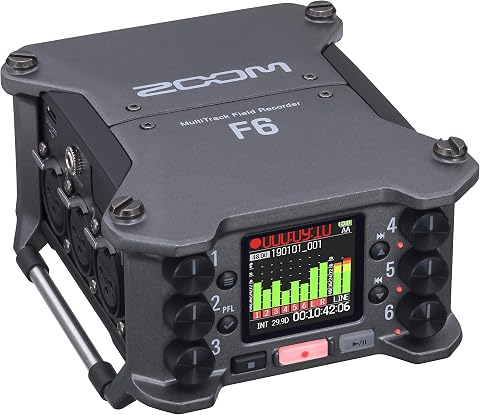
The Zoom F6 is a portable multitrack field recorder with 32-bit float recording and dual A/D converters for capturing a wide dynamic range. It has six XLR inputs, records up to 14 tracks, and includes timecode I/O for syncing audio with video.
Pros:
- 32-bit float recording with dual A/D converters provides wide dynamic range
- Six XLR inputs and up to 14 tracks support multitrack recording
- Timecode I/O supports audio and video synchronization
- Portable design with multiple power options
Cons:
- Requires four AA batteries when using battery power
- The description does not specify included storage beyond the stated 8 GB capacity
Best for: Shoppers considering a recorder for a portable recording workflow.
Not ideal for: Recording setups whose source connections or file workflow do not match verified details.
Bottom line: Confirm inputs, storage, and file handling against the recording workflow you need.
In-Ear Monitor System
Monitoring equipment needs to fit into the complete signal path, so clarify what role this item is expected to play before purchase. The listed pick is the Phenyx Pro Wireless Antenna Combiner for In-Ear Monitor System PAS-227. Its name describes a wireless antenna combiner for an in-ear monitor system; confirm the intended compatibility and required companion equipment in the manufacturer’s documentation.
A common mistake is treating a component for a wireless setup as a complete monitoring system. Check whether this item works with the specific in-ear monitor equipment you own or plan to buy, and verify the connections, configuration, and operating requirements. Confirm whether additional components are needed for your intended setup. Do not infer compatibility from the general product category or from similar model names.
Physical fit matters too: consider where the component will be placed, how it will connect to the rest of the system, and how the setup will be packed or stored. Check dimensions and included accessories in the listing, and compare the documented requirements with your available space and equipment. If you are building a system from separate products, map each connection and confirm the complete chain before ordering. This helps avoid a mismatched component.
What to look for:
- Confirm documented compatibility with your specific in-ear monitor equipment.
- Check required connections and configuration for the full signal path.
- Verify whether other components are needed for your intended setup.
- Compare dimensions and placement needs with your equipment space.
- Review included accessories and the exact model designation.
Phenyx Pro Wireless Antenna Combiner for In-Ear Monitor System PAS-227X
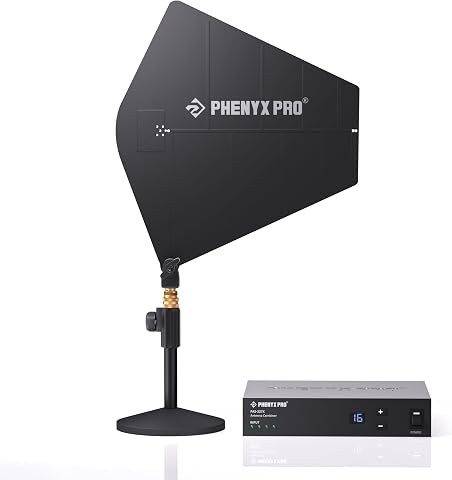
The PAS-227X antenna combiner supports four inputs, seamlessly merging signals into a single output to reduce noise and extend range. It features adaptive gain adjustment, wide bandwidth compatibility (460-970MHz), and easy setup with LED indicators and rack-mount options, making it ideal for live performances and large events.
Pros:
- Supports four antenna inputs for reliable signal management
- Wide bandwidth compatibility with most IEM systems
- Adjustable gain with LCD display for easy monitoring
- Compact half-rack design for space-saving setup
Cons:
- Requires some technical knowledge for optimal setup
- Limited to specific frequency range (460-970MHz)
- No mention of weather resistance for outdoor use
Best for: Shoppers checking a wireless antenna combiner for an in-ear monitor setup.
Not ideal for: Anyone who needs a complete monitoring system from this listed component alone.
Bottom line: Verify compatibility and required companion equipment across the complete signal path.
For a budget-first buying order, prioritize the pieces your setup cannot function without, then add supporting gear after confirming connections and compatibility. Compare essential requirements and total setup needs using current product listings, and avoid buying accessories until you know they fit the equipment you choose.
Use the checklist as a practical starting point, then verify the details that matter for your space, workflow, and existing gear. With a few careful checks, you can build a well-matched setup one decision at a time.