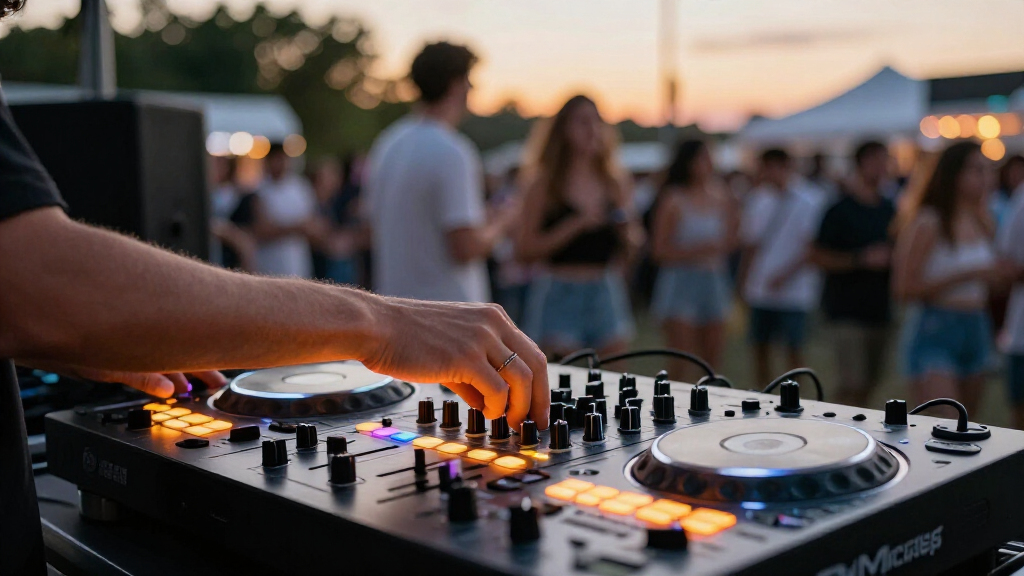
DMX lighting controllers for DJs range from compact, hands-on consoles to computer-linked systems built for more coordinated shows. My best overall pick is the ADJ WMX1 Mk2 for DJs who want standalone control, while the SoundSwitch Control One stands out for a software-based workflow and the CHAUVET DJ Obey 40 for straightforward control of a modest rig. The main tradeoff is between tactile, preprogrammed operation and computer-assisted flexibility; channel count alone does not tell you which will be easier to run live. I also weigh fixture programming, portability, and whether a controller fits a DJ’s show routine. Read on for the full breakdown of all 15 options and how to choose among them.

Get audio and creator gear delivered free with Prime
- Fast, free delivery on millions of items
- Prime Video, Amazon Music and more included
- Member-only deals all year
Complete the kit

Key Takeaways
- The ADJ WMX1 Mk2 leads for standalone operation: it is the clearest fit for DJs who want a dedicated controller without making a computer the center of the show.
- SoundSwitch Control One serves a different workflow: its appeal is tied to computer-based lighting control, so it suits DJs who prefer software integration over a traditional console layout.
- Obey 40 and Obey 70 occupy distinct roles: the Obey 40 is the simpler choice for smaller rigs, while the Obey 70 gives buyers a step up within CHAUVET DJ’s controller family.
- Many 192-channel consoles are close substitutes: TCFUNDY, MAD OWL, MINGJIE, MetYonLaser, CO-Z, and XPCLEOYZ should be judged by control layout, programming needs, and support details—not channel count alone.
- 384-channel and MIDI options suit expansion-minded setups: the Rockville ROCKFORCE and the DMX/MIDI 384-channel controller make more sense when added capacity or MIDI control has a clear role in the DJ’s rig.
| TCFUNDY 192-Channel DMX 512 Lighting Controller |  | Best for Structured Scene Programming | Channels: 192 | Maximum fixtures: 12 | Channels per fixture: Up to 16 | VIEW LATEST PRICE | See Our Full Breakdown |
| ADJ WMX1 Mk2 Standalone DMX Lighting Controller |  | Best for Larger Multi-Universe Rigs | DMX universes: Up to 4 | Output sockets: 4 | Backlit buttons: 37 | VIEW LATEST PRICE | See Our Full Breakdown |
| MAD OWL 12-Channel DMX512 Lighting Controller |  | Best Compact Manual Controller | Channels: 12 | DMX output: 3-pin XLR | Controls: Six channel faders, one master fader, and blackout button | VIEW LATEST PRICE | See Our Full Breakdown |
| SoundSwitch Control One DMX Lighting Controller |  | Best for Music-Synced DJ Sets | DMX universes: 2 | Smart-light support: Philips Hue Smart Lights | Audio response: Live BPM detection | VIEW LATEST PRICE | See Our Full Breakdown |
| DMX512 DJ Lighting Controller, 384 Channels, 30 Banks, 8 Scenes, 24 Fixtures |  | Best for Higher Fixture Capacity | Control signal: DMX512 | Control channels: 384 | Maximum fixtures: 24 | VIEW LATEST PRICE | See Our Full Breakdown |
| CHAUVET DJ Obey 40 DMX Light and Fog Machine Controller |  | Best for Fog and Strobe Control | DMX channels: 192 | Fixture capacity: Up to 12 fixtures, up to 16 channels each | Scene storage: Up to 240 scenes across 30 banks | VIEW LATEST PRICE | See Our Full Breakdown |
| 192-Channel DMX Stage Lighting Controller |  | Best for Straightforward Manual Control | DMX channels: 192 | Device capacity: Up to 12 devices, 16 channels each | Programmable scenes: Up to 240 | VIEW LATEST PRICE | See Our Full Breakdown |
| MAD OWL 192-Channel DMX512 Lighting Controller |  | Best for Choreographed Chase Playback | DMX channels: 192 | Fixture capacity: Up to 12 fixtures, 16 channels or fewer each | Programmable scenes: 23 banks of 8 scenes | VIEW LATEST PRICE | See Our Full Breakdown |
| MINGJIE DMX512 Controller, 192-Channel Stage Lighting Console |  | Best for Sound-Activated Sets | DMX channels: 192 | Maximum fixtures: 12 | Scenes and banks: 240 scenes across 30 banks | VIEW LATEST PRICE | See Our Full Breakdown |
| CHAUVET DJ Obey 70 Universal DMX-512 Controller |  | Best for Higher-Channel Fixtures | DMX channels: 384 | Fixture capacity: Up to 12 lights, up to 32 channels each | Scene storage: 240 scenes across 30 banks | VIEW LATEST PRICE | See Our Full Breakdown |
| MetYonLaser DMX512 Stage Lighting Controller, 192-Channel Console |  | Best Compact Console | Channels: 192 | Protocol: DMX512 | Wireless compatibility: Compatible with 2.4G DMX512 controllers | VIEW LATEST PRICE | See Our Full Breakdown |
| DMX 384-Channel Lighting Controller with DMX512 and MIDI Control |  | Best for MIDI-Linked Setups | Channels: 384 | Fixture capacity: Up to 24 intelligent lights, 16 channels each | Programmable banks: 30 banks of 8 scenes | VIEW LATEST PRICE | See Our Full Breakdown |
| CO-Z 192-Channel DMX 512 Stage Light Controller |  | Best for Voice-Activated Sets | Channels: 192 | Maximum lights: 12 | Maximum channels per light: 16 | VIEW LATEST PRICE | See Our Full Breakdown |
| Rockville ROCKFORCE 384-Channel DMX Lighting Controller with MIDI |  | Best for Hands-On Control of a Larger Rig | DMX channels: 384 | Fixture capacity: Up to 24 lights with 16 channels each | Programmable scenes: 30 banks of 8 scenes, 240 total | VIEW LATEST PRICE | See Our Full Breakdown |
| XPCLEOYZ DMX512 192-Channel Stage Lighting Controller |  | Best for Fine-Tuning Scene Timing | Channels: 192 | Maximum fixtures: 12 | Maximum channels per fixture: 16 | VIEW LATEST PRICE | See Our Full Breakdown |
More Details on Our Top Picks
TCFUNDY 192-Channel DMX 512 Lighting Controller
I’d shortlist the TCFUNDY 192-Channel for DJs who want to build scenes and chases on a conventional hardware console rather than rely on music-sync software. Its 30 banks of eight scenes and six programmable chases give a resident DJ room to prepare different looks for sets or event moments, while manual sliders and speed and fade controls allow hands-on adjustments. Compared with the MAD OWL 12-Channel, it handles a much larger fixture setup, supporting up to 12 lights at 16 channels each. That capacity still has a firm ceiling: 192 channels may not suit fixtures needing more control channels or a growing rig. It also requires compatible 3-pin DMX connections, and its programming approach is less focused on automatic beat matching than the SoundSwitch Control One.
Pros:- Supports up to 12 fixtures with as many as 16 channels each.
- Thirty banks of eight scenes provide a useful structure for storing lighting looks.
- Six programmable chases and speed and fade controls support hands-on show changes.
- Manual sliders allow direct adjustment during a performance.
Cons:- The 192-channel limit can restrict fixtures with higher channel counts or larger rigs.
- Requires compatible 3-pin lighting connections.
- Does not offer the music-sync features described for the SoundSwitch Control One.
Best for: DJs with up to 12 compatible intelligent lights who want programmable scenes and chases with direct fader control.
Not ideal for: DJs seeking automatic music-synced shows, more than 192 channels, or fixtures that do not use compatible 3-pin DMX connections.
- Channels:192
- Maximum fixtures:12
- Channels per fixture:Up to 16
- Programmable banks:30 banks of 8 scenes
- Programmable chases:6 chases of 240 scenes
- Manual sliders:8
- Connectivity:XLR
- Power input:DC 9–12 V
Our verdict“Choose the TCFUNDY if you want a traditional scene-and-chase console for a modest multi-fixture DJ rig, not automatic music syncing.”
ADJ WMX1 Mk2 Standalone DMX Lighting Controller
The ADJ WMX1 Mk2 is the strongest fit here for a DJ whose lighting rig has outgrown a single-universe console. Support for up to four DMX universes gives it more room to address fixtures than the TCFUNDY’s 192 channels, and four output sockets provide separate physical connections for a more involved setup. Its 37 backlit buttons and four rotary encoders put frequently used controls within reach, while the stainless-steel chassis suits regular transport between events. The tradeoff is that the supplied details do not spell out fixture counts or scene-programming capacity, so buyers should confirm the control workflow meets their needs. Four output sockets may also limit how a large rig is physically connected, even with four-universe support. Compared with the SoundSwitch Control One, this is the more hardware-focused option, not the clearer choice for automatic music syncing.
Pros:- Supports up to four DMX universes, providing more addressing capacity than the 192-channel TCFUNDY.
- Four output sockets offer multiple physical DMX connections.
- Thirty-seven backlit silicone buttons and four rotary encoders provide varied hands-on controls.
- Stainless-steel construction is suited to frequent setup and transport.
Cons:- Four output sockets may constrain physical connections in larger installations.
- The supplied product details do not specify fixture limits or scene and chase capacity.
- Its feature set is less directly aimed at music-synced control than the SoundSwitch Control One.
Best for: Mobile and club DJs running a multi-universe DMX rig who want a durable standalone controller with tactile buttons and encoders.
Not ideal for: Beginners who want clearly documented scene-programming details or DJs prioritizing automatic beat-synced lighting over hardware control.
- DMX universes:Up to 4
- Output sockets:4
- Backlit buttons:37
- Rotary encoders:4
- Connectivity:USB Type-A
- Material:Stainless steel
- Dimensions:10 × 9.25 × 3.5 in
- Weight:2.36 lb
Our verdict“Pick the WMX1 Mk2 if your priority is tactile control and four-universe capacity, and verify its workflow fits your fixtures before buying.”
MAD OWL 12-Channel DMX512 Lighting Controller
For a DJ with a few simple fixtures, the MAD OWL C-12 is a compact manual controller rather than a console for programming a full light show. Six channel faders, a master fader, and a blackout button make basic adjustments and quick shutdowns straightforward. Its aluminum body and small footprint are easier to accommodate than the TCFUNDY 192-Channel console, but that portability comes from a major capacity limit: this model controls only 12 DMX channels total, not 12 fixtures. Fixtures that need more than 12 channels are unsupported, making careful channel-count checks essential. Compared with the TCFUNDY’s banks and chases, the C-12 offers much less scope for stored looks; it suits direct, simple control instead. It also requires DMX512-compatible fixtures and a 3-pin XLR connection.
Pros:- Compact aluminum housing is easy to fit into a small DJ setup.
- Six channel faders and a master fader provide direct manual adjustments.
- A dedicated blackout button offers a quick way to cut the lighting output.
- Uses a 3-pin XLR DMX output.
Cons:- Limited to 12 channels total, far below the TCFUNDY’s 192-channel capacity.
- Does not provide the programmable banks and chases listed for the TCFUNDY.
- Fixtures requiring more than 12 channels are not supported.
Best for: DJs who need straightforward manual control of a small set of DMX fixtures using no more than 12 channels in total.
Not ideal for: DJs using multi-channel moving lights, wanting programmable scenes and chases, or planning to expand beyond 12 DMX channels.
- Channels:12
- DMX output:3-pin XLR
- Controls:Six channel faders, one master fader, and blackout button
- Power source:Corded electric
- Voltage:12 V
- Dimensions:7.09 × 3.94 × 1.38 in
- Material:Aluminum
- Mounting type:Rack mount
Our verdict“Choose the MAD OWL C-12 for compact, basic fader control, but skip it if your fixtures need more than 12 channels.”
SoundSwitch Control One DMX Lighting Controller
The SoundSwitch Control One earns its place for DJs who want lighting to follow the music rather than rely solely on manually triggered scenes. It supports live BPM detection from any audio source, plus two DMX universes and Philips Hue lights, so it can bridge conventional fixtures and compatible smart lighting. Its tactile controls, autoloops, and customizable RGB pads give DJs ways to shape the show during a set. Compared with the TCFUNDY, which focuses on stored banks and chases, this option is more closely tailored to music-led performance. The tradeoff is a steeper setup and learning curve: the listed Engine DJ and rekordbox integrations may require a SoundSwitch software bridge for PRO DJ LINK functionality. DJs who prefer a straightforward standalone console may find the ADJ WMX1 Mk2’s hardware-centered approach a better fit.
Pros:- Live BPM detection can sync lighting to any audio source.
- Supports two DMX universes and Philips Hue Smart Lights.
- Autoloops and customizable RGB pads add performance flexibility.
- Designed to integrate with Engine DJ hardware and rekordbox software.
Cons:- PRO DJ LINK functionality requires a SoundSwitch software bridge.
- The DMX programming and integration options may be complex for beginners.
- Two universes offer less capacity than the ADJ WMX1 Mk2’s four.
Best for: DJs who want lighting to react to live music and use compatible DMX fixtures, Philips Hue lights, or supported DJ software and hardware.
Not ideal for: Newcomers seeking a simple manual-only console, or DJs unwilling to set up SoundSwitch software for certain integrations.
- DMX universes:2
- Smart-light support:Philips Hue Smart Lights
- Audio response:Live BPM detection
- Autoloops:Supported
- Software and hardware integration:Engine DJ hardware and rekordbox software
- Material:Stainless steel
- Dimensions:10.68 × 6.6 × 2.16 in
- Weight:1.76 lb
Our verdict“Choose the Control One if music-reactive lighting matters more than a simple standalone programming workflow.”
DMX512 DJ Lighting Controller, 384 Channels, 30 Banks, 8 Scenes, 24 Fixtures
This 384-channel console is aimed at DJs who need more fixture capacity than the TCFUNDY’s 192-channel limit. It supports up to 24 fixtures and provides 30 banks of eight scenes, making it a plausible fit for a growing conventional DMX rig with multiple looks to recall. The included gooseneck LED light is a practical extra for working at a console in dim event spaces. The listing does not provide specific fixture compatibility details, though, so buyers should check channel modes and DMX connections before committing. Its listed dimensions, 9 × 6 × 24 inches, also conflict with the product’s compact-console description; I would verify the physical size rather than assume it will fit a particular DJ booth. Unlike the SoundSwitch Control One, the supplied details do not describe live BPM syncing.
Pros:- 384 control channels provide more capacity than the 192-channel TCFUNDY.
- Supports up to 24 fixtures.
- Thirty banks of eight scenes support a range of stored lighting looks.
- Includes a gooseneck LED light for console use in dark venues.
Cons:- The product listing gives conflicting dimensions, so booth fit is uncertain.
- Specific fixture compatibility details are not provided.
- The supplied information does not describe music-sync features like those of the SoundSwitch Control One.
Best for: DJs with a larger conventional DMX setup who need up to 384 channels, support for as many as 24 fixtures, and programmable scene banks.
Not ideal for: DJs who need confirmed compatibility with particular fixtures, music-reactive automation, or dependable dimensions for a tightly packed booth.
- Control signal:DMX512
- Control channels:384
- Maximum fixtures:24
- Programmable banks:30
- Scenes per bank:8
- Power supply:110–240 VAC, 50–60 Hz; DC 9–12 V
- Power consumption:10 W
- Listed dimensions:9 × 6 × 24 in
Our verdict“Choose this console for its stated 384-channel and 24-fixture capacity, but verify fixture compatibility and physical dimensions first.”
CHAUVET DJ Obey 40 DMX Light and Fog Machine Controller
The Obey 40 is the clearest fit here for DJs who want fixture programming plus direct control of fog and strobe effects from the same console. Its 192 DMX channels cover up to 12 fixtures with 16 channels each, while 240 stored scenes and six chase sets give a mobile rig options for repeatable looks. Compared with the CHAUVET DJ Obey 70, it has less capacity per fixture, so it is a better match for simpler lights than for fixtures needing up to 32 channels. MIDI support and reversible sliders add useful flexibility for hands-on operation, but this remains a wired, physical console rather than a wireless setup. I’d choose it for a compact DJ rig that values dedicated effect controls; buyers should account for its separate power supply and lack of listed wireless connectivity.
Pros:- Controls up to 12 fixtures across 192 DMX channels
- Stores up to 240 scenes across 30 banks for repeatable looks
- Dedicated fog and strobe controls suit DJ effects workflows
- MIDI compatibility and reversible sliders add hands-on flexibility
Cons:- Supports only up to 16 channels per fixture, below the Obey 70’s 32-channel capacity
- Requires an external power supply
- No wireless connectivity is listed
Best for: DJs running up to 12 modest-channel fixtures who want dedicated fog and strobe controls alongside scene and chase playback
Not ideal for: DJs using fixtures that need more than 16 channels each, or those who need wireless control and a minimal-cable setup
- DMX channels:192
- Fixture capacity:Up to 12 fixtures, up to 16 channels each
- Scene storage:Up to 240 scenes across 30 banks
- Chases:6 sets
- Connectivity:USB and MIDI
- Input voltage:9 VDC, 500 mA
- Material and weight:Metal; 6.7 lb
Our verdict“Choose the Obey 40 if fog and strobe controls matter more than high channel capacity per fixture or wireless operation.”
192-Channel DMX Stage Lighting Controller
This 192-channel console suits DJs who want conventional sliders and basic programmed playback without a feature-heavy control scheme. It handles up to 12 devices at 16 channels each, with space for 240 scenes and six chases; automatic speed and fade controls can help keep changes moving without constant manual adjustment. Compared with the MAD OWL 192-Channel DMX512 Lighting Controller, the supplied description emphasizes its eight manual sliders and automatic controls, while the MAD OWL specifies chase steps and includes a DMX cable. The ABS body keeps the unit lighter than a metal-console option, though it may feel less substantial for frequent transport. Its rack-mount format and 3-pin connection fit compatible wired DJ rigs, but the 90-day warranty and 12-device ceiling make it a less reassuring choice for demanding or expanding setups.
Pros:- Controls up to 12 devices across 192 channels
- Provides eight manual sliders plus automatic speed and fade controls
- Supports up to 240 programmable scenes and six chases
- Includes a power adapter and supports 3-pin stage-light connections
Cons:- Limited to 12 devices with up to 16 channels each
- ABS construction may be less robust than metal-bodied alternatives
- Listed manufacturer warranty is 90 days
Best for: Mobile DJs seeking a basic rack-mount controller with physical sliders, automatic speed and fade controls, and compatible 3-pin fixtures
Not ideal for: DJs who need detailed fixture capacity beyond 12 devices, a longer support warranty, or a metal chassis for frequent heavy transport
- DMX channels:192
- Device capacity:Up to 12 devices, 16 channels each
- Programmable scenes:Up to 240
- Programmable chases:6
- Manual controls:8 sliders
- Connections:3-pin cable
- Power input:DC 9–12 V, 500 mA
- Material and weight:ABS; 1.65 kg
- Mounting and dimensions:Rack mount; 7 × 6 × 12 in
Our verdict“Pick this console for straightforward slider-led control in a compatible 3-pin DJ rig, but look elsewhere for tougher construction or broader capacity.”
MAD OWL 192-Channel DMX512 Lighting Controller
The MAD OWL WK-192 is a good match for DJs who build lighting sequences around programmed chases rather than relying only on live slider moves. It controls up to 12 fixtures with 16 channels or fewer each and offers six chases with up to 240 steps, giving a set more room for evolving patterns. Its included 6.6-foot DMX cable is a practical advantage over the MINGJIE console, whose supplied cable is only four feet long. Scene storage is organized as 23 banks of eight scenes, so it reaches 184 scenes rather than the 240 listed for the CHAUVET Obey 40. The metal body and rack-mount format suit a fixed booth or protected rack, but its stated fixture limit rules it out for lights needing more than 16 channels each.
Pros:- Supports six programmable chases with up to 240 steps
- Includes a 6.6-foot DMX cable
- Metal construction and rack-mount design suit a fixed DJ booth
- Controls up to 12 fixtures with 16 channels or fewer each
Cons:- Fixture support is limited to 16 channels or fewer per fixture
- 23 banks of eight scenes provide 184 scenes, fewer than the 240-scene Obey 40
- No MIDI, sound activation, or wireless features are listed
Best for: DJs who program multi-step chases for a rack of up to 12 fixtures, each requiring no more than 16 channels
Not ideal for: DJs with higher-channel fixtures or anyone who needs 240 stored scenes rather than the listed 184
- DMX channels:192
- Fixture capacity:Up to 12 fixtures, 16 channels or fewer each
- Programmable scenes:23 banks of 8 scenes
- Chases:6, with up to 240 steps
- Connectivity:DMX
- Included cable:6.6 ft (2 m)
- Material and weight:Metal; 4 lb
- Mounting and dimensions:Rack mount; 22.44 × 7.28 × 4.72 in
Our verdict“Choose the MAD OWL if chase programming and an included DMX cable matter more than maximum scene count or support for higher-channel fixtures.”
MINGJIE DMX512 Controller, 192-Channel Stage Lighting Console
The MINGJIE MJDMX031 stands out for DJs who want lighting changes to respond to music without building every moment around manual cues. Sound activation joins its 240 scenes and six chases, while the 192-channel layout supports up to 12 intelligent fixtures. Compared with the CHAUVET DJ Obey 40, it offers a stated sound-activation feature and a 100–240 V input, while the Obey 40 specifically lists MIDI, USB, and dedicated fog and strobe controls. The alloy chassis keeps the MINGJIE’s listed weight to 3.09 pounds, and a 3-pin DMX cable is included, though its four-foot length may constrain placement between the console and first fixture. This is a focused option for music-responsive DJ lighting, not the pick for buyers seeking detailed listed controls for fog, strobe, or MIDI.
Pros:- Sound activation supports music-responsive lighting
- Provides 240 scenes across 30 banks and six chases
- Includes a 3-pin DMX cable and accepts 100–240 V input
- Alloy chassis with a listed weight of 3.09 lb
Cons:- The included DMX cable is only 4 ft long
- No MIDI or USB connectivity is listed
- No dedicated fog or strobe controls are specified
Best for: DJs who want sound-activated lighting and stored scenes in a compact, wired console for up to 12 fixtures
Not ideal for: Performers who need MIDI integration, dedicated fog and strobe buttons, or a longer included DMX cable
- DMX channels:192
- Maximum fixtures:12
- Scenes and banks:240 scenes across 30 banks
- Chases:6
- DMX protocol:DMX512
- Included cable:3-pin DMX cable, 4 ft (1.2 m)
- Input voltage:100–240 V
- Chassis and weight:Alloy; 3.09 lb
- Warranty:1 year
Our verdict“Pick the MINGJIE for sound-activated DJ lighting, but choose the Obey 40 if MIDI or dedicated fog and strobe controls matter more.”
CHAUVET DJ Obey 70 Universal DMX-512 Controller
The Obey 70 earns its place for DJs whose intelligent lights need more channel space per fixture than the 192-channel consoles in this group can provide. It controls up to 12 lights at as many as 32 channels each, totaling 384 DMX channels; that makes it a stronger match for feature-rich fixtures than the Obey 40, which supports up to 16 channels per light. Reassignable channels, a joystick, and the ability to grab a fixture during operation offer more hands-on flexibility, while beat activation, tap-sync, and auto-run give DJs several ways to pace looks. The tradeoff is a larger rack-mount format and a more involved control surface than a basic 192-channel console. I’d choose it for a growing rig, not a small setup that will never use the extra channel capacity.
Pros:- Provides 384 DMX channels and supports up to 32 channels per fixture
- Stores up to 240 scenes in 30 banks
- Includes a joystick, reassignable channels, and reversible sliders
- Offers beat activation, tap-sync, auto-run, fog, and strobe controls
Cons:- Its higher channel capacity and expanded controls may be unnecessary for simpler DJ rigs
- The 4-space 19-inch rack-mount format needs more booth or rack space than a compact console
- No wireless connectivity is listed
Best for: DJs using up to 12 intelligent fixtures that require as many as 32 channels each and who want tap-sync, beat activation, or live fixture adjustments
Not ideal for: DJs with simple, low-channel lights who prefer a smaller, less involved console or do not need 384 channels
- DMX channels:384
- Fixture capacity:Up to 12 lights, up to 32 channels each
- Scene storage:240 scenes across 30 banks
- Chases:6 sets, containing up to 240 scenes
- Live controls:Reversible sliders, reassignable channels, assignable joystick
- Playback features:Beat activation, tap-sync, auto-run, sequential chase linking
- Connectivity:MIDI compatible
- Mounting and dimensions:4-space 19-inch rack mount; 19.01 × 7 × 2.79 in
- Material and weight:Stainless steel; 6.9 lb
Our verdict“Choose the Obey 70 when your fixtures need up to 32 channels each; for simpler lights, the Obey 40’s smaller channel capacity may be enough.”
MetYonLaser DMX512 Stage Lighting Controller, 192-Channel Console
The MetYonLaser’s compact footprint makes it a practical pick for mobile DJs who want hands-on control without carrying a larger console. It offers 192 DMX channels for compatible fixtures, with scene and chase playback to prepare looks before a set rather than adjust every light manually during it. At 2 pounds and 12 inches long, it is easier to fit into a small booth than the larger CO-Z 192-Channel, though the CO-Z lists more specific fixture and scene limits. The MetYonLaser also works with compatible 2.4G wireless DMX controllers, which can help reduce cable runs when the rest of the system supports them. Its tradeoff is a relatively basic feature set: there is no stated MIDI control or voice control, and it still requires DMX-compatible gear.
Pros:- 192 DMX channels for controlling compatible fixtures and effects
- Stores and plays back scenes and chase sequences
- Compatible with standard DMX512 fixtures
- Works with compatible 2.4G wireless DMX512 controllers
Cons:- No stated MIDI, sound-activation, or voice-control options
- Requires compatible DMX512 fixtures or wireless controllers
- Product details do not specify fixture capacity or scene limits
Best for: Mobile DJs with a compact booth and a modest DMX rig who want scene and chase playback in a lightweight console.
Not ideal for: DJs who need MIDI integration, detailed fixture-capacity guidance, or controls for non-DMX lights.
- Channels:192
- Protocol:DMX512
- Wireless compatibility:Compatible with 2.4G DMX512 controllers
- Item weight:2 pounds
- Package dimensions:12 x 8 x 2 inches
- Playback:Stores and plays scenes and chase sequences
Our verdict“Choose the MetYonLaser if a lightweight console with scene and chase playback matters more than advanced triggering or detailed programming capacity.”
DMX 384-Channel Lighting Controller with DMX512 and MIDI Control
MIDI control is the defining advantage of this 384-channel rack-mount console for DJs who want lighting cues linked to compatible MIDI gear. Its stated capacity of 24 fixtures with 16 channels each gives it more room for a growing rig than the 192-channel CO-Z, while 30 banks of scenes and six chases provide options for saving and recalling looks. Sound activation and pre-programmed effects also offer alternatives when a DJ does not want to trigger every change manually. The rack-mount design suits a fixed booth or equipment rack, but is less convenient for a DJ seeking a small tabletop controller like the MetYonLaser. The setup also depends on compatible 3-pin DMX fixtures, and the available product details do not explain how MIDI mapping or programming works.
Pros:- 384 channels support up to 24 intelligent lights with 16 channels each
- MIDI control can link lighting operation to compatible performance gear
- Provides 30 banks of 8 scenes and six chases
- Includes sound activation, pre-programmed effects, and a gooseneck lamp
Cons:- Rack-mount format is less suited to compact, quick-deploy DJ booths
- Requires compatible 3-pin DMX fixtures
- Product details do not explain MIDI mapping or programming steps
Best for: DJs with a rack-based setup and compatible MIDI equipment who want to coordinate lighting cues with their performance.
Not ideal for: Mobile DJs seeking a lightweight tabletop console or buyers who need clear setup guidance for MIDI programming.
- Channels:384
- Fixture capacity:Up to 24 intelligent lights, 16 channels each
- Programmable banks:30 banks of 8 scenes
- Chases:6 chases with 240 scenes
- Control features:MIDI, sound activation, and pre-programmed lighting effects
- Compatibility:3-pin DMX cable
- Mounting type:Rack mount
- Included items:Controller, power cable, and LED gooseneck lamp
Our verdict“Pick this console for a rack-based DJ lighting rig where MIDI triggering and 384-channel capacity matter more than portability.”
CO-Z 192-Channel DMX 512 Stage Light Controller
Voice control gives the CO-Z a distinct role among these 192-channel consoles, offering DJs a hands-free trigger option for compatible lighting setups. It handles up to 12 intelligent lights with as many as 16 channels each and supports up to 240 scenes, making it a more clearly specified choice than the MetYonLaser for buyers planning a small-to-mid-size fixture rig. Dedicated controls for lights, channels, scenes, speed, and functions also give operators direct access to common adjustments. That said, the CO-Z is a long, 19.1-inch plastic console, so it takes more booth space than the compact MetYonLaser. Its three-pin connection and 16-channel-per-light limit also narrow its fit; DJs with larger fixtures or MIDI-driven workflows may prefer a 384-channel model.
Pros:- Controls up to 12 intelligent lights with up to 16 channels each
- Supports up to 240 scenes
- Voice control adds a hands-free operating option
- Dedicated controls cover light selection, channels, scenes, speed, and functions
Cons:- 19.1-inch length takes more booth space than the MetYonLaser
- Limited to 16 channels per light
- Requires compatible three-pin connections
Best for: DJs running up to 12 compatible three-pin fixtures who want voice control and dedicated buttons for common lighting adjustments.
Not ideal for: DJs with limited booth space, fixtures needing more than 16 channels each, or a setup built around MIDI control.
- Channels:192
- Maximum lights:12
- Maximum channels per light:16
- Maximum scenes:240
- Connectivity:Three-pin cable
- Voice control:Available
- Voltage:130 volts
- Weight and dimensions:3.9 pounds; 19.1 x 5.3 x 2.8 inches
- Warranty:1 year
Our verdict“Choose the CO-Z for a small-to-mid-size three-pin DMX rig where voice control and direct scene access are priorities.”
Rockville ROCKFORCE 384-Channel DMX Lighting Controller with MIDI
The ROCKFORCE 384 pairs high fixture capacity with hands-on adjustments, making it a strong fit for DJs who want more than basic scene playback. It controls up to 24 lights at 16 channels each and offers 16 sliders, programmable scenes and chases, adjustable fade and speed, plus manual override. Compared with the other 384-channel console in this batch, it lists more operational detail, including reversible DMX channels, power-failure memory, and included DMX cables. MIDI and music-triggered modes add ways to cue changes without relying only on the sliders. The tradeoff is a larger, heavier metal unit that needs a substantial booth or rack area, and its programming controls may take time to learn. DJs wanting simpler voice-operated scenes may find the CO-Z easier to approach.
Pros:- Controls up to 24 intelligent lights with 16 channels each
- 16 sliders, manual override, and reversible DMX channels support hands-on operation
- Programmable scenes and chases include adjustable fade and speed
- Metal housing, power-failure memory, gooseneck lamp, and DMX cables are specified
Cons:- Complex programming may take time for new DMX users to learn
- At 5.4 pounds and over 20 inches long, it is less convenient for compact booths
- Requires compatible 3-pin DMX fixtures and cabling
Best for: DJs with a larger multi-fixture rig who want sliders, manual override, MIDI options, and saved lighting sequences in one console.
Not ideal for: Beginners seeking a simple controller, or mobile DJs prioritizing a light and compact unit.
- DMX channels:384
- Fixture capacity:Up to 24 lights with 16 channels each
- Programmable scenes:30 banks of 8 scenes, 240 total
- Programmable chases:6
- Controls:16 sliders; MIDI, music-triggered modes, and manual override
- Connectivity:3-pin XLR DMX in/out
- Dimensions and weight:20.71 x 7.28 x 3.15 inches; 5.4 pounds
- Included components:LED gooseneck lamp and 3-pin XLR DMX in/out cables
- Warranty:1 year
Our verdict“Choose the ROCKFORCE 384 if you need broad fixture capacity and hands-on control and are ready to learn DMX programming.”
XPCLEOYZ DMX512 192-Channel Stage Lighting Controller
Adjustable step pauses and transition speeds set the XPCLEOYZ apart from the CO-Z, whose listed strengths center on voice control and dedicated operation buttons. This 192-channel console handles up to 12 fixtures with 16 channels each and stores up to 240 scenes, with as many as 40 steps per scene. For a DJ, that means more scope to shape a programmed sequence’s pacing rather than rely on a fixed look. Voice control is also included, alongside a three-pin XLR DMX output. The tradeoff is a control layout that may take beginners longer to learn, and its 192-channel capacity is less suited to a growing rig than either 384-channel option in this batch. It is a focused choice for DJs who value programmed timing over MIDI integration.
Pros:- Supports up to 240 programmable scenes with up to 40 steps per scene
- Adjustable pause and transition times allow control over scene pacing
- Controls up to 12 fixtures with up to 16 channels each
- Includes voice control and a 3-pin XLR DMX output
Cons:- 192-channel capacity offers less headroom than the ROCKFORCE 384
- Multiple control sections may take time for beginners to learn
- Requires compatible DMX fixtures with a three-pin connection
Best for: DJs with up to 12 compatible fixtures who want to program scene sequences with adjustable pauses and transition speeds.
Not ideal for: DJs who need 384 channels, MIDI control, or a particularly simple first DMX console.
- Channels:192
- Maximum fixtures:12
- Maximum channels per fixture:16
- Programmable scenes:Up to 240
- Steps per scene:Up to 40
- Pause time per step:1–25.5 seconds
- Transition speed:0.1–25.5 seconds
- DMX output and control modes:DMX512, 3-core XLR output; voice control
- Warranty:1 year manufacturer
Our verdict“Choose the XPCLEOYZ if detailed scene timing matters more to your DJ set than MIDI control or room for a larger fixture rig.”
How We Picked
I compared these controllers around the demands of DJ lighting: how quickly a performer can make changes live, how much fixture and scene programming the unit supports, and whether its operating style suits a one-person show. I also weighed stated channel capacity, fixture limits where provided, computer or MIDI dependencies, physical portability, and the clarity of the product’s intended workflow. A larger channel number can help with expansion, but it does not automatically make a controller easier or faster to operate.
The ranking favors options with a more distinct DJ use case and clearer role in a live setup. The ADJ WMX1 Mk2 ranks first for its standalone focus; SoundSwitch Control One follows for DJs who want software-oriented control, while CHAUVET DJ’s Obey models suit more traditional hands-on operation. The 192-channel consoles are grouped lower because their headline capacity is similar and buyers may need to compare exact layouts and documentation closely. Higher-capacity and MIDI models rise for specific expansion needs, but are not automatic picks for a basic mobile-DJ rig.
Factors to Consider When Choosing DMX Lighting Controllers For DJs
Before choosing a controller, map the lighting workflow to the way you perform. The right fit depends on fixtures, programming time, and live control—not just the largest channel figure on the box. These factors can help prevent an awkward mismatch between your controller and your gig setup.
Match the Controller to Your DJ Workflow
Decide whether you want to trigger scenes manually, run a prepared sequence, or manage lighting through DJ software. A standalone console can keep lighting control separate from a laptop and may be easier to operate when you want dedicated physical controls. Software-linked control can suit DJs already building a computer-centered show, but it adds a dependency on software, configuration, and the computer itself. A common mistake is buying around a workflow you hope to adopt rather than the one you will actually use at gigs. Pick the operating style you can set up and control confidently under time pressure.
Count Fixtures and DMX Channels Before You Buy
Work out how many fixtures you plan to address and how many DMX channels each fixture needs in its chosen mode. A moving head or multi-effect fixture can use many more channels than a simple wash light, so a fixture count by itself can understate what the controller must handle. Leave capacity for a likely addition, but do not pay for expansion you have no practical plan to use. Also check the controller’s stated fixture limits and how it organizes addresses or fixture profiles. This is where a lower-capacity console may be adequate for a small rig, while a 384-channel model may make sense for a growing system.
Think Through Programming Time and Show Changes
Programming flexibility helps only if you have time to build and maintain cues before a performance. For DJs who repeat similar events, a manageable set of prepared scenes may be more useful than a console with a large feature list. If every venue brings a different fixture mix, check how straightforward it is to configure fixtures and revise looks. Avoid assuming that more banks, scenes, or channels automatically mean less work; they can also mean more setup and organization. Choose a system whose programming demands fit your preparation time between gigs.
Prioritize Live Controls You Can Reach Quickly
During a set, lighting adjustments compete with mixing, announcements, and crowd interaction. Look for a layout that makes the controls you will use most easy to identify, such as scene selection, playback, or manual adjustments. A large console can offer more direct controls but take more space in a mobile booth. A compact unit saves room, though it may require more menu work or careful preprogramming. If possible, review a clear image of the control surface and manual before buying; a channel count cannot tell you whether the interface suits live operation.
Check Connections and the Rest of the Signal Chain
A controller is only one part of a DMX setup. Confirm that its output connection matches your cabling and that you have the correct DMX cables, appropriate termination, and a workable way to distribute the signal across your fixtures. If you are considering MIDI or computer control, verify that the rest of your gear and software can send the signals the controller expects. Do not treat ordinary audio cables as interchangeable with DMX cables simply because the connectors look similar. Planning the full signal path first can prevent last-minute compatibility problems at a venue.
Balance Portability Against Expandability
Mobile DJs should account for the controller’s footprint, protection during transport, and how quickly it can be connected at a venue. More channels or a larger control surface may be useful for a permanent installation or expanding rig, but it adds little if the unit is cumbersome for your usual gigs. Smaller systems can keep setup simple, provided they still support your fixtures and preferred programming method. Consider what you are likely to add over the next few years rather than buying capacity solely for a hypothetical large show. The best balance is enough room to grow without making every current job harder.
Frequently Asked Questions
Is a 192-channel controller enough for a mobile DJ lighting rig?
It can be enough for a compact rig, but the answer depends on the channel mode of each fixture and how many fixtures you plan to control independently. Add up the channel requirements from your fixture manuals rather than relying on fixture count alone. Leave some headroom if you expect to add moving heads or multi-effect lights. If you are close to the controller’s limit now, a higher-capacity model may save you from replacing it soon. For a stable, small setup, extra channels may not make the show easier to operate.
Should I choose a standalone controller or a computer-linked system?
Choose standalone control if you want a dedicated lighting surface that can operate without relying on a computer during the show. A computer-linked option can be a better fit when you already use compatible lighting software and want that software to shape your workflow. Consider what happens if the laptop needs attention mid-performance, and whether you are comfortable configuring software and fixtures before each event. Neither approach is automatically more professional; the better choice is the one you can set up reliably and control while DJing. Check compatibility requirements before purchasing a software-oriented controller.
Do MIDI features matter for a DJ who already uses a mixer or controller?
MIDI can be useful when you have a specific plan to trigger lighting actions from compatible DJ gear or software. It is less valuable if you expect the lighting controller to work independently and do not want to map or troubleshoot additional controls. Before choosing a MIDI-equipped model, confirm which MIDI messages it accepts and what your existing gear can send. The presence of a MIDI connection does not guarantee that your devices will communicate in the way you want. Treat MIDI as a workflow feature, not a substitute for checking DMX output and fixture control.
What should I verify before using a controller with my existing lights?
Check that each fixture supports DMX and review its manual for channel modes, address settings, and any required fixture profile or programming approach. Confirm the controller can accommodate the total channels and fixtures you intend to run. Then check connector type, cable requirements, and how the DMX line will be connected across the rig. If you use software or MIDI, verify compatibility with the exact version and hardware in your setup. A short compatibility checklist before buying is more useful than assuming that all DMX controllers handle every fixture the same way.
Is it worth choosing a 384-channel controller if my current setup is small?
It may be worthwhile if you already expect to add fixtures that will push a smaller controller’s capacity or if a specific show needs the added room. For a small, stable rig, a 384-channel label alone may not justify a larger or more complex control surface. Compare the layout, programming method, and connections as carefully as the capacity figure. Also consider whether the added channels help you control the show more easily, rather than simply allowing more addresses. Buy for a realistic expansion plan, not just a larger number.
Conclusion
For most DJs seeking a dedicated lighting controller, I recommend the ADJ WMX1 Mk2 as the best overall because its standalone focus gives it a clear role in a live setup. The best value direction is a straightforward 192-channel console such as the TCFUNDY, MAD OWL, MINGJIE, CO-Z, or XPCLEOYZ—compare the exact interface and documentation before choosing among similar-capacity options. For a best premium or expansion-minded pick, look at the Rockville ROCKFORCE or the DMX/MIDI 384-channel model when the extra capacity or MIDI connection fits your rig. Beginners who want traditional hands-on control can start by comparing the CHAUVET DJ Obey 40 with the simpler 192-channel consoles; those who already rely on lighting software should consider SoundSwitch Control One. Choose by your fixtures and preferred show workflow first, then use channel capacity to narrow the field.