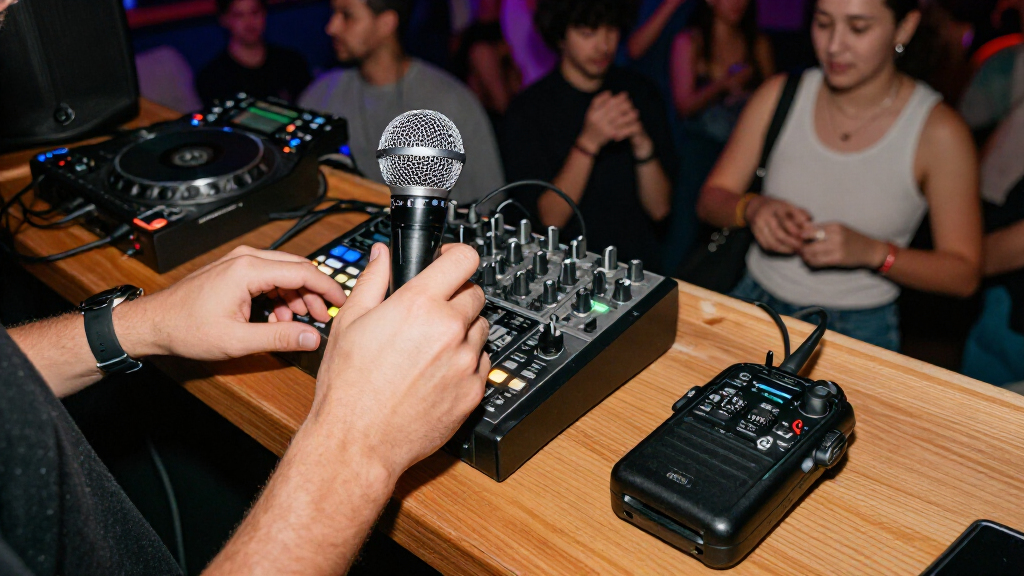

For most DJs, the Phenyx Pro PTU-71-2H is the best overall starting point: its dual UHF handheld setup suits announcements and two-person hosting without adding channels many small events do not need. The Phenyx Pro PTU-5000-4H stands out when four microphones are a genuine requirement, while the JBL Wireless Two-Microphone System is a simpler brand-name option for straightforward two-mic use. The main tradeoffs are one versus multiple microphones, UHF versus 2.4GHz or VHF operation, and how much setup control a DJ wants. A larger channel count does not automatically mean better sound or fewer dropouts; venue conditions and frequency planning matter too. Read on for the full breakdown, selection criteria, and advice on matching a system to your events.

Get audio and creator gear delivered free with Prime
- Fast, free delivery on millions of items
- Prime Video, Amazon Music and more included
- Member-only deals all year
Complete the kit


Key Takeaways
- Two handheld microphones fit the most common DJ use case. The Phenyx Pro PTU-71-2H and PTU-52-2H are more targeted choices for announcements and occasional two-person hosting than four-channel systems built for a larger stage.
- Four microphones solve a specific coordination problem. The Aveek, MELONARE, and Phenyx Pro PTU-5000-4H are relevant when several hosts or performers need separate mics, but their extra channels add setup and monitoring work.
- UHF is the dominant fit across this roundup. Many options use UHF, giving buyers a consistent category to compare, while 2.4GHz models such as the GOLDEN MARS and Loewieta systems may face congestion from venue Wi-Fi and other devices.
- Channel count alone does not settle reliability. DJs still need to check frequency selection, scanning features, receiver placement, and local RF conditions; the Kaschun‘s auto-scan feature addresses a different need from simply adding more microphones.
- The lineup ranges from basic function to more polished convenience. JBL offers a recognizable, straightforward two-mic package, while rechargeable or compact 2.4GHz options emphasize ease of handling; DJs should weigh those benefits against battery routines and RF demands.
| Phenyx Pro PTU-52-2H Dual UHF Wireless Microphone System |  | Best Overall for Two-Mic DJ Sets | Wireless band: UHF, 500–590 MHz | Microphones: 2 handheld microphones | Outputs: 2 XLR outputs and 1 mixed 1/4-inch output | VIEW LATEST PRICE | See Our Full Breakdown |
| TONOR TW360 UHF Wireless Handheld Microphone System, Gray | 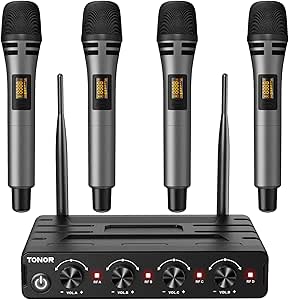 | Best for Straightforward Setup | Wireless band: UHF | Microphones: 1 handheld microphone | Channels: 40 selectable channels, arranged in 4 groups of 10 | VIEW LATEST PRICE | See Our Full Breakdown |
| FIFINE K036 UHF Dual-Channel Wireless Handheld Microphone System |  | Best for Basic Mic-and-Music Mixing | Wireless band: UHF, 520–578 MHz | Microphones: 2 handheld microphones | Operating range: Up to 80 ft | VIEW LATEST PRICE | See Our Full Breakdown |
| GOLDEN MARS 2.4GHz Wireless Microphone System with Two Handheld Microphones |  | Best Rechargeable Option | Wireless technology: 2.4 GHz | Microphones: 2 handheld microphones | Maximum range: Up to 400 ft line of sight | VIEW LATEST PRICE | See Our Full Breakdown |
| Phenyx Pro PTU-71-2H Dual UHF Wireless Handheld Microphone System |  | Best for Frequency Management | Channels: 2 | Selectable frequencies: 200 total, 100 per channel | Frequency ranges: Channel 1: 536.57–561.32 MHz; Channel 2: 562.37–587.12 MHz | VIEW LATEST PRICE | See Our Full Breakdown |
| Pyle PDWM2135 Dual-Channel VHF Wireless Microphone System with Two Handheld Microphones |  | Best Basic Two-Mic Setup | Channels: 2 | Wireless technology: Fixed-frequency VHF | Frequency range: 174–216 MHz | VIEW LATEST PRICE | See Our Full Breakdown |
| Aveek 4-Microphone Wireless System with 262 ft Range |  | Best for Four-Mic Group Events | Microphones: 4 handheld dynamic microphones | Wireless connectivity: UHF | Wireless range: Up to 262 ft | VIEW LATEST PRICE | See Our Full Breakdown |
| GOLDEN MARS Rechargeable Wireless Microphone System, 2-Pack |  | Best for USB-C-Rechargeable Two-Mic Use | Microphones: 2 | Wireless technology: 2.4 GHz | Wireless range: Up to 300 ft | VIEW LATEST PRICE | See Our Full Breakdown |
| MELONARE 4-Channel UHF Wireless Microphone System |  | Best for Multi-System Event Flexibility | Channels: 4 | Wireless connectivity: UHF digital transmission | Frequency range: 530–580 MHz | VIEW LATEST PRICE | See Our Full Breakdown |
| Talomen K60-2 Dual Handheld Wireless Microphone System |  | Best Compact Plug-and-Play Pair | Wireless frequency: 2.4 GHz | Wireless range: Up to 160 ft (50 m) | Microphone type: Dynamic, unidirectional | VIEW LATEST PRICE | See Our Full Breakdown |
| Loewieta UX100-G26B2 2.4G Wireless Microphone System |  | Best for Flexible PA Connections | Wireless connection: 2.4G | Microphones: 2 handheld dynamic microphones | Channels: 2 | VIEW LATEST PRICE | See Our Full Breakdown |
| JBL Wireless Two-Microphone System with Dual-Channel Receiver, Black |  | Best for JBL PartyBox Setups | Microphones: 2 wireless microphones | Channels: 2 | Receiver: Rechargeable dual-channel UHF receiver | VIEW LATEST PRICE | See Our Full Breakdown |
| Wireless Dual Handheld Microphone System |  | Best for Basic Two-Mic PA Use | Microphones: 2 handheld dynamic microphones | Claimed range: Up to 200 ft, line of sight | Receiver connection: 6.35 mm plug; 3.5 mm adapter included | VIEW LATEST PRICE | See Our Full Breakdown |
| Kaschun Dual UHF Auto-Scan Handheld Wireless Microphone System |  | Best for Frequency Adjustment | Model: ML380 | Channels and microphones: 2 channels; 2 handheld microphones | Wireless band: UHF | VIEW LATEST PRICE | See Our Full Breakdown |
| Phenyx Pro PTU-5000-4H 4-Channel UHF Wireless Microphone System |  | Best for Four-Person Hosting | Channels: 4 | Microphones: 4 handheld dynamic cardioid microphones | Wireless band: UHF | VIEW LATEST PRICE | See Our Full Breakdown |
| wireless microphone systems for DJ | Microphones | Channels |
|---|---|---|
| Phenyx Pro PTU-52-2H Dual UHF | 2 handheld microphones | 60 |
| TONOR TW360 UHF Wireless Handh | 1 handheld microphone | 40 selectable channels, arranged in 4 groups of 10 |
| FIFINE K036 UHF Dual-Channel W | 2 handheld microphones | 2 |
| GOLDEN MARS 2.4GHz Wireless Mi | 2 handheld microphones | — |
| Phenyx Pro PTU-71-2H Dual UHF | — | 2 |
| Pyle PDWM2135 Dual-Channel VHF | — | 2 |
| Aveek 4-Microphone Wireless Sy | 4 handheld dynamic microphones | — |
| GOLDEN MARS Rechargeable Wirel | 2 | — |
| MELONARE 4-Channel UHF Wireles | — | 4 |
| Talomen K60-2 Dual Handheld Wi | — | — |
| Loewieta UX100-G26B2 2.4G Wire | 2 handheld dynamic microphones | 2 |
| JBL Wireless Two-Microphone Sy | 2 wireless microphones | 2 |
| Wireless Dual Handheld Microph | 2 handheld dynamic microphones | — |
| Kaschun Dual UHF Auto-Scan Han | — | — |
| Phenyx Pro PTU-5000-4H 4-Chann | 4 handheld dynamic cardioid microphones | 4 |
More Details on Our Top Picks
Phenyx Pro PTU-52-2H Dual UHF Wireless Microphone System
For DJs who need two handheld mics for announcements, requests, or MC work, the PTU-52-2H earns my best-overall spot through a useful mix of connection options and setup flexibility. Its two XLR outputs let you route each microphone separately to a mixer, while the mixed 1/4-inch output suits simpler rigs. That gives it an advantage over the FIFINE K036, which offers individual volume controls but has a shorter stated range and a more home-oriented connection setup. Frequency hopping, automatic pairing, and 30 tunable groups help with setup, though they do not remove the need to manage radio conditions at a busy venue. The metal receiver and microphones are suited to regular handling; the tradeoff is that both handhelds need AA batteries, and the 200-foot range is a line-of-sight figure, not a promise through a crowded room.
Pros:- Two XLR outputs allow the microphones to feed separate mixer channels.
- Mixed 1/4-inch output provides a simpler connection option.
- Frequency hopping, 30 tunable groups, and automatic pairing support practical setup and frequency changes.
- Metal receiver and handheld microphones are suited to repeated transport and handling.
Cons:- Handheld microphones require AA batteries.
- The advertised 200-foot operating range applies to open space with line of sight.
- The receiver and included accessories take more setup space than a compact plug-in receiver.
Best for: Mobile DJs who need two microphones and want separate XLR feeds into a mixer or a single mixed output for a simpler setup.
Not ideal for: DJs who want rechargeable handhelds or need a long wireless link through obstructions; the microphones use AA batteries and the stated range assumes open line of sight.
- Wireless band:UHF, 500–590 MHz
- Microphones:2 handheld microphones
- Outputs:2 XLR outputs and 1 mixed 1/4-inch output
- Tunable frequency groups:30
- Channels:60
- Operating range:Up to 200 ft in open space, line of sight
- Polar pattern:Unidirectional
- Frequency response:40 Hz–15 kHz
- Microphone power:4 AA batteries
Our verdict“Choose the PTU-52-2H if your DJ rig benefits from two separate XLR mic channels, and skip it if rechargeable mics or obstructed long-range operation matter more.”
TONOR TW360 UHF Wireless Handheld Microphone System, Gray
The TONOR TW360 is the clearest choice here for a DJ who wants a basic wireless handheld connection without a long feature list to manage. Its receiver automatically syncs with the microphone, and 40 selectable channels give some room to change frequencies if a channel is unsuitable. The included 6.35 mm cable fits compatible mixers, powered speakers, and amplifiers, though the listed connection is less flexible than the Phenyx Pro PTU-52-2H, which adds separate XLR outputs for mixer-channel control. The cardioid pickup is intended to emphasize the speaker and reduce surrounding sound, a useful trait for announcements near a dance floor. This is a single handheld system, so it is not a fit for DJs who need two simultaneous mic channels. It also needs two AA batteries that are not included, and the source notes best results through a speaker’s MIC IN input.
Pros:- Automatic receiver syncing keeps setup simple.
- 40 selectable channels provide frequency-change options.
- Cardioid pickup is designed to focus on the main voice and reduce background sound.
- Included 6.35 mm cable connects to compatible mixers, amplifiers, and powered speakers.
Cons:- Only one handheld microphone is included.
- Two AA batteries are required and are not included.
- Best sound output calls for a speaker with a MIC IN input.
Best for: Solo mobile DJs who need one handheld microphone, a simple 6.35 mm connection, and automatic receiver pairing.
Not ideal for: DJs who need two simultaneous microphones, separate XLR routing, or a system that includes batteries.
- Wireless band:UHF
- Microphones:1 handheld microphone
- Channels:40 selectable channels, arranged in 4 groups of 10
- Wireless range:Up to 200 ft (60 m)
- Polar pattern:Unidirectional cardioid
- Connector:6.35 mm jack
- Microphone power:2 AA batteries, not included
- Compatible equipment:Mixers, karaoke machines, amplifiers, and powered speakers
Our verdict“Pick the TW360 for uncomplicated single-mic DJ announcements, but choose the dual-channel Phenyx Pro PTU-52-2H if you need two mics or separate XLR feeds.”
FIFINE K036 UHF Dual-Channel Wireless Handheld Microphone System
The FIFINE K036 makes the most sense for a DJ or host who wants to combine microphone audio and music without adding a separate mixer. Its separate mic volume controls and adjustable echo allow quick vocal-level changes, while three included audio cables offer connection flexibility for compatible gear. Compared with the Phenyx Pro PTU-52-2H, it is more focused on simple mic-and-music mixing than on sending two microphones to separate XLR channels. Its stated 80-foot range is also shorter than the 200-foot claims for the PTU-52-2H and TONOR TW360, so I would favor it for a compact venue or a stationary setup rather than a DJ moving far from the receiver. It includes two handheld microphones, but a third microphone must be supplied separately. Bluetooth is not supported, and the connected speaker or soundbar needs a microphone or RCA input.
Pros:- Separate volume controls let the operator balance the two microphones.
- Adjustable echo provides a simple vocal effect without an external processor.
- Can mix microphone and music signals without a separate mixer.
- Includes three audio cables for compatible connection setups.
Cons:- Stated operating range is 80 feet, shorter than several other systems in this roundup.
- Does not support Bluetooth.
- A third microphone is not included, and the receiver needs compatible microphone or RCA input equipment.
Best for: DJs, karaoke hosts, and event operators with a compatible speaker who want two mic levels and music mixed without a separate mixer.
Not ideal for: DJs working larger rooms who need greater stated wireless range, Bluetooth, or independent XLR outputs for both microphones.
- Wireless band:UHF, 520–578 MHz
- Microphones:2 handheld microphones
- Operating range:Up to 80 ft
- Channels:2
- Connector:6.35 mm jack
- Polar pattern:Unidirectional
- Signal-to-noise ratio:90 dB
- Power:4 AA batteries
- Receiver enclosure:Metal
Our verdict“Choose the K036 for a small DJ setup that needs simple mic-and-music mixing, not for long-range use or a mixer workflow with separate XLR channels.”
GOLDEN MARS 2.4GHz Wireless Microphone System with Two Handheld Microphones
For DJs who would rather charge their microphones than keep spare AA batteries in the case, the GOLDEN MARS KM-KU103 is the standout rechargeable pick. Its two handhelds are rated for over 12 hours per charge, and automatic 2.4GHz pairing keeps the setup straightforward. The listed 400-foot line-of-sight range exceeds the 200-foot claims for the TONOR TW360 and Phenyx Pro PTU-52-2H, but that figure depends on clear space and should not be treated as guaranteed coverage through walls or a packed venue. This system offers 6.35 mm and XLR connections, giving it a practical route into compatible DJ audio gear. Its key limitation is equipment compatibility: it does not connect directly to a TV, computer, or phone, and its plastic enclosure is a less rugged choice than the metal-bodied Phenyx systems. I’d choose it for battery convenience, not maximum venue versatility.
Pros:- Rechargeable microphones are rated for over 12 hours of use per charge.
- Automatic pairing and channel synchronization simplify setup.
- Listed line-of-sight range reaches up to 400 feet.
- Receiver offers 6.35 mm and XLR connection options.
Cons:- Cannot connect directly to TVs, computers, or mobile phones.
- Requires compatible audio equipment with a 6.35 mm or XLR interface.
- Plastic enclosure is less rugged than the metal construction listed for the Phenyx Pro systems.
Best for: Mobile DJs who want two rechargeable handheld microphones and use a mixer, powered speaker, or other compatible 6.35 mm or XLR equipment.
Not ideal for: DJs who need direct connection to phones, computers, or TVs, or who prioritize metal construction for frequent heavy-duty transport.
- Wireless technology:2.4 GHz
- Microphones:2 handheld microphones
- Maximum range:Up to 400 ft line of sight
- Battery life:Over 12 hours
- Charging time:2–3 hours
- Polar pattern:Hyper cardioid
- Connectors:6.35 mm jack and XLR
- Battery type:2 included lithium-ion batteries
- Enclosure material:Plastic
Our verdict“Choose the KM-KU103 if rechargeable microphones and long clear-line-of-sight operation matter most, and skip it if your DJ setup needs direct device connections or a metal-bodied system.”
Phenyx Pro PTU-71-2H Dual UHF Wireless Handheld Microphone System
The Phenyx Pro PTU-71-2H is the strongest fit in this group for a DJ who expects to manage radio interference and wants more frequency choices than a basic dual-mic setup provides. Its Auto Scan finds a low-interference frequency, while 200 selectable frequencies and IR synchronization help pair the microphones with the receiver. That gives it a more involved frequency-management toolkit than the PTU-52-2H, which offers 30 tunable groups and frequency hopping. The stated 290–328-foot range also exceeds the PTU-52-2H’s 200-foot figure, though both are line-of-sight claims and real venues can limit reach. Metal construction, replaceable microphone heads, cardioid pickup, and mute controls suit demanding event use. The tradeoffs are AA-powered handhelds and a setup that has more frequency options to manage than a beginner may need. I’d favor it over the rechargeable GOLDEN MARS when replaceability and UHF frequency selection matter more than charging convenience.
Pros:- Auto Scan and frequency lock help manage interference.
- 200 selectable frequencies offer more adjustment options than the PTU-52-2H’s 30 tunable groups.
- Metal construction and replaceable microphone heads support maintenance and repeated event use.
- Cardioid pickup and tuned EQ are designed for clear vocals and ambient-noise rejection.
Cons:- Handheld microphones require AA batteries.
- The stated 290–328-foot range is limited to line-of-sight conditions.
- The larger number of frequency choices may add setup work for users who do not need detailed frequency management.
Best for: Working mobile DJs who perform in venues where frequency selection matters and want durable handhelds with replaceable heads.
Not ideal for: New DJs seeking the simplest setup or operators who prefer rechargeable microphones and want to avoid AA battery changes.
- Channels:2
- Selectable frequencies:200 total, 100 per channel
- Frequency ranges:Channel 1: 536.57–561.32 MHz; Channel 2: 562.37–587.12 MHz
- Operating range:290–328 ft line of sight
- Microphone type:Dynamic handheld
- Polar pattern:Cardioid, unidirectional
- Signal-to-noise ratio:98 dB
- Frequency response:18 kHz
- Microphone power:AA batteries; 4 AA batteries included
Our verdict“Choose the PTU-71-2H for dual-mic DJ work where scanning, frequency options, and replaceable heads take priority over rechargeable power and simple setup.”
Pyle PDWM2135 Dual-Channel VHF Wireless Microphone System with Two Handheld Microphones
The Pyle PDWM2135 makes sense for a DJ who needs two handheld mics for announcements or a simple karaoke set and already has a mixer or powered speaker with a 1/4-inch microphone input. Independent channel volume controls let me set the two mics separately, while the mute switches and LED indicators help with basic event operation. Compared with the four-mic Aveek and MELONARE systems, this is a simpler, smaller-channel-count setup rather than a group-performance choice. Its fixed-frequency VHF connection is also less adaptable than the UHF systems in this roundup, so I would not choose it for a crowded venue where radio conditions may be unpredictable. The receiver needs AC power, and the microphones require AA batteries that are not included.
Pros:- Includes two handheld dynamic microphones and a receiver.
- Independent volume controls make it easier to balance two speakers.
- Microphone mute switches and receiver signal indicators support basic live operation.
- Dual antennas are included.
Cons:- Fixed-frequency VHF offers less flexibility than the UHF systems in this roundup.
- The receiver requires AC power, and the microphones need separately purchased AA batteries.
- A 1/4-inch mono cable is not included.
Best for: Mobile DJs who need two straightforward handheld microphones for announcements and have compatible gear with a 1/4-inch input.
Not ideal for: DJs working busy venues or needing flexible frequency management, more than two microphones, or a receiver that can run without AC power.
- Channels:2
- Wireless technology:Fixed-frequency VHF
- Frequency range:174–216 MHz
- Microphone type:Handheld dynamic
- Receiver connector:6.35 mm (1/4-inch) mono jack
- Signal-to-noise ratio:>70 dB
- Power:Receiver: AC 120V, 60Hz; each microphone: 2 AA batteries
Our verdict“Choose the Pyle for basic two-mic DJ announcements with compatible 1/4-inch gear, but look to UHF alternatives for greater frequency flexibility.”
Aveek 4-Microphone Wireless System with 262 ft Range
For a DJ hosting trivia, group karaoke, or audience participation, the Aveek four-microphone system puts four handhelds on the table without requiring disposable batteries for every event. Its rechargeable microphones are rated for up to 40 hours per charge, and the included Type-C cables make ongoing charging more convenient than the MELONARE, which uses eight AA batteries. The stated 262-foot range is generous on paper, though venue layout and interference can affect real-world coverage. This system connects through a 1/4-inch output, so it suits PA speakers and mixers rather than direct computer or phone setups. One meaningful operational compromise is that the receiver randomly assigns a channel when pairing; that gives me less control over channel selection than I might want when coordinating multiple wireless systems at an event.
Pros:- Four handheld microphones support group use.
- Rechargeable microphones are rated for up to 40 hours per charge.
- Includes a receiver, power adapter, 1/4-inch cable, and Type-C charging cables.
- Non-slip microphone rings can help with handling during active events.
Cons:- Not compatible with laptops, tablets, phones, or AV receivers.
- The receiver randomly assigns a channel when a microphone pairs.
- Requires audio equipment with a compatible 1/4-inch input.
Best for: DJs running group karaoke, games, or event hosting where four simultaneous handheld microphones and rechargeable batteries are useful.
Not ideal for: DJs who need direct laptop, phone, tablet, or AV-receiver connectivity, or who need predictable manual channel selection.
- Microphones:4 handheld dynamic microphones
- Wireless connectivity:UHF
- Wireless range:Up to 262 ft
- Battery life:Up to 40 hours
- Charging:Type-C
- Receiver output:1/4-inch
- Signal-to-noise ratio:85 dB
- Compatibility:PA systems, mixers, karaoke machines, powered speakers, and amplifiers
Our verdict“Pick Aveek when four rechargeable handhelds matter more than direct device compatibility or manual channel control.”
GOLDEN MARS Rechargeable Wireless Microphone System, 2-Pack
The GOLDEN MARS two-mic system suits DJs who want a rechargeable pair and may need to connect to either 3.5 mm or 6.35 mm microphone jacks. Its 2.4 GHz connection and stated range of up to 300 feet give it a different approach from the Pyle’s fixed-frequency VHF design, while USB-C charging for both microphones and the receiver cuts down on battery changes. A full charge is rated for over 10 hours, which is more limited than Aveek’s stated 40-hour microphone life but may cover a typical event. Automatic pairing also keeps setup simple. The main catch is input compatibility: these are microphone-jack connections, not AUX inputs. I would check the DJ mixer or speaker’s inputs before choosing it, since a jack that looks similar may not provide the required microphone connection.
Pros:- Both microphones and the receiver recharge via USB-C.
- Rated for over 10 hours of use on a full charge.
- Supports 3.5 mm and 6.35 mm microphone jacks.
- Anodized aluminum construction with a non-slip finish.
Cons:- Not compatible with AUX interfaces.
- Requires compatible microphone inputs on the connected equipment.
- Its stated battery life is shorter than Aveek’s up-to-40-hour rating.
Best for: DJs who need two rechargeable handheld microphones and use speakers or mixers with 3.5 mm or 6.35 mm microphone inputs.
Not ideal for: DJs whose equipment only offers AUX or line inputs, or who need four microphones or longer stated battery life.
- Microphones:2
- Wireless technology:2.4 GHz
- Wireless range:Up to 300 ft
- Battery life:Over 10 hours
- Charging:USB-C; 2–3 hours
- Connectors:3.5 mm and 6.35 mm microphone jacks
- Polar pattern:Hyper cardioid
- Signal-to-noise ratio:90 dB
Our verdict“Choose GOLDEN MARS for a rechargeable two-mic setup when your mixer or speaker has a supported microphone jack, not just AUX.”
MELONARE 4-Channel UHF Wireless Microphone System
The MELONARE four-channel system is the most coordination-focused pick here for DJs who need several handhelds and may run more than one system. Its frequency hopping and stated support for up to eight systems operating at once give it an advantage over the Aveek, whose receiver randomly assigns a channel. The 24-bit/48 kHz specification and cardioid pickup pattern add useful detail for a multi-mic event setup, while the 200-foot stated range is shorter than the Aveek’s 262 feet and GOLDEN MARS’s 300 feet. A built-in receiver antenna keeps the package compact, and included batteries and cables help get it connected. The tradeoff is ongoing power management: it uses eight AA batteries, unlike Aveek’s rechargeable microphones. DJs should also check local frequency rules and venue conditions for its listed 530–580 MHz band.
Pros:- Four handheld microphones are included, with support for up to eight systems operating at once.
- Frequency hopping can help manage interference.
- Includes eight AA batteries, a power adapter, a 1/4-inch cable, and a 3.5 mm adapter.
- Built-in receiver antenna and color-coded buttons simplify transport and channel identification.
Cons:- Requires eight AA batteries rather than rechargeable microphone batteries.
- Its stated 200-foot range is shorter than the Aveek and GOLDEN MARS figures.
- The listed 530–580 MHz band may not suit every location or local frequency rules.
Best for: Event DJs who need four handheld microphones and may coordinate multiple wireless systems at the same venue.
Not ideal for: DJs who want rechargeable microphones, a longer stated range, or do not want to manage disposable AA batteries and frequency-band suitability.
- Channels:4
- Wireless connectivity:UHF digital transmission
- Frequency range:530–580 MHz
- Maximum range:Up to 200 ft
- Audio sampling rate:24-bit/48 kHz
- Polar pattern:Unidirectional (cardioid)
- Connector:6.35 mm jack
- Power:8 included AA batteries
Our verdict“Choose MELONARE when multi-system coordination matters more than rechargeable power or maximum stated range.”
Talomen K60-2 Dual Handheld Wireless Microphone System
The Talomen K60-2 is a practical fit for a DJ who needs two handheld mics, straightforward pairing, and a receiver that can connect to either 1/4-inch or 1/8-inch microphone inputs. Compared with the Pyle PDWM2135, it swaps fixed-frequency VHF for 2.4 GHz transmission and adds rechargeable batteries and DSP noise reduction. Its stated 160-foot range is more modest than the GOLDEN MARS’s 300 feet, so I would favor the latter when extended coverage is the priority. Talomen’s automatic pairing and included adapters make setup less involved, but the system is not a universal device connection: it does not support AUX or line inputs and will not connect to phones, computers, or tablets. DJs should confirm their speaker or mixer has a microphone input before buying.
Pros:- Includes two handheld microphones and a rechargeable receiver.
- Automatic pairing supports a simple plug-and-play setup.
- DSP noise reduction and unidirectional dynamic microphones are specified.
- Includes 1/4-inch and 1/8-inch microphone-input connection options.
Cons:- Does not support AUX or line inputs.
- Not compatible with phones, computers, or tablets.
- Its stated 160-foot range is shorter than the GOLDEN MARS system’s stated range.
Best for: Mobile DJs who need a rechargeable two-mic kit with automatic pairing and compatible 1/4-inch or 1/8-inch microphone inputs.
Not ideal for: DJs relying on AUX or line inputs, or those who need direct phone, computer, or tablet connectivity.
- Wireless frequency:2.4 GHz
- Wireless range:Up to 160 ft (50 m)
- Microphone type:Dynamic, unidirectional
- Microphone inputs:6.35 mm (1/4-inch) and 3.5 mm (1/8-inch)
- Battery life:More than 10 hours per full charge
- Charging time:2–3 hours
- Batteries included:3 rechargeable 1200 mAh lithium batteries
- Included accessories:1/4-inch to 3.5 mm adapter, anti-slip rings, microphone covers, and USB charging cable
Our verdict“Pick the Talomen for a convenient rechargeable pair when your DJ gear has a supported microphone input and you do not need extended range.”
Loewieta UX100-G26B2 2.4G Wireless Microphone System
The Loewieta suits DJs who want a two-mic setup that can connect to a range of sound systems: its receiver offers both XLR and 6.35 mm outputs, unlike the JBL system, which is designed for select PartyBox speakers. Independent channel levels let me balance two speakers without changing the mix at the mixer. Automatic pairing and saved settings also make setup less fiddly between events. Its 2.4G link and claimed range of up to 500 feet look generous on paper, but venue conditions can reduce usable distance, so I would not choose it on range alone. The tradeoff is battery dependence: the microphones use AAA batteries, while the rechargeable JBL receiver is easier to top up between gigs. This is a flexible connection pick, not a substitute for a venue-grade frequency-management system.
Pros:- Two channels have separate volume controls for balancing speakers.
- XLR and 6.35 mm outputs suit a range of PA and mixer setups.
- Automatic pairing and power-off memory simplify repeat setups.
- Cardioid pickup and automatic noise reduction are designed to help limit unwanted sound.
Cons:- Handheld microphones require AAA batteries.
- The claimed 500-foot range may not reflect performance inside a busy venue.
Best for: DJs who need two handheld mics and want to connect the receiver to a PA, mixer, or amplifier using XLR or 6.35 mm.
Not ideal for: DJs who prefer rechargeable microphones or need predictable wireless performance in crowded RF environments.
- Wireless connection:2.4G
- Microphones:2 handheld dynamic microphones
- Channels:2
- Claimed range:Up to 500 ft (150 m)
- Outputs:6.35 mm and XLR
- Microphone batteries:2 AAA batteries included
- Claimed playtime:Up to 40 hours
- Pickup and processing:Cardioid pattern; automatic noise reduction
Our verdict“Choose the Loewieta if your DJ setup needs two mics and both XLR and 6.35 mm receiver connections matter more than rechargeable operation.”
JBL Wireless Two-Microphone System with Dual-Channel Receiver, Black
For a DJ whose sound system is a compatible JBL PartyBox, this is the simplest pairing in the group: the USB receiver plugs into the speaker and mixes both microphones, avoiding a separate mixer for basic announcements or guest vocals. Compared with the Loewieta, its advantage is direct PartyBox compatibility and a rechargeable receiver; its limitation is that it is not a general-purpose XLR or 6.35 mm receiver for a conventional PA chain. The stated up to six hours of playback suits shorter events, but leaves less room for a long wedding or back-to-back bookings than systems with longer stated runtimes. Replaceable AA microphone batteries are practical to carry, while the plastic enclosure and narrow compatibility make this a targeted convenience pick rather than the most adaptable DJ system.
Pros:- USB receiver is designed to work directly with select JBL PartyBox speakers.
- Both microphones can be used together and mixed through the speaker.
- Plug-and-play setup reduces connection steps.
- Microphones use replaceable AA batteries.
Cons:- Compatible only with select JBL PartyBox speakers.
- Receiver playback is stated at up to six hours and requires charging.
- USB connection does not provide the general XLR or 6.35 mm outputs found on the Loewieta.
Best for: DJs who use a compatible JBL PartyBox and want two wireless mics for announcements, karaoke, or guest participation.
Not ideal for: DJs running a conventional mixer or PA that needs XLR or 6.35 mm receiver outputs, or anyone needing an all-day receiver runtime.
- Microphones:2 wireless microphones
- Channels:2
- Receiver:Rechargeable dual-channel UHF receiver
- Connection:USB receiver for select JBL PartyBox speakers
- Playback time:Up to 6 hours
- Microphone batteries:Replaceable AA batteries
- Pickup pattern:Unidirectional
- Frequency range:65–15,000 Hz
Our verdict“Pick the JBL system for quick two-mic use with a compatible PartyBox, but skip it if your DJ rig relies on standard PA connections.”
Wireless Dual Handheld Microphone System
This system covers the straightforward DJ task of putting two handheld microphones on a speaker or PA with a compatible mic input. Its receiver uses a 6.35 mm plug and includes a 3.5 mm adapter, so it can suit simpler rigs without requiring a dedicated receiver rack. The stated 200-foot line-of-sight range is more modest than the Loewieta’s claimed 500 feet, and the product data does not describe the same combination of XLR output and separate channel controls. Its unidirectional capsules and stated distortion below 0.2% are useful on paper for speech and event hosting, but the limitations matter: it does not work with AUX inputs or phones, computers, and tablets. I would treat this as a basic PA-input option, not a flexible tool for every DJ audio chain.
Pros:- Includes two handheld microphones and a receiver.
- 6.35 mm receiver plug comes with a 3.5 mm adapter.
- Stated range reaches up to 200 feet in line of sight.
- Metal enclosure and unidirectional pickup are suited to basic live vocal use.
Cons:- Not compatible with phones, computers, or tablets.
- Does not work with AUX inputs.
- Receiver versions are shipped at random.
Best for: DJs using a speaker or amplifier with a 6.35 mm or compatible 3.5 mm microphone input who need two handheld mics.
Not ideal for: DJs who need phone or computer compatibility, AUX connectivity, or a receiver with specified XLR outputs.
- Microphones:2 handheld dynamic microphones
- Claimed range:Up to 200 ft, line of sight
- Receiver connection:6.35 mm plug; 3.5 mm adapter included
- Pickup pattern:Unidirectional
- Impedance:600 ohms
- Signal-to-noise ratio:70 dB
- Distortion:Less than 0.2%
- Batteries:3 lithium polymer batteries included
Our verdict“Choose this for a simple two-mic setup on a compatible PA input, but pass if you need broad device compatibility or more connection options.”
Kaschun Dual UHF Auto-Scan Handheld Wireless Microphone System
The Kaschun is the clearest fit here for DJs who want more control over frequency selection: its auto-scan and 200 selectable frequencies offer more ways to find a usable channel than the Phenyx Pro PTU-5000-4H, which uses four fixed frequencies. That can help when a venue has competing wireless gear, though it does not guarantee a clean signal in every room. IR sync, battery indicators, and a metal build add practical support for event work, and the receiver includes both XLR and 6.35 mm connections. Its claimed 328-foot range is explicitly line of sight, so walls and people may cut into that figure. The other tradeoff is power: two microphones require four AA batteries, and the stated runtime is up to eight hours. This is a more adjustable two-mic choice, not the group-vocal solution offered by the four-channel Phenyx.
Pros:- Auto-scan and 200 selectable frequencies provide channel flexibility.
- IR sync supports straightforward pairing with the receiver.
- XLR and 6.35 mm connections fit common PA and mixer inputs.
- Metal construction and battery indicators suit event use.
Cons:- The 328-foot range is a line-of-sight claim and can be reduced by venue obstacles.
- The microphones require four AA batteries.
- Up to eight hours of stated battery life may not cover every extended event.
Best for: DJs who work at changing venues and want a two-microphone UHF system with channel scanning and multiple connection options.
Not ideal for: DJs who need more than two simultaneous handheld microphones or want rechargeable microphone power.
- Model:ML380
- Channels and microphones:2 channels; 2 handheld microphones
- Wireless band:UHF
- Selectable frequencies:200
- Claimed range:Up to 328 ft, line of sight
- Claimed battery life:Up to 8 hours
- Batteries:4 AA batteries included
- Connections:XLR and 6.35 mm jack
- Construction:Metal
Our verdict“Choose the Kaschun if scanning for a usable UHF frequency matters more than getting four microphones from the Phenyx Pro PTU-5000-4H.”
Phenyx Pro PTU-5000-4H 4-Channel UHF Wireless Microphone System
When a DJ needs four handheld mics live at once—for a panel, group game, or multiple hosts—the Phenyx Pro PTU-5000-4H fills a different role from the two-channel Kaschun and Loewieta. Its four individual XLR outputs and volume controls let a mixer handle each microphone separately, which is more useful for balancing several voices than a receiver that combines two channels. The metal receiver and LCD frequency display also make the rack-side setup clearer. The tradeoff is flexibility: the system uses four fixed UHF frequencies, so it offers less channel choice than the Kaschun’s 200 selectable frequencies, and it is not intended for multi-set operation. It also needs an amplifier or powered speaker for sound output; the receiver alone is not a complete DJ sound system. Four microphones mean more batteries to manage, too.
Pros:- Four handheld microphones support group hosting and multi-person events.
- Individual volume controls and four XLR outputs allow separate mixer inputs.
- Metal receiver includes an LCD frequency display.
- Includes eight AA batteries and states up to eight hours of battery life.
Cons:- Four fixed frequencies provide less selection than the Kaschun’s 200 selectable frequencies.
- Requires an amplifier or speaker for sound output.
- Not intended for multi-set operation.
Best for: Mobile DJs hosting panels, games, or group events where four people may need separate handheld microphones at the same time.
Not ideal for: DJs who only need one or two mics, need adjustable frequency selection, or expect to run multiple sets together.
- Channels:4
- Microphones:4 handheld dynamic cardioid microphones
- Wireless band:UHF
- Frequency range:541.9–568.65 MHz
- Fixed frequencies:541.9, 546.3, 561.6, and 568.65 MHz
- Claimed range:Up to 260 ft
- Receiver outputs:4 XLR outputs and 6.35 mm jack
- Power and battery life:8 AA batteries included; up to 8 hours
- Receiver material:Metal
Our verdict“Choose this Phenyx Pro when four independently routed handheld mics matter more than the frequency flexibility of a two-channel system.”
How We Picked
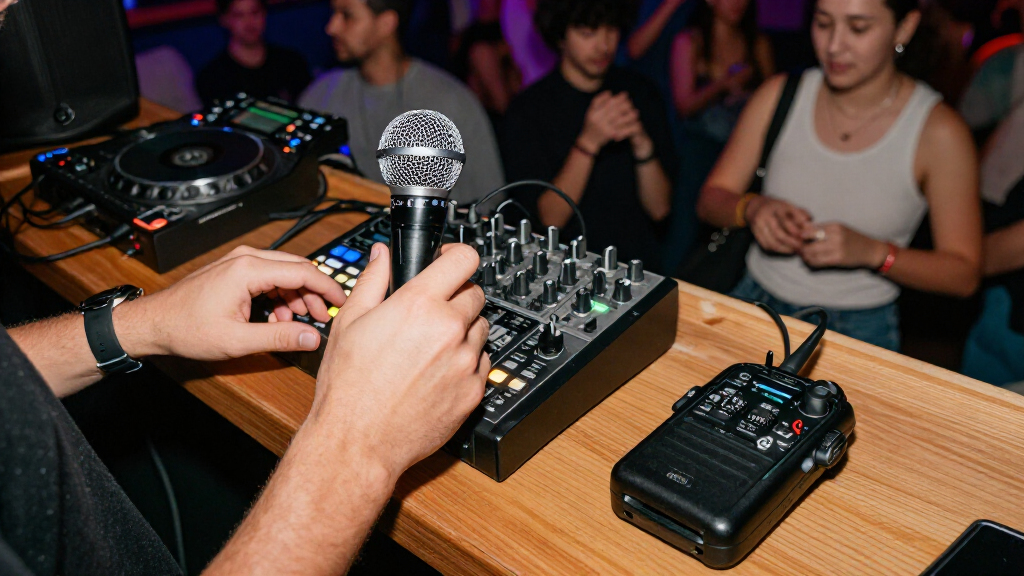
I ranked these wireless microphone systems for DJ work by how well their microphone count, frequency approach, and setup features match common event demands: announcements, introductions, karaoke, and guest hosting. I gave more weight to practical control and a clear fit than to headline range claims or channel count alone. A DJ needs a receiver that can sit alongside a mixer, microphones that are manageable during a long event, and a system whose operation is understandable under time pressure.
The order reflects versatility, usability, and the size of the tradeoffs. Dual UHF systems generally rank ahead for broad DJ use because they cover two-speaker events without the extra coordination of four channels. Four-mic systems move up for buyers who need them, but are not universal winners; VHF and 2.4GHz models are judged against their particular interference and venue considerations. Product names and listed features guide this comparison, but performance can vary with venue layout, competing radio signals, and setup.
Factors to Consider When Choosing Wireless Microphone Systems For DJs
Choosing a DJ microphone system is less about collecting the biggest spec sheet and more about avoiding problems during a live event. I would start with how many people need microphones at once, then match the radio system and controls to the venues where I work most often.
Match Channel Count to the Event, Not the Package
Two microphones cover most DJ announcements, wedding introductions, and occasional duet hosting. A four-channel receiver makes sense when a panel, multiple presenters, or karaoke guests need separate microphones at the same time. More channels also mean more batteries to manage, more transmitters to label, and more chances for a guest to switch on the wrong mic. A common mistake is buying extra channels for a rare event while accepting a larger, more involved setup at every gig. If you rent or borrow gear for unusual events, a capable two-mic system may be easier to own and operate. Choose four channels when simultaneous use is routine, not just because the number looks like an upgrade.
Choose a Frequency Band for Your Venues
UHF systems are common in this roundup and can suit DJ use, but the available frequencies and local radio environment matter more than the band label by itself. 2.4GHz systems share spectrum with Wi-Fi and other everyday devices, which can make a crowded venue a more demanding setting. VHF models may suit simple, lower-complexity setups, but buyers should check their operating conditions and the system’s available controls. Do not assume a quoted range will carry over to a room full of people, walls, wireless equipment, and competing signals. Check local frequency rules and scan or select a clear channel before an event where possible. A stable link at the actual venue is more useful than a long-range claim measured under ideal conditions.
Look for the Controls You Can Use Under Pressure
Frequency selection, auto-scan, clear channel indicators, and receiver controls can save time when a mic starts picking up interference or another system is nearby. Those features matter most for DJs who move between venues and cannot assume the RF environment will be the same each night. A basic plug-and-play receiver may be easier for a beginner, but it offers less flexibility if the default channel is occupied. Before buying, check whether both microphones can operate independently and how clearly the receiver shows their status. Also confirm that the receiver outputs match your mixer or powered speaker inputs. A feature is only useful if it is easy to understand while handling a live set.
Plan the Receiver-to-Mixer Connection
Wireless convenience ends at the receiver: it still needs a clean route into the DJ mixer, controller, or PA. Check the output type and the cable you will need rather than assuming every receiver connects directly to your preferred input. A receiver with separate outputs can be useful if you want to control each microphone on its own mixer channel; a combined output may simplify a small setup but limit independent adjustment. Keep the receiver where its antennas have a clear path, not buried behind a rack or speaker. Short, secure cable runs also reduce trip hazards and accidental unplugging. These practical details often matter more on a crowded booth than an extra advertised feature.
Treat Batteries and Charging as Part of the Setup
Handheld microphones need enough power for the event, plus a plan for what happens if a battery runs low. Replaceable batteries can be swapped quickly when spares are ready, while rechargeable models reduce disposable battery use but require a reliable charging routine. Do not assume that a rechargeable microphone will be ready just because it was packed after the previous gig. For systems with several transmitters, label each microphone and track charging or battery changes before loading in. Keep compatible spares in the DJ case if the design allows them. A modest battery routine prevents a preventable interruption during speeches or announcements.
Spend More for a Real Workflow Benefit
Extra channels, rechargeable convenience, scanning controls, and a more familiar brand can all justify paying more when they solve a repeated problem. They matter less if the mic is used for a few short announcements at small events. Buyers should compare the complete working setup, including the receiver, microphones, cables, batteries, and any accessories needed to connect to the PA. Avoid paying for a range claim that does not reflect the venues you play, or for channels that will rarely be used. For frequent gigs, easy frequency management and a dependable battery plan may save more hassle than an additional microphone. The right spend is the one that removes a regular bottleneck in your event workflow.
Frequently Asked Questions
Is a two-microphone system enough for most DJ events?
For announcements, wedding introductions, and a DJ plus one guest speaker, two handheld microphones are usually enough. The Phenyx Pro PTU-71-2H and JBL system both suit that basic two-person pattern, though their feature sets and operating approaches differ. A four-mic system becomes more useful for panels, several hosts, or karaoke where multiple people need separate microphones at once. Think about simultaneous users rather than the total number of people who may speak during the event. If you only need extra microphones a few times a year, renting or borrowing may be simpler than managing a larger system at every gig.
Should I choose UHF or 2.4GHz for DJ work?
Neither band guarantees a trouble-free connection in every venue. UHF appears across many systems in this roundup and is a common choice for DJ microphones, but channel availability and local interference still matter. A 2.4GHz model can be convenient, yet the band may be busy where Wi-Fi and other wireless devices are active. Match the choice to the venues you play and the frequency controls provided by the system. For varied or crowded venues, channel selection or scanning can be more useful than choosing by band name alone.
Do I need a four-channel system if I sometimes host karaoke?
Not necessarily: occasional karaoke with one or two singers can work with a dual-mic setup. Four channels are a better fit when several people sing or speak at the same time, or when you want separate control of multiple performers. The Aveek, MELONARE, and Phenyx Pro PTU-5000-4H address that higher channel-count need, but extra transmitters add battery and setup responsibilities. Consider whether your mixer or PA has enough inputs for the way you plan to use the receiver. If karaoke is occasional and guest count varies, a two-mic system plus a rental option may be the simpler choice.
Will a wireless microphone system connect directly to my DJ controller?
That depends on the receiver’s output and the inputs available on your controller or mixer. Check the receiver connection type and whether the microphones feed separate outputs or a combined signal before choosing. You may need an appropriate cable or an open channel on an external mixer, particularly if your controller has limited microphone inputs. Also check whether you need individual level control for each speaker. Planning the signal path before the gig avoids discovering that the receiver and controller do not connect as expected.
What should I prioritize if I play different venues every week?
For changing venues, prioritize frequency flexibility, clear receiver status, and a setup process you can repeat quickly. A scanning or selectable-channel feature can help when one frequency is already occupied, while receiver placement and a clear antenna path still affect performance. Pack the correct cables and spare batteries or a charged backup microphone as part of the same routine. Do not rely on a range specification as a substitute for checking the room and testing the signal before guests arrive. If you work in crowded venues, a system with useful channel controls is often a better fit than one chosen mainly for a high microphone count.
Conclusion
For the broadest fit, I would start with the Phenyx Pro PTU-71-2H as the best overall pick for two-mic DJ events. The Phenyx Pro PTU-52-2H is a strong value-minded alternative for buyers who want a dual UHF setup without moving to four channels, while the JBL Wireless Two-Microphone System suits beginners who want a straightforward two-mic package. For a premium, higher-capacity setup, the Phenyx Pro PTU-5000-4H makes the most sense when four microphones will see regular use. Choose the Kaschun Dual UHF Auto-Scan for a specific need to find a usable channel across changing venues, or consider a rechargeable GOLDEN MARS system if charging convenience matters more to your routine. Match the system to the number of people speaking at once and the rooms you play; that will narrow this list faster than headline range or channel count alone.