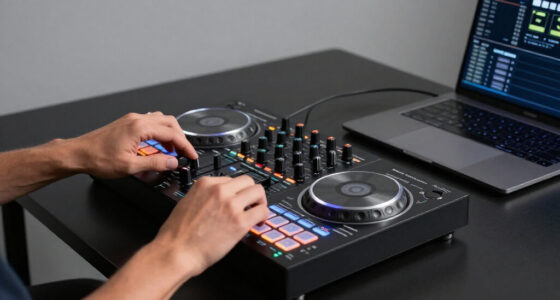

DJ wireless microphone transmitters can free a performer from a cable, but the right system depends on your mixer or PA, microphone type, and the wireless conditions at your venue. I name the Phenyx Pro PTU-X my best overall pick for its UHF transmitter-and-receiver format; the Bose XLR Wireless Mic/Line Transmitter stands out for S1 Pro+ owners, while the Xvive U35D suits buyers seeking a dual stereo setup. The main tradeoffs are compatibility and convenience versus frequency congestion, channel capacity, and how much setup control the system offers. Check that the transmitter and receiver connections match your gear before choosing. Read on for the full breakdown and a guide to picking a system for your DJ setup.

Get audio and creator gear delivered free with Prime
- Fast, free delivery on millions of items
- Prime Video, Amazon Music and more included
- Member-only deals all year
Complete the kit


Key Takeaways
- The Phenyx Pro PTU-X leads the general-purpose picks because its UHF transmitter-and-receiver format offers a practical fit for DJs who need an XLR link without buying into a PA-specific ecosystem.
- Compatibility can outweigh range claims: the Bose option is purpose-built for the S1 Pro+, while other plug-on systems need a clear match with the mixer, PA, and microphone.
- Frequency band changes the venue tradeoff. UHF and 2.4GHz or 5.8GHz systems can behave differently around other wireless devices, so venue conditions matter more than a range figure alone.
- Dual or multichannel designs solve different problems. The Xvive U35D is oriented toward dual stereo audio, while the JOYO MW-1A offers four channels; neither feature is useful if a single mic link is all the set needs.
- Power and microphone support deserve a check before purchase. The New Bee specifies support for dynamic and 48V condenser microphones, while the Aveek is specified for dynamic microphones, making phantom-power compatibility a key distinction.
| Phenyx Pro PTU-X UHF XLR Wireless Transmitter and Receiver System |  | Best for Condenser Mic Flexibility | Connectivity: XLR | Frequency range: 550–570 MHz | Selectable frequencies: 16 | VIEW LATEST PRICE | See Our Full Breakdown |
| Bose XLR Wireless Mic/Line Transmitter for S1 Pro+ PA System, Black |  | Best for Bose S1 Pro+ Owners | Connector: XLR | Wireless frequency: 2.4 GHz | Compatibility: Bose S1 Pro+ PA System | VIEW LATEST PRICE | See Our Full Breakdown |
| HHLPRO UHF Wireless XLR Transmitter and Receiver, 902–927 MHz, 500 ft Range |  | Best for Long-Range DJ Sets | Frequency band: 902–927 MHz | Transmission range: Up to 500 ft | Channels: 50 | VIEW LATEST PRICE | See Our Full Breakdown |
| Donner CV-2 Wireless XLR Microphone Transmitter and Receiver |  | Best for Multi-Mic Setups | Wireless frequency: 2.4 GHz | Microphone compatibility: Wired dynamic microphones | Wireless range: Up to 100 feet | VIEW LATEST PRICE | See Our Full Breakdown |
| JOYO MW-2 2.4GHz Wireless XLR Microphone System |  | Best Plug-and-Play Value | Wireless frequency: 2.4 GHz | Range: Up to 100 ft in open spaces | Audio sampling: 24-bit/48 kHz | VIEW LATEST PRICE | See Our Full Breakdown |
| Kadjuh T9-2 Wireless XLR Transmitter and Receiver for Microphones and Instruments |  | Best for Mic-and-Instrument Flexibility | Wireless band: UHF | Channels: 16 | Stated range: Up to 196 ft | VIEW LATEST PRICE | See Our Full Breakdown |
| JOYO MW-1A 5.8GHz 4-Channel Wireless XLR Microphone System |  | Best for Low-Latency Speech | Wireless frequency: 5.8 GHz | Selectable channels: 4 | Audio: 24-bit/48 kHz | VIEW LATEST PRICE | See Our Full Breakdown |
| Xvive U35D Dual Stereo XLR Plug-On Wireless Audio System, 5.8 GHz |  | Best for Wireless Speaker Links | Wireless frequency: 5.8 GHz | Channels: 6 | Connectivity: XLR | VIEW LATEST PRICE | See Our Full Breakdown |
| AirSync – Wireless XLR Transmitter and Receiver, UHF Microphone System |  | Best for Multi-Unit UHF Setups | Wireless band: UHF | Simultaneous units: Up to 16, per product description | Stated range: Up to 150 ft | VIEW LATEST PRICE | See Our Full Breakdown |
| New Bee 5.8 GHz Wireless XLR Transmitter and Receiver for Dynamic and 48V Condenser Microphones |  | Best for Long Runtime and Condenser Mics | Wireless frequency: 5.8 GHz | Stated range: Up to 100 ft / 30 m | Channels: 6 | VIEW LATEST PRICE | See Our Full Breakdown |
| LEKATO MW-1 5.8GHz Wireless XLR Microphone Transmitter and Receiver |  | Best for Multi-Mic 5.8GHz Setups | Wireless frequency: 5.8GHz | Connector: XLR | Channels: 4 | VIEW LATEST PRICE | See Our Full Breakdown |
| Coda Music Technologies AirSync Wireless XLR Transmitter and Receiver System |  | Best for Condenser-Mic Compatibility | Connectivity: UHF | Connector: XLR | Microphone compatibility: Dynamic and phantom-powered condenser microphones | VIEW LATEST PRICE | See Our Full Breakdown |
| Aveek Wireless XLR Transmitter and Receiver System for Dynamic Microphones, 200 ft Range |  | Best for Long Events and Open-Venue Range | Microphone compatibility: Dynamic microphones only | Transmission range: Up to 200 ft (60 m) in open environments | Latency: Less than 2 ms | VIEW LATEST PRICE | See Our Full Breakdown |
| DJ wireless microphone transmitter | Battery life | Latency | Wireless frequency | Microphone compatibility |
|---|---|---|---|---|
| Phenyx Pro PTU-X UHF XLR Wirel | Up to 7 hours; about 4.5 hours with phantom power | — | — | — |
| Bose XLR Wireless Mic/Line Tra | Up to 4 hours | — | 2.4 GHz | — |
| HHLPRO UHF Wireless XLR Transm | Over 5 hours | Less than 5 ms | — | Dynamic microphones |
| Donner CV-2 Wireless XLR Micro | Up to 8 hours | Less than 5 ms | 2.4 GHz | Wired dynamic microphones |
| JOYO MW-2 2.4GHz Wireless XLR | 6–8 hours | — | 2.4 GHz | Dynamic microphones; some condenser microphones requiring 24V or lower phantom power |
| Kadjuh T9-2 Wireless XLR Trans | 6–8 hours | — | — | — |
| JOYO MW-1A 5.8GHz 4-Channel Wi | — | Less than 5 ms | 5.8 GHz | — |
| Xvive U35D Dual Stereo XLR Plu | — | — | 5.8 GHz | — |
| AirSync | Up to 8 hours | Less than 3 ms | — | Dynamic and 48V condenser microphones |
| New Bee 5.8 GHz Wireless XLR T | Up to 20 hours dynamic mode; up to 9 hours 48V mode | Less than 4.6 ms | 5.8 GHz | — |
| LEKATO MW-1 5.8GHz Wireless XL | Up to 5 hours | Less than 5 ms | 5.8GHz | Dynamic microphones; select condenser microphones requiring 24V or less |
| Coda Music Technologies AirSyn | Up to 8 hours | Less than 3 ms | — | Dynamic and phantom-powered condenser microphones |
| Aveek Wireless XLR Transmitter | Up to 12 hours | Less than 2 ms | — | Dynamic microphones only |
More Details on Our Top Picks
Phenyx Pro PTU-X UHF XLR Wireless Transmitter and Receiver System
The Phenyx Pro PTU-X is the most adaptable pick here for DJs who want to send more than a standard dynamic microphone wirelessly. Its +48V phantom power supports compatible condenser mics, while MIC/LINE gain control also suits higher-output sources such as mixers and keyboards. That gives it a broader role than the Donner CV-2 or HHLPRO F30P, both of which are specified for dynamic microphones. Auto-scan and 16 selectable frequencies provide some channel choice, though the system has one channel and its stated range is only 100 feet in line of sight, well below the HHLPRO’s claimed 500 feet. Runtime is another tradeoff: expect up to seven hours without phantom power, but about 4.5 hours with it enabled. I’d choose it for source flexibility, not long-range roaming.
Pros:- 48V phantom power supports compatible condenser microphones.
- MIC/LINE gain control accommodates microphones and higher-output devices.
- Auto-scan and 16 selectable frequencies offer channel selection.
- Locking transmitter knob helps secure a wired microphone.
Cons:- Phantom power cuts stated battery life to about 4.5 hours.
- The 100-foot range is specified for line-of-sight use.
- One-channel operation is less suited to multi-microphone setups.
Best for: DJs and small-event operators who need one XLR wireless system for compatible condenser microphones, dynamic mics, or line-level sources.
Not ideal for: Performers who need several hours of operation with phantom power active or need long-range coverage beyond a 100-foot line-of-sight specification.
- Connectivity:XLR
- Frequency range:550–570 MHz
- Selectable frequencies:16
- Wireless range:Up to 100 ft line of sight
- Phantom power:+48V
- Battery life:Up to 7 hours; about 4.5 hours with phantom power
- Frequency response:50 Hz–15 kHz
- Signal-to-noise ratio:98 dB
Our verdict“Choose the PTU-X when condenser-mic support and line-level flexibility matter more than extended runtime or long-range coverage.”
Bose XLR Wireless Mic/Line Transmitter for S1 Pro+ PA System, Black
The Bose XLR Wireless Mic/Line Transmitter is a purpose-built convenience choice, not a general wireless XLR kit: it pairs with the receiver built into the Bose S1 Pro+. For a DJ already using that speaker, the XLR input accepts a microphone, mixer, or other line-level source, and storing the compact transmitter inside the speaker provides a tidy place to charge it between sets. That integration is simpler than carrying the separate transmitter-and-receiver setup of the Phenyx Pro PTU-X or Donner CV-2. The tradeoff is a short stated range of up to 30 feet and up to four hours of battery life, so it is less suited to roaming performers or longer events without charging breaks. I’d skip it if the S1 Pro+ isn’t already part of the setup.
Pros:- Designed to connect directly to the S1 Pro+ receiver.
- Accepts microphones, mixers, and other line-level sources through XLR.
- Stores inside the speaker for charging between performances.
- Compact 50 g design is easy to carry.
Cons:- Compatibility is limited to the Bose S1 Pro+ PA system.
- Stated wireless range is up to 30 feet.
- Up to four hours of battery life may not cover longer events.
Best for: DJs who own a Bose S1 Pro+ and want to wirelessly connect an XLR microphone, mixer, or line-level source with minimal extra gear.
Not ideal for: Buyers using other PA systems, or performers who need longer range and more than four hours of stated battery life.
- Connector:XLR
- Wireless frequency:2.4 GHz
- Compatibility:Bose S1 Pro+ PA System
- Wireless range:Up to 30 feet
- Battery life:Up to 4 hours
- Weight:50 g
- Dimensions:3.28 x 1.14 x 1.18 inches
Our verdict“Pick this transmitter for a Bose S1 Pro+ setup where integrated storage and charging outweigh limited range and system compatibility.”
HHLPRO UHF Wireless XLR Transmitter and Receiver, 902–927 MHz, 500 ft Range
For a DJ who needs to move well beyond the booth, the HHLPRO F30P makes range its defining advantage: its stated transmission distance reaches up to 500 feet, compared with 100 feet for the Phenyx Pro PTU-X and Donner CV-2. It also offers 50 channels, auto-scanning, one-touch pairing, and latency under 5 ms, a combination aimed at larger venues where channel choice and responsive sound matter. Dual antennas and a metal enclosure add to its event-ready appeal, and the rechargeable battery is specified to run for over five hours. The important limitation is microphone compatibility: it supports dynamic microphones only and does not provide phantom power. That makes it a poor match for DJs relying on condenser mics, even though the PTU-X can accommodate compatible models.
Pros:- Stated range of up to 500 feet exceeds the other reviewed systems here.
- 50 channels, auto-scanning, and one-touch pairing support setup flexibility.
- Latency is specified at less than 5 ms.
- Dual antennas and metal enclosure suit demanding event use.
Cons:- Compatible with dynamic microphones only.
- No phantom power for condenser microphones.
- Over five hours of stated battery life may be limiting for extended events.
Best for: DJs using dynamic microphones who need to move across a large venue and want extensive channel selection and fast pairing.
Not ideal for: Performers with condenser microphones or line-level sources that require phantom power, which this system does not support.
- Frequency band:902–927 MHz
- Transmission range:Up to 500 ft
- Channels:50
- Latency:Less than 5 ms
- Battery life:Over 5 hours
- Microphone compatibility:Dynamic microphones
- Antennas:Dual
- Phantom power:Not supported
Our verdict“Choose the HHLPRO F30P for long-distance use with a dynamic mic, but skip it if your setup requires condenser-mic support.”
Donner CV-2 Wireless XLR Microphone Transmitter and Receiver
The Donner CV-2 suits DJs building a wireless setup around several compatible dynamic microphones: it supports up to six simultaneous channels, more than the single-channel Phenyx Pro PTU-X. Automatic pairing on power-up keeps setup simple, while the stated 100-foot range and latency under 5 ms fit many small and medium event spaces. Its up-to-eight-hour battery life also outlasts the Bose transmitter’s four-hour specification. The compromise is microphone choice: the CV-2 is specified for wired dynamic microphones and is not suitable for condensers, so it lacks the source flexibility of the PTU-X. It also requires XLR-compatible connections. I’d favor it for a multi-mic DJ rig with dynamic mics, but not for a setup built around condenser microphones or very long-distance coverage like the HHLPRO F30P’s stated 500 feet.
Pros:- Supports up to six simultaneous channels for multi-microphone use.
- Up to eight hours of stated battery life.
- Transmitter and receiver pair automatically when powered on.
- Latency is specified at less than 5 ms.
Cons:- Not suitable for condenser microphones.
- Requires XLR-compatible connections.
- Its stated 100-foot range is shorter than the HHLPRO F30P’s claimed reach.
Best for: DJs and small event crews using multiple wired dynamic microphones who want automatic pairing and long battery life.
Not ideal for: Users with condenser microphones, non-XLR microphone connections, or venues where the HHLPRO F30P’s longer stated range is needed.
- Wireless frequency:2.4 GHz
- Microphone compatibility:Wired dynamic microphones
- Wireless range:Up to 100 feet
- Latency:Less than 5 ms
- Simultaneous channels:Up to 6
- Battery life:Up to 8 hours
- Audio sampling rate and bit depth:192 kHz, 24-bit
- Frequency response:20 Hz–20 kHz
Our verdict“Pick the CV-2 for a multi-mic dynamic setup with straightforward pairing, but choose another option if you need condenser support or extended range.”
JOYO MW-2 2.4GHz Wireless XLR Microphone System
The JOYO MW-2 is a straightforward option for DJs who want a quick wireless link between an XLR microphone and a mixer, PA, interface, or compatible camera. Auto-pairing reduces setup steps, and support for up to four systems simultaneously gives it more room for a small group of microphones than a one-channel setup like the Phenyx Pro PTU-X. Its 24-bit/48 kHz transmission and six-to-eight-hour battery specification make it a practical general-purpose pick, though the Donner CV-2 claims longer runtime and supports up to six simultaneous channels. The MW-2 works best with dynamic microphones; some condenser microphones may produce noise, so its compatibility is less dependable than the PTU-X’s +48V support. Its ABS housing is lighter than a metal enclosure, and the mixer should be muted before powering the units on or off to avoid a loud pop.
Pros:- Auto-pairing supports a simple plug-and-play setup.
- Supports up to four systems simultaneously.
- 24-bit/48 kHz audio transmission is specified.
- Battery indicators are provided on both transmitter and receiver.
Cons:- Some condenser microphones may produce noise.
- Mixer should be muted before powering the units on or off to avoid a loud pop.
- ABS plastic housing is less substantial than the Donner CV-2’s metal construction.
Best for: DJs who want an easy-to-pair XLR wireless link for a dynamic microphone and may run up to four systems at once.
Not ideal for: DJs who depend on condenser microphones, want a metal-bodied unit, or need more than four simultaneous systems.
- Wireless frequency:2.4 GHz
- Range:Up to 100 ft in open spaces
- Audio sampling:24-bit/48 kHz
- Battery life:6–8 hours
- Simultaneous systems:Up to 4
- Microphone compatibility:Dynamic microphones; some condenser microphones requiring 24V or lower phantom power
- Connectors:USB Type-C, XLR
- Enclosure material:ABS plastic
Our verdict“Choose the MW-2 for a simple dynamic-mic setup with up to four wireless systems, but look elsewhere for reliable condenser support or metal construction.”
Kadjuh T9-2 Wireless XLR Transmitter and Receiver for Microphones and Instruments
The Kadjuh T9-2 is the most flexible pick here if your DJ setup sometimes includes an instrument as well as a microphone. Its XLR transmitter and receiver support dynamic mics and instrument audio, giving it a broader role than the AirSync, which is presented mainly as a microphone and speaker-link system. The stated 16 UHF channels and range up to 196 feet offer room to place gear around a venue, though actual performance depends on the environment. A screen showing battery and frequency status also makes it easier to check the link during setup. The tradeoff is a listed 6–8 hours of battery life, shorter than the New Bee’s claimed runtime in dynamic mode, and the description does not spell out the same detailed multi-receiver setup options.
Pros:- Supports dynamic microphones and instrument audio, including guitar and bass.
- Offers 16 selectable UHF channels.
- Display shows battery level, frequency, and operating status.
- Stated operating range reaches up to 196 feet.
Cons:- Listed battery life is only 6–8 hours per charge.
- Actual range and stability may vary with venue conditions.
- The product information does not detail multi-receiver broadcasting.
Best for: DJs who want one rechargeable wireless kit for a dynamic microphone and occasional guitar or bass connections.
Not ideal for: DJs running long events without charging breaks, or anyone who needs a clearly specified multi-receiver broadcast setup.
- Wireless band:UHF
- Channels:16
- Stated range:Up to 196 ft
- Battery life:6–8 hours
- Audio resolution:24-bit
- Sampling frequency:48 kHz
- Power modes:0V/5V/48V
- Item weight:13.7 oz
Our verdict“Choose the Kadjuh T9-2 if your DJ rig needs to wirelessly handle both a microphone and instruments, and its 6–8-hour runtime fits your event schedule.”
JOYO MW-1A 5.8GHz 4-Channel Wireless XLR Microphone System
For DJs who prioritize a quick response between speaking and hearing their voice through the PA, the JOYO MW-1A stands out with stated latency below 5 ms. Its transmitter plugs directly into an XLR microphone, while 24-bit/48 kHz audio and a 20 Hz–20 kHz frequency response give the system a clearly defined audio spec. Compared with the UHF Kadjuh T9-2, JOYO uses 5.8 GHz frequency hopping and has fewer selectable channels; its stated line-of-sight range is also shorter at 100 feet. That makes it a more compact choice for a straightforward stage or event setup, not the strongest fit for long-distance placement. Runtime is about five hours, and condenser support is limited to some low-power models.
Pros:- Stated latency is less than 5 ms.
- 24-bit/48 kHz audio with a 20 Hz–20 kHz frequency response.
- 5.8 GHz frequency hopping and four selectable channels.
- A dual USB-C cable can charge both units together.
Cons:- About five hours of runtime may not cover longer events.
- Condenser compatibility is limited to some low-power microphones.
- The 100-foot range is specified for line-of-sight use, and camera mounting hardware is not included.
Best for: DJs and presenters who use an XLR dynamic mic, need low stated latency, and work within a 100-foot line-of-sight setup.
Not ideal for: Operators needing a full-event battery margin, broad 48V condenser compatibility, or a long-range link.
- Wireless frequency:5.8 GHz
- Selectable channels:4
- Audio:24-bit/48 kHz
- Frequency response:20 Hz–20 kHz
- Latency:Less than 5 ms
- Stated range:Up to 100 ft / 30 m line of sight
- Runtime:About 5 hours
- Charging:USB-C
Our verdict“Pick the JOYO MW-1A for responsive speech and a simple dynamic-mic setup, but choose a longer-runtime system for extended events.”
Xvive U35D Dual Stereo XLR Plug-On Wireless Audio System, 5.8 GHz
The Xvive U35D serves a different DJ need from the microphone plug-on kits: it is designed to send audio wirelessly between a mixing console and powered speakers or monitors. Its set of two transmitters and two receivers can help with a dual-link mobile rig, and the receivers plug directly into compatible XLR inputs for a mixer-free connection at the speaker end. Compared with the JOYO MW-1A, which plugs into a microphone and focuses on low-latency mic transmission, the U35D is aimed at moving a signal across the PA setup. It uses 5.8 GHz and offers six channels, but the available specs do not state range, latency, or runtime. Its plastic enclosure and reliance on compatible XLR connections also narrow its appeal.
Pros:- Includes two transmitters and two receivers for dual wireless links.
- Receivers plug directly into compatible powered-speaker XLR inputs.
- Designed for connections between mixers, speakers, and monitors.
- Uses the 5.8 GHz band and offers six channels.
Cons:- Requires compatible XLR connections on the connected equipment.
- The enclosure is plastic.
- The supplied product data does not specify range, latency, or battery runtime.
Best for: Mobile DJs who want to reduce long XLR cable runs between a mixing console and powered speakers or monitors.
Not ideal for: DJs seeking a wireless handheld-microphone adapter, or buyers who need published range, latency, and runtime figures before choosing.
- Wireless frequency:5.8 GHz
- Channels:6
- Connectivity:XLR
- Included transmitters:2
- Included receivers:2
- Compatible devices:PA systems and speakers
- Power source:Battery powered; four lithium-polymer batteries included
- Enclosure material:Plastic
Our verdict“Choose the Xvive U35D to cut cable runs between a mixer and XLR-equipped speakers, not as your primary wireless microphone transmitter.”
AirSync – Wireless XLR Transmitter and Receiver, UHF Microphone System
The AirSync is the clearest fit in this group for a DJ building a multi-unit UHF setup: the product description says it supports up to 16 units simultaneously. That makes it more suitable for a larger wireless arrangement than the JOYO MW-1A, which lists four selectable channels. AirSync also claims up to 150 feet of range, less than 3 ms latency, and up to eight hours of battery life, with USB-C charging. Its stated compatibility covers dynamic and 48V condenser microphones, plus powered-speaker connections. Those claims make it versatile on paper, but the supplied specs give limited detail on channel tuning and audio resolution, unlike JOYO’s explicit 24-bit/48 kHz figures. The listed single channel and 80 dB signal-to-noise ratio may also matter to buyers comparing systems for demanding sound setups.
Pros:- Description states support for up to 16 units simultaneously.
- Compatible with dynamic and 48V condenser microphones.
- Up to eight hours of battery life with USB-C charging.
- Stated range up to 150 feet and latency below 3 ms.
Cons:- The supplied specifications provide limited detail on audio resolution and channel tuning.
- The listed channel count is one, which may not describe the full multi-unit coordination process.
- Actual range and wireless stability can depend on the venue environment.
Best for: Event DJs and sound operators who need several UHF units in one setup and want a plug-and-play link for microphones or powered speakers.
Not ideal for: Buyers who need detailed published audio-resolution specifications or a system with clearly documented channel-selection controls.
- Wireless band:UHF
- Simultaneous units:Up to 16, per product description
- Stated range:Up to 150 ft
- Battery life:Up to 8 hours
- Latency:Less than 3 ms
- Microphone compatibility:Dynamic and 48V condenser microphones
- Signal-to-noise ratio:80 dB
- Charging:USB-C
Our verdict“Choose AirSync when multi-unit UHF capacity matters more than having the more detailed audio specifications listed for the JOYO MW-1A.”
New Bee 5.8 GHz Wireless XLR Transmitter and Receiver for Dynamic and 48V Condenser Microphones
The New Bee is the strongest choice here for DJs who need 48V condenser support without giving up long stated battery life. It claims up to 20 hours in dynamic mode and nine hours with 48V phantom power, plus pass-through USB-C charging—well beyond the roughly five-hour runtime listed for the JOYO MW-1A. The system also supports one transmitter broadcasting to as many as six receivers, which can help feed multiple XLR destinations. Its 5.8 GHz link is specified at up to 100 feet, so it is not the range leader beside the UHF Kadjuh T9-2 or AirSync. The tradeoff is that 48V operation cuts the runtime, and its XLR connections limit use to equipment with suitable inputs and outputs.
Pros:- Supports dynamic and 48V phantom-powered condenser microphones.
- Up to 20 hours of runtime in dynamic mode and up to nine hours in 48V mode.
- Pass-through USB-C charging supports use while charging.
- One transmitter can broadcast to as many as six receivers.
Cons:- Runtime drops to up to nine hours when using 48V mode.
- Stated range is up to 100 feet, shorter than the Kadjuh T9-2 and AirSync claims.
- XLR connections limit compatibility with other equipment.
Best for: DJs using 48V condenser microphones who want pass-through charging, extended dynamic-mic runtime, or one transmitter feeding multiple XLR receivers.
Not ideal for: Operators who need a longer stated range than 100 feet or must connect equipment without compatible XLR ports.
- Wireless frequency:5.8 GHz
- Stated range:Up to 100 ft / 30 m
- Channels:6
- Maximum receivers:6 per transmitter
- Battery life:Up to 20 hours dynamic mode; up to 9 hours 48V mode
- Audio transmission:24-bit, up to 48 kHz
- Latency:Less than 4.6 ms
- Charging:USB-C with pass-through charging
Our verdict“Choose the New Bee for its long dynamic-mode runtime, 48V condenser support, and multi-receiver capability, provided a 100-foot range is enough.”
LEKATO MW-1 5.8GHz Wireless XLR Microphone Transmitter and Receiver
The LEKATO MW-1 is a practical pick for DJs who want to free a dynamic XLR microphone from its cable without moving to a larger rack system. Its four switchable channels let up to four sets operate at once, while 24-bit/48kHz audio and latency under 5 ms suit live speech and performance. Compared with the Aveek Wireless XLR System, the LEKATO offers more channels but has shorter stated range and battery life. The main limitation is microphone compatibility: dynamic mics are the safer match, since some condenser microphones may introduce noise depending on phantom-power needs and setup. Five hours per charge also favors shorter gigs or a charging plan over long event days.
Pros:- Four switchable channels support up to four sets simultaneously.
- 24-bit/48kHz audio and latency under 5 ms suit live performance.
- Stated wireless range reaches up to 100 feet.
- Rechargeable batteries and plug-and-play XLR connectors simplify setup.
Cons:- Up to five hours of battery life may not cover a long event.
- Some condenser microphones may produce noise depending on power draw, shielding, or interference.
Best for: DJs running dynamic XLR microphones who need several compatible wireless sets for a multi-mic event.
Not ideal for: DJs relying on phantom-powered condenser microphones or needing a full-day battery without recharging.
- Wireless frequency:5.8GHz
- Connector:XLR
- Channels:4
- Wireless range:Up to 100 ft
- Latency:Less than 5 ms
- Audio resolution:24-bit/48kHz
- Battery life:Up to 5 hours
- Microphone compatibility:Dynamic microphones; select condenser microphones requiring 24V or less
Our verdict“Choose the LEKATO MW-1 for a multi-mic setup built around dynamic XLR microphones, but favor the Aveek if longer battery life matters more than extra channels.”
Coda Music Technologies AirSync Wireless XLR Transmitter and Receiver System
For DJs who switch between dynamic and condenser microphones, the Coda Music Technologies AirSync offers broader mic compatibility than the LEKATO MW-1 or Aveek, both of which are primarily aimed at dynamic mics. Its UHF transmission, stated 150-foot range, and latency under 3 ms are suited to moving around a venue while keeping speech responsive. It also supports up to 13 systems simultaneously, a useful distinction for larger setups, and its metal enclosure is suited to regular transport. The tradeoffs are a required XLR microphone connection and a battery life of up to eight hours—longer than the LEKATO’s, but shorter than Aveek’s stated 12 hours. Its mute control uses a triple-click, which may be less immediate than a dedicated switch.
Pros:- Supports dynamic and phantom-powered condenser microphones.
- UHF transmission, latency under 3 ms, and stated range up to 150 feet.
- Supports up to 13 systems simultaneously.
- Metal enclosure, USB-C charging, and up to eight hours of battery life.
Cons:- Requires an XLR microphone connection.
- Up to eight hours of battery life falls short of Aveek’s stated 12 hours.
- Triple-click mute may be less direct to operate than a dedicated mute switch.
Best for: DJs and event operators who use both dynamic and phantom-powered condenser XLR microphones or coordinate multiple wireless systems.
Not ideal for: Performers using non-XLR microphones or those who need the longest stated battery runtime among these three options.
- Connectivity:UHF
- Connector:XLR
- Microphone compatibility:Dynamic and phantom-powered condenser microphones
- Maximum simultaneous systems:13
- Range:Up to 150 ft
- Latency:Less than 3 ms
- Battery life:Up to 8 hours
- Mute control:Triple-click
Our verdict“Pick the AirSync if condenser-mic compatibility and coordinating multiple wireless systems matter more than the Aveek’s longer stated battery life.”
Aveek Wireless XLR Transmitter and Receiver System for Dynamic Microphones, 200 ft Range
The Aveek Wireless XLR System stands out for DJs who want long operating time and room to move across an open venue. It claims up to 200 feet of range in open environments and up to 12 hours per charge, outlasting both the LEKATO MW-1 and Coda AirSync on stated battery life. Latency under 2 ms and 24-bit/48kHz audio also fit live microphone use, while automatic pairing keeps setup straightforward. That reach is conditional, though: the stated maximum applies to open spaces, not every crowded or obstructed venue. Unlike the AirSync, Aveek does not support condenser microphones; its two channels also offer less simultaneous-system capacity than the LEKATO’s four. The included XLR-to-1/4-inch adapter adds connection flexibility.
Pros:- Up to 12 hours of battery life with USB-C charging.
- Stated range reaches up to 200 feet in open environments.
- Latency under 2 ms and 24-bit/48kHz audio support live use.
- Automatic pairing and included XLR-to-1/4-inch adapter simplify setup.
Cons:- Condenser microphones are not supported.
- The 200-foot range applies to open environments and may not reflect obstructed venues.
- Two channels provide less simultaneous-system capacity than the LEKATO MW-1.
Best for: DJs using a dynamic XLR microphone at long events who value extended battery life and movement across open spaces.
Not ideal for: DJs using condenser microphones or needing more than two channels for several wireless systems.
- Microphone compatibility:Dynamic microphones only
- Transmission range:Up to 200 ft (60 m) in open environments
- Latency:Less than 2 ms
- Audio processing:24-bit/48kHz
- Frequency response:20 Hz–20 kHz
- Battery life:Up to 12 hours
- Charging:USB-C; 2–3 hours
- Channels:2
- Included adapter:XLR female-to-1/4-inch
Our verdict“Choose Aveek for a dynamic-mic setup where long battery life and open-venue reach take priority over condenser compatibility or extra channels.”

How We Picked
I compared the 13 systems as tools for DJ microphone use, not as interchangeable wireless gadgets. The main criteria were connection and microphone compatibility, frequency band, channel options, stated range, setup demands, and whether the design fits a specific PA or broader XLR use. I also weighed how clearly a product’s stated capabilities map to a real DJ setup, since an impressive feature is of little help if it does not match the user’s equipment.
The order favors systems with a broadly useful format and a clear use case, then distinguishes specialist options from more general plug-on links. Phenyx Pro PTU-X ranks first as the general-purpose lead pick; Bose ranks for S1 Pro+ owners rather than universal use, and options such as the Xvive U35D and JOYO MW-1A earn attention for more specific channel needs. Models with narrower compatibility or less clearly differentiated use cases rank lower, even when their listed range or frequency band may appeal to some buyers. I do not treat advertised range as a guarantee of reliable performance in every room.
| DJ wireless microphone transmitter | Latency |
|---|---|
| Phenyx Pro PTU-X UHF XLR Wirel | — |
| Bose XLR Wireless Mic/Line Tra | — |
| HHLPRO UHF Wireless XLR Transm | Less than 5 ms |
| Donner CV-2 Wireless XLR Micro | Less than 5 ms |
| JOYO MW-2 2.4GHz Wireless XLR | — |
| Kadjuh T9-2 Wireless XLR Trans | — |
| JOYO MW-1A 5.8GHz 4-Channel Wi | Less than 5 ms |
| Xvive U35D Dual Stereo XLR Plu | — |
| AirSync | Less than 3 ms |
| New Bee 5.8 GHz Wireless XLR T | Less than 4.6 ms |
| LEKATO MW-1 5.8GHz Wireless XL | Less than 5 ms |
| Coda Music Technologies AirSyn | Less than 3 ms |
| Aveek Wireless XLR Transmitter | Less than 2 ms |
Factors to Consider When Choosing DJ Wireless Microphone Transmitters
Before choosing a transmitter, I would start with the entire signal path: microphone, transmitter, receiver, mixer or PA, and the room where the system will operate. These checks help avoid a purchase that connects physically but does not suit the mic, power needs, or wireless environment.
Match Every Connector in the Signal Path
Trace the signal from the microphone to the speaker before comparing wireless features. An XLR plug-on link can replace a cable between compatible XLR points, but it does not automatically replace a receiver, mixer, or input that your setup still needs. Check whether the system sends mic-level or line-level audio and whether its output works with your PA input. A connector that fits is not proof that the signal level is right. DJs using a powered speaker and a separate mixer should map where the receiver will connect and how the microphone signal will reach the mix. This simple diagram can prevent buying a system that solves only half the cable run.
Check Microphone Type and Phantom Power
Dynamic microphones and condenser microphones can have different power needs, so do not assume every XLR wireless link supports both. Verify the manufacturer’s microphone and phantom-power specifications for the exact system, not just the connector shape. Phantom power is supplied by some mixers and PA inputs; a battery-powered plug-on transmitter may not pass or provide it. If you plan to use a condenser, confirm that the wireless system explicitly supports the required voltage and operating arrangement. For a dynamic mic, extra phantom-power support may add little value, while a mismatch can stop a condenser setup from working as intended. Treat microphone support as a compatibility requirement, not an optional upgrade.
Choose a Frequency Band for the Venue
UHF, 2.4GHz, and 5.8GHz systems each operate in different parts of the radio spectrum, and the cleanest choice depends on what else is active at the venue. Wi-Fi networks, other microphones, and nearby wireless equipment can affect performance, so a band label alone cannot predict a trouble-free show. Consider whether you can select channels, pair devices easily, or coordinate frequencies with other performers. For mobile DJs, test the system at the actual event space when possible, especially if several wireless systems will be used together. A stated range is usually measured under favorable conditions and can shrink when walls, bodies, or interference block the signal. Give frequency coordination and practical testing more weight than the longest advertised distance.
Decide Whether Extra Channels Solve a Real Need
Multi-channel and dual-link features matter when you need more than one audio path, but they can add setup steps and equipment that a single-mic DJ rig does not use. A four-channel system may help a performer who needs several compatible links, while a dual stereo design addresses a different routing task. Confirm what the channel count means: it may refer to selectable frequencies, simultaneous transmitters, or audio channels, and those are not interchangeable. Also check whether additional transmitters are included or sold separately. If your setup only needs one handheld mic, prioritize straightforward pairing and dependable connections over unused capacity. Pay for extra channels when they reduce a real limitation in your rig.
Plan for Power, Mounting, and Show-Day Handling
A wireless link adds batteries or charging to a DJ’s pre-show checklist, so confirm runtime, charging method, and whether the system can be used while charging. A plug-on transmitter can add weight and length to a microphone, which may affect balance or make it awkward for a guest to hold. Check the receiver’s placement, power supply, and cable needs as well; a wireless microphone still leaves a receiver-to-mixer connection in many setups. Bring a wired backup for events where a microphone failure would interrupt announcements or performances. Label transmitters and receivers if several systems are in use, and test pairing before guests arrive. These small logistics can matter more during a long event than a headline feature.
Pay More for a Clear Fit, Not a Longer Feature List
A higher-cost or more specialized system makes sense when it solves a concrete problem, such as direct integration with a compatible PA or support for a particular microphone and channel setup. For a simple one-mic connection, a basic system with the right connectors and band may be a better fit than a model with unused stereo or multichannel features. Compare what is included in the box, including receiver, charging accessories, and any required cables, before judging the overall value. Look for clear specifications on range conditions, supported microphones, and frequency selection rather than relying on broad marketing language. If your venue changes often, prioritize flexibility and a workable channel plan. If you use one compatible speaker every time, dedicated integration may justify choosing a narrower system.
Frequently Asked Questions
Can I connect any XLR wireless transmitter directly to my DJ mixer?
Not automatically. Check whether the system includes a receiver and whether its output level and connector suit the mixer input you plan to use. Some products are built around a particular PA, while other transmitter-and-receiver pairs offer a more general connection path. Also confirm whether the transmitter is intended for a microphone or a line-level source. Map the complete route from mic to transmitter, receiver, mixer, and speakers before buying.
Will a wireless XLR system work with my condenser microphone?
Only if the system explicitly supports the condenser’s power requirements. Many buyers focus on XLR connectors and miss the need for phantom power or another specified power arrangement. Check both the transmitter’s input support and any instructions for supplying phantom power; the mixer’s phantom-power switch may not solve every wireless setup. The New Bee listing specifically describes support for dynamic and 48V condenser microphones, while the Aveek is described for dynamic microphones. If the manufacturer’s specifications do not clearly cover your mic, ask before relying on it for a show.
Is UHF or 5.8GHz better for a DJ performing in different venues?
Neither band is universally better for every venue. The local mix of wireless microphones, Wi-Fi equipment, and other radio devices can affect performance, while system features such as channel selection and pairing also matter. UHF systems and 5.8GHz systems may suit different operating conditions, so compare the available frequency controls rather than choosing by label alone. If you can, test the system in the spaces where you perform and check for interference before the event. Keep a wired microphone or cable as a backup for critical announcements.
Does a claimed 500-foot range mean I can use the microphone that far away?
A range figure is a stated maximum, not a promise for every room or event. Walls, crowds, transmitter placement, receiver placement, and radio interference can all reduce the usable distance. A DJ usually benefits more from a stable signal across the actual performance area than from a large open-air figure. Keep the receiver in a clear location and avoid placing it behind metal equipment or inside a crowded rack when possible. Test the full path at the venue before relying on the link for a performance.
Should I choose a dual or multichannel system if I only use one wireless microphone?
Usually, a single-link system is the simpler choice if you only need one microphone and do not expect that to change. Extra channels help when you need multiple compatible links or a specific stereo routing arrangement, but the terms can describe different capabilities. Check whether the channels work simultaneously and whether extra transmitters are included or must be added. A feature you do not use can mean more pairing and setup steps without improving your current rig. Choose a multichannel model when it solves a real routing or expansion need.
Conclusion
For most DJs seeking a general XLR wireless link, I recommend the Phenyx Pro PTU-X as best overall. The best value direction is a straightforward system such as the Donner CV-2 or LEKATO MW-1, provided its specifications match your mic and mixer; I would compare included components and compatibility before deciding. The Bose XLR Wireless Mic/Line Transmitter is my premium-style pick for buyers already using the S1 Pro+, but it is not the broadest choice for a mixed PA setup. For beginners, a simple transmitter-and-receiver pair with clearly matching connections is easier to manage than an unused multichannel system. Choose the Xvive U35D for a dual stereo need, the JOYO MW-1A when four-channel capability fits your setup, or the New Bee if its stated condenser support matches your microphone. Before ordering, verify the full signal path, power requirements, and frequency plan for the venues you play.