Wireless DJ microphone systems vary most in how many people can speak or sing at once, how they connect to a sound system, and how much setup they require. My best overall pick is the innopow WM-400, a four-channel option for DJs and hosts who need several handheld mics; the Phenyx Pro PTU-5000-4H is another multi-mic choice, while the JBL PartyBox Wireless Microphones suit buyers who want a simple match for a compatible PartyBox speaker. The main tradeoff is between channel capacity and straightforward operation: more microphones can serve larger groups but add receiver and coordination demands. Other differences include UHF versus VHF operation, receiver connections, and how well a system fits your existing audio gear. Read on for the full breakdown and a guide to choosing the right setup for your events.

Get audio and creator gear delivered free with Prime
- Fast, free delivery on millions of items
- Prime Video, Amazon Music and more included
- Member-only deals all year
Complete the kit

Key Takeaways
- Four-mic systems stand out for group hosting. The innopow WM-400, MELONARE four-channel kit, Aveek four-piece system, and Phenyx Pro PTU-5000-4H address events where two microphones are not enough, but their extra capacity makes receiver setup and mic management more involved.
- Two-mic kits are the practical center of this lineup. Models such as the Phenyx Pro PTU-52-2H, FIFINE K036, and TONOR TW-820 fit duets, announcements, and small events without requiring a four-mic workflow.
- Speaker compatibility can matter more than channel count. JBL‘s PartyBox Wireless Microphones are tailored to PartyBox use, while other systems call for checking receiver outputs and your mixer or speaker inputs before buying.
- UHF dominates the options, but the Pyle PDWM2135 uses VHF. Buyers choosing that model should weigh its different wireless band against the channel and connection needs of their venue.
- Brand family alone does not determine the best fit. Phenyx Pro appears in both dual- and four-channel configurations, so the right choice depends on how many active microphones your events need rather than the name on the receiver.
| innopow WM-400 4-Channel UHF Wireless Microphone System |  | Best for DJ Sets with Four Speakers | Channels: 4 | Microphone type: Handheld, unidirectional dynamic | Outputs: Two individual XLR outputs; one mixed 6.35 mm output | VIEW LATEST PRICE | See Our Full Breakdown |
| MELONARE 4-Channel UHF Wireless Microphone System with Four Handheld Microphones |  | Best for Multi-System Flexibility | Channels: 4 | Frequency range: 530–580 MHz | Wireless range: Up to 200 ft | VIEW LATEST PRICE | See Our Full Breakdown |
| Phenyx Pro PTU-52-2H Dual UHF Wireless Microphone System |  | Best for Mixer-Friendly Two-Mic DJ Setups | Microphones: 2 handheld | Frequency range: 500–590 MHz | Tunable frequency groups: 30 | VIEW LATEST PRICE | See Our Full Breakdown |
| JBL PartyBox Wireless Microphones, 2-Pack |  | Best for JBL PartyBox Owners | Microphones: 2 handheld digital wireless microphones | Compatibility: JBL PartyBox speakers | Wireless connection: 2.4 GHz with dongle | VIEW LATEST PRICE | See Our Full Breakdown |
| TONOR TW360 UHF Wireless Microphone System, Gray | 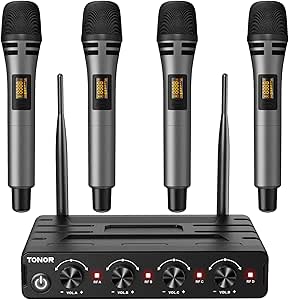 | Best for a Simple Single-Mic DJ Setup | Model: TW360 | Wireless type: UHF | Channels: 40 selectable channels (4 × 10) | VIEW LATEST PRICE | See Our Full Breakdown |
| GOLDEN MARS Dual-Handheld Wireless Microphone System |  | Best Long-Range Rechargeable Pair | Wireless technology: 2.4 GHz | Microphones: 2 handheld microphones | Pickup pattern: Hyper cardioid (listed in specs) | VIEW LATEST PRICE | See Our Full Breakdown |
| FIFINE K036 UHF Dual-Channel Wireless Handheld Microphone System |  | Best for Karaoke and Simple Two-Mic Mixing | Wireless technology: UHF | Frequency range: 520–578 MHz | Channels: 2 | VIEW LATEST PRICE | See Our Full Breakdown |
| Aveek 4-Piece UHF Wireless Handheld Microphone System |  | Best Rechargeable Four-Mic Set | Wireless technology: UHF | Channels: 4 | Microphones: 4 handheld dynamic microphones | VIEW LATEST PRICE | See Our Full Breakdown |
| Phenyx Pro PTU-5000-4H 4-Channel UHF Wireless Microphone System |  | Best for Separate Four-Channel Control | Wireless technology: UHF | Channels: 4 | Wireless frequencies: 541.9, 546.3, 561.6, and 568.65 MHz | VIEW LATEST PRICE | See Our Full Breakdown |
| Pyle PDWM2135 Dual-Channel VHF Wireless Microphone System with Two Handheld Microphones |  | Best Basic Two-Mic PA Set | Wireless technology: VHF | Frequency range: 174–216 MHz | Channels: 2 | VIEW LATEST PRICE | See Our Full Breakdown |
| Wireless Dual Handheld Dynamic Microphone System, Gray |  | Best for Simple, Occasional DJ Setups | Microphone type: Handheld dynamic | Channels: Two microphones | Operating range: Up to 200 feet line of sight | VIEW LATEST PRICE | See Our Full Breakdown |
| Phenyx Pro PTU-71-2H Dual UHF Handheld Wireless Microphone System |  | Best for Larger Venues and Frequency Control | Model: PTU-71-2H | Channels: Two | Selectable frequencies: 100 per channel | VIEW LATEST PRICE | See Our Full Breakdown |
| JBL Wireless Two-Microphone System with Dual-Channel Receiver, Black |  | Best for JBL PartyBox Owners | Channels: Two | Compatibility: Select JBL PartyBox models | Microphone pattern: Unidirectional | VIEW LATEST PRICE | See Our Full Breakdown |
| Loewieta UX100-G26B2 Dual Wireless Microphone System |  | Best for Flexible PA Connections | Model: UX100-G26B2 | Wireless connectivity: 2.4G | Channels and microphones: Two channels; two handheld dynamic microphones | VIEW LATEST PRICE | See Our Full Breakdown |
| TONOR TW-820 UHF Wireless Microphone System with Two Handheld Mics |  | Best for Adjustable UHF Channels | Model: TW-820 | Microphones: Two handheld dynamic microphones | Frequency channels: 15 adjustable frequencies per microphone | VIEW LATEST PRICE | See Our Full Breakdown |
More Details on Our Top Picks
innopow WM-400 4-Channel UHF Wireless Microphone System
The innopow WM-400 is the clearest fit here when a DJ needs four handheld mics and control over each mic’s level. Its two individual XLR outputs let a mixer handle two signals separately, while the mixed 6.35 mm output gives a simpler connection option. Compared with the MELONARE 4-Channel UHF Wireless Microphone System, the innopow’s listed outputs offer more direct routing flexibility, but its fixed-frequency design lacks MELONARE’s frequency hopping and support for multiple sets. Metal housings and unidirectional capsules suit regular announcements and karaoke, though they do not remove the need for careful mic placement. The stated 150–200 ft range applies in open areas, and multiple WM-400 units cannot be used together as freely as frequency-selectable alternatives.
Pros:- Four handheld microphones have individual channel volume controls.
- Two individual XLR outputs support separate mixer channels.
- Metal microphone housings are suited to frequent event handling.
- Unidirectional dynamic cartridges are designed to help limit feedback and handling noise.
Cons:- Fixed-frequency operation limits use alongside multiple units.
- The stated 150–200 ft range is for open areas, not a guarantee through venue walls.
- Four microphones mean managing four sets of AA batteries.
Best for: DJs, karaoke hosts, or event organizers who need four handheld mics and want individual XLR feeds for mixer control.
Not ideal for: DJs planning to run multiple wireless systems in the same venue, since this model uses fixed frequencies and cannot be used simultaneously with multiple units.
- Channels:4
- Microphone type:Handheld, unidirectional dynamic
- Outputs:Two individual XLR outputs; one mixed 6.35 mm output
- Frequency:Fixed
- Working range:150–200 ft in open areas
- Battery life:14–17 hours
- Power:4 AA batteries included
- Enclosure:Metal
Our verdict“Choose the WM-400 if four mics and separate XLR routing matter more than frequency flexibility for multi-system DJ setups.”
MELONARE 4-Channel UHF Wireless Microphone System with Four Handheld Microphones
For a DJ who may add another wireless set or needs to adapt frequencies around a busy venue, the MELONARE four-mic system has an advantage over the fixed-frequency innopow WM-400: its frequency-hopping design supports clearer frequency selection, and the product data lists up to eight simultaneous sets. That flexibility makes it a stronger candidate for shared event spaces, while the four color-coded handhelds help hosts keep track of channels during a lively program. Its cardioid pickup is intended to focus on the speaker rather than surrounding sound. The tradeoff is connectivity: MELONARE supplies a 6.35 mm output rather than the innopow’s individual XLR outputs, so it is less suited to DJs who want separate mic feeds at a mixer. The receiver’s built-in antenna is convenient, but the system still needs eight AA batteries.
Pros:- Frequency hopping helps find clearer frequencies in crowded wireless environments.
- Supports up to eight sets, offering room for larger multi-system setups.
- Four color-coded channel buttons make mic assignment easier during events.
- Compact receiver with a built-in antenna simplifies packing and setup.
Cons:- The 6.35 mm output offers less separate-channel routing than the innopow WM-400.
- The four transmitters require eight AA batteries.
- Metal-and-plastic construction is less uniformly metal than the innopow receiver-and-mic setup.
Best for: Mobile DJs and event operators who need four handheld mics and may run several wireless systems in one venue.
Not ideal for: DJs who need individual XLR outputs to mix or process each microphone separately.
- Channels:4
- Frequency range:530–580 MHz
- Wireless range:Up to 200 ft
- Simultaneous systems:Up to 8 sets
- Output connector:6.35 mm jack
- Microphone pattern:Unidirectional cardioid
- Power:8 AA batteries included
- Receiver dimensions:10 × 4.6 × 11.73 in
Our verdict“Pick MELONARE when frequency flexibility and the option to run multiple sets matter more than individual XLR outputs.”
Phenyx Pro PTU-52-2H Dual UHF Wireless Microphone System
The Phenyx Pro PTU-52-2H is the most mixer-oriented two-mic choice in this group. Its two XLR outputs provide separate feeds for the handhelds, while a mixed 1/4-inch output can serve a simpler speaker connection. Compared with the JBL PartyBox Wireless Microphones, it is a better match for a DJ using conventional audio equipment rather than a PartyBox-specific setup. Its 30 tunable frequency groups, automatic pairing, and frequency hopping also give it more room to adapt than the fixed-frequency innopow WM-400. In exchange, it supplies only two microphones, so it cannot cover a four-person panel like the innopow or MELONARE systems. Its up-to-200-foot range is specified for open line of sight, and the microphones require AA batteries.
Pros:- Two XLR outputs allow each microphone to feed a separate mixer channel.
- Thirty tunable frequency groups and frequency hopping aid frequency selection.
- Automatic pairing helps speed up setup.
- Metal receiver and microphones are designed for regular event use.
Cons:- Includes only two handheld microphones, unlike the four-mic innopow and MELONARE systems.
- The up-to-200-foot range is specified for open line-of-sight conditions.
- Microphones require four AA batteries.
Best for: DJs who use a mixer or PA and need two wireless handhelds with separate XLR feeds and adjustable frequencies.
Not ideal for: Hosts who need four microphones, or anyone expecting the stated range to hold through walls and crowded rooms.
- Microphones:2 handheld
- Frequency range:500–590 MHz
- Tunable frequency groups:30
- Outputs:2 XLR; 1 mixed 1/4-inch
- Operating range:Up to 200 ft in open line of sight
- Frequency response:40 Hz–15 kHz
- Signal-to-noise ratio:98 dB
- Power:4 AA batteries
Our verdict“Choose the PTU-52-2H for a two-mic DJ setup that needs separate XLR feeds and more frequency options than fixed-frequency systems.”
JBL PartyBox Wireless Microphones, 2-Pack
The JBL PartyBox Wireless Microphones are a convenient pairing for DJs whose sound system is already built around a compatible PartyBox. Their cardioid pickup, built-in pop filter, and shock mount are aimed at cleaner vocals and less handling noise, while rechargeable operation avoids the AA-battery routine required by the Phenyx Pro PTU-52-2H. With the wireless dongle, the stated range reaches up to 30 meters; battery life is up to 12 hours in that mode, compared with up to 20 hours without it. The main limitation is compatibility: unlike the Phenyx Pro, which offers XLR and mixed 1/4-inch outputs for conventional audio gear, this JBL pair is designed around PartyBox speakers. It is a convenient system match, not a flexible all-purpose DJ wireless kit.
Pros:- Cardioid pickup, pop filter, and shock mount help control vocal and handling noise.
- Rechargeable microphones can be used while charging.
- Dongle connection provides a stated wireless range of up to 30 meters.
- Avoids replacing AA batteries, unlike the Phenyx Pro PTU-52-2H.
Cons:- Designed for use with JBL PartyBox speakers, limiting compatibility with standard DJ systems.
- Battery life is up to 12 hours when using the wireless dongle.
- Does not list separate XLR outputs for individual mixer channels.
Best for: DJs and party hosts who use a compatible JBL PartyBox and want rechargeable wireless handheld mics.
Not ideal for: DJs with a traditional mixer or PA who need XLR outputs or broad compatibility beyond JBL PartyBox speakers.
- Microphones:2 handheld digital wireless microphones
- Compatibility:JBL PartyBox speakers
- Wireless connection:2.4 GHz with dongle
- Wireless range:Up to 30 meters with dongle
- Battery life:Up to 20 hours; up to 12 hours with dongle
- Pickup pattern:Cardioid, unidirectional
- Frequency range:50–15,000 Hz
- Charging connector:USB Type-C
Our verdict“Buy the JBL pair if a compatible PartyBox is your sound system; choose the Phenyx Pro instead for conventional mixer connections.”
TONOR TW360 UHF Wireless Microphone System, Gray
The TONOR TW360 suits a DJ or karaoke host who needs a straightforward handheld system rather than a multi-mic package. Its 40 selectable channels and automatic receiver pairing offer more frequency adjustment than the fixed-frequency innopow WM-400, while the cardioid pickup is intended to reduce background noise around the speaker. The listed 200-foot range gives room to move in open conditions, and a 6.35 mm connection works with compatible mixers, amplifiers, karaoke machines, and powered speakers. Compared with the MELONARE four-channel system, this is a simpler, lower-complexity option, but it does not provide four microphones or a separate XLR output. The transmitter needs two AA batteries, which are not included, and the connected speaker must have a 6.35 mm MIC IN connection.
Pros:- Forty selectable channels provide frequency options beyond the fixed-frequency innopow WM-400.
- Automatic receiver pairing helps simplify setup.
- Cardioid pickup is designed to reduce background noise.
- Works with compatible mixers, karaoke machines, amplifiers, and powered speakers.
Cons:- Two AA batteries per microphone are required and are not included.
- Requires a 6.35 mm MIC IN connection on the connected speaker or audio equipment.
- A single-mic setup is less suited to panels or multi-person DJ events than the MELONARE system.
Best for: Solo DJs, karaoke hosts, and small-event operators who need one handheld mic with selectable frequencies and compatible 6.35 mm gear.
Not ideal for: DJs who need multiple handhelds, separate XLR routing, or a receiver connection other than 6.35 mm.
- Model:TW360
- Wireless type:UHF
- Channels:40 selectable channels (4 × 10)
- Wireless range:Up to 200 ft (60 m)
- Microphone pattern:Unidirectional cardioid
- Connector:6.35 mm jack
- Power:2 AA batteries per microphone; not included
- Compatible equipment:Mixers, karaoke machines, amplifiers, powered speakers
Our verdict“Choose the TW360 for a simple, frequency-selectable handheld setup with 6.35 mm gear, but skip it if your DJ work needs multiple mics or XLR routing.”
GOLDEN MARS Dual-Handheld Wireless Microphone System
The GOLDEN MARS suits DJs who need two handhelds for a larger room and want to avoid routine battery changes. Its stated 400-foot line-of-sight range is the longest in this group, while USB-C charging and more than 12 hours of use make it easier to keep the microphones ready for an event. Automatic pairing also cuts down setup steps compared with the FIFINE K036, which uses replaceable AA batteries and has a shorter stated range.
The tradeoff is connection flexibility: the receiver needs compatible gear with a 6.35 mm or XLR input, so it will not plug directly into a phone, computer, or TV. Its plastic enclosure is also less substantial than the FIFINE’s metal receiver. I’d choose this for range and rechargeable convenience, not for a plug-and-play home media setup.
Pros:- Two handheld microphones are included for hosts, duos, or audience participation.
- Stated line-of-sight range reaches up to 400 feet.
- USB-C rechargeable microphones are specified for over 12 hours of use per charge.
- Automatic pairing and anti-interference features simplify setup.
Cons:- Requires compatible audio equipment with a 6.35 mm or XLR connection.
- Does not connect directly to TVs, computers, or mobile phones.
- Plastic enclosure offers less rugged construction than the FIFINE K036’s metal receiver.
Best for: DJs and event hosts who need two rechargeable microphones for a compatible PA or mixer across a large line-of-sight venue.
Not ideal for: Buyers who want direct phone, computer, or TV connectivity, or who need a metal receiver for frequent transport.
- Wireless technology:2.4 GHz
- Microphones:2 handheld microphones
- Pickup pattern:Hyper cardioid (listed in specs)
- Connectors:6.35 mm jack, XLR
- Range:Up to 400 ft line of sight
- Battery life:Over 12 hours
- Charging:USB-C; 2–3 hours
- Model:KM-KU103
Our verdict“Choose the GOLDEN MARS if long-range operation and rechargeable handhelds matter more than direct device compatibility or a metal receiver.”
FIFINE K036 UHF Dual-Channel Wireless Handheld Microphone System
The FIFINE K036 is the practical pick for a compact karaoke or small-event setup where the host wants control over two voices without adding a separate mixer. Independent microphone volume controls and adjustable echo let a DJ balance singers or add a light vocal effect at the receiver; its extra microphone input and included audio cables also give it more mixing flexibility than the Pyle PDWM2135, which offers basic channel controls but fewer described audio adjustments.
That convenience comes with a shorter 80-foot operating range and four AA batteries to manage. The metal receiver is a sturdier portable choice than the plastic Pyle receiver, but this system still needs a compatible speaker or amplifier and has no Bluetooth. I’d skip it for large venues or wireless music streaming and choose it for modest rooms and straightforward vocal mixing.
Pros:- Separate volume controls and adjustable echo help balance two singers.
- Metal receiver is suited to portable setups.
- Includes two handheld microphones and an additional 6.35 mm microphone input.
- Three audio cables support several compatible connection setups.
Cons:- Operating range is limited to a stated 80 feet.
- Requires four AA batteries and a compatible speaker or amplifier.
- No Bluetooth; connecting some smart TVs may require a digital-to-analog converter.
Best for: Karaoke hosts and small-event DJs who want separate vocal levels, adjustable echo, and a compact receiver for a compatible speaker or amplifier.
Not ideal for: DJs covering large venues or anyone expecting Bluetooth music playback or direct smart-TV connection.
- Wireless technology:UHF
- Frequency range:520–578 MHz
- Channels:2
- Microphones:2 handheld microphones
- Operating range:Up to 80 ft
- Additional microphone input:6.35 mm (1/4 inch)
- Power:4 AA batteries
- Receiver material:Metal
Our verdict“Pick the FIFINE K036 for two-person karaoke and basic vocal mixing in a smaller room, but not for long-range DJ work or Bluetooth playback.”
Aveek 4-Piece UHF Wireless Handheld Microphone System
For group karaoke, family events, or a DJ who regularly passes microphones among several performers, the Aveek’s main advantage is simple: four handheld microphones are ready to use without adding another wireless set. Its stated battery life of up to 40 hours is far beyond the Phenyx Pro PTU-5000-4H’s listed eight hours, making the Aveek less demanding to recharge between events. The USB-C charging and non-slip rings add practical convenience for shared use.
The receiver connects through a standard 1/4-inch output, but it is not a direct option for laptops, phones, or AV receivers; compatible PA equipment, a mixer, or a powered speaker is required. The receiver also randomly assigns a channel when pairing, which gives the operator less control over frequency setup than the Phenyx Pro’s fixed-frequency arrangement. I’d favor Aveek for rechargeable group use, not for carefully managed multi-set installations.
Pros:- Four handheld microphones support group vocals and rotating performers.
- Rechargeable microphones are specified for up to 40 hours of use.
- USB-C charging and included non-slip rings suit repeated shared use.
- Standard 1/4-inch receiver output works with compatible PA systems, mixers, and powered speakers.
Cons:- Does not connect directly to laptops, tablets, phones, or AV receivers.
- Receiver randomly assigns a channel when a microphone pairs.
- ABS receiver construction is less substantial than the Phenyx Pro PTU-5000-4H’s metal receiver.
Best for: Karaoke organizers, community-event hosts, and DJs who need four handhelds with long stated battery life for compatible PA equipment.
Not ideal for: Buyers who need direct connection to a computer, phone, or AV receiver, or who require manual control over channel assignment.
- Wireless technology:UHF
- Channels:4
- Microphones:4 handheld dynamic microphones
- Wireless range:Up to 262 ft
- Battery life:Up to 40 hours
- Charging:USB-C
- Output:1/4-inch (6.35 mm)
- Enclosure material:ABS
Our verdict“Choose Aveek for four rechargeable microphones and extended use between charges, provided your sound system accepts its 1/4-inch output.”
Phenyx Pro PTU-5000-4H 4-Channel UHF Wireless Microphone System
The Phenyx Pro PTU-5000-4H is the better fit when a DJ needs four vocal channels routed and adjusted with more separation than a basic group-mic receiver provides. Its four individual XLR outputs and receiver-side volume controls make it easier to send microphones to a mixer separately than with the Aveek, which uses a single 1/4-inch output. A metal receiver and cardioid dynamic microphones also suit a more permanent or frequently transported PA setup.
The tradeoff is less flexibility in wireless planning: the system uses fixed frequencies and is not intended for multi-set operation. Its listed battery life is up to eight hours, far below Aveek’s 40-hour claim, and an amplifier or speaker is still needed. I’d pick this for channel-by-channel mixer control, while a buyer prioritizing rechargeable runtime should look at Aveek instead.
Pros:- Four XLR outputs allow separate microphone feeds to a compatible mixer.
- Individual receiver volume controls support channel-level adjustment.
- Metal receiver and cardioid dynamic microphones suit regular event use.
- Includes four microphones, antennas, cables, and eight AA batteries.
Cons:- Fixed frequencies limit frequency selection and the system is not intended for multi-set operation.
- Listed battery life is up to eight hours.
- Requires an amplifier or speaker for sound output.
Best for: DJs and event operators who need four microphones with separate XLR feeds into a mixer or PA system.
Not ideal for: Users planning multiple wireless sets in the same area, or those who prioritize long rechargeable runtime and flexible frequency selection.
- Wireless technology:UHF
- Channels:4
- Wireless frequencies:541.9, 546.3, 561.6, and 568.65 MHz
- Range:Up to 260 ft
- Microphones:4 dynamic handheld microphones
- Receiver outputs:4 XLR outputs
- Battery life:Up to 8 hours
- Receiver material:Metal
Our verdict“Choose the PTU-5000-4H when separate four-channel XLR feeds matter more than rechargeable convenience or flexible frequency coordination.”
Pyle PDWM2135 Dual-Channel VHF Wireless Microphone System with Two Handheld Microphones
The Pyle PDWM2135 is a straightforward option for a small PA or karaoke setup that needs two wireless handhelds and independent channel levels. Its mute switches and signal indicators give the operator basic control without the echo adjustment found on the FIFINE K036. Compared with the rechargeable GOLDEN MARS pair, though, the Pyle uses fixed-frequency VHF transmission and AA-powered microphones, so it offers fewer conveniences for frequent events or setups where range is a priority.
This is best treated as a simple receiver-and-microphone package rather than a complete DJ sound system: the receiver needs AC power, and audio exits through a 1/4-inch mono jack. The required microphone batteries and 1/4-inch cable are not included. I’d consider it for basic two-person speaking or karaoke with compatible equipment already on hand, but skip it if rechargeable mics, longer range, or easier frequency planning matter.
Pros:- Two handheld dynamic microphones are included.
- Independent channel volume controls help balance two voices.
- Microphone switches can mute, and the receiver has RF/AF signal indicators.
- Dual antennas are included on the receiver.
Cons:- Fixed-frequency VHF operation offers limited frequency flexibility.
- Two AA batteries per microphone and a 1/4-inch mono cable are not included.
- Receiver requires AC power, limiting placement away from an outlet.
Best for: Hosts and casual karaoke users who need two microphones with separate volume controls for a nearby, compatible PA setup.
Not ideal for: Mobile DJs seeking rechargeable microphones, included connection essentials, or a system for larger venues and demanding RF setups.
- Wireless technology:VHF
- Frequency range:174–216 MHz
- Channels:2
- Microphone type:Handheld dynamic
- Output:6.35 mm (1/4-inch) mono jack
- Microphone batteries:2 AA per microphone; not included
- Receiver power:AC 120 V, 60 Hz
- Signal-to-noise ratio:>70 dB
Our verdict“Choose the Pyle for basic two-microphone PA use with compatible gear already available, but look to the GOLDEN MARS or FIFINE for more convenience features.”
Wireless Dual Handheld Dynamic Microphone System, Gray
I’d put this system on the shortlist for a DJ who needs two handheld mics and wants to avoid frequency menus or involved setup. The automatic pairing is simpler than the scanning and synchronization process on the Phenyx Pro PTU-71-2H, while its stated line-of-sight range is shorter. Its unidirectional dynamic capsules are intended to limit pickup from the surrounding room, a useful trait when both a DJ and a guest are speaking near a PA speaker.
The receiver has both a 6.35 mm plug and a 3.5 mm adapter, but that flexibility does not make it a phone or computer system: it needs a compatible microphone input, and AUX connections are unsupported. The randomly shipped receiver version also makes the purchase less predictable. I’d choose it for straightforward speaker-based events, not for a setup that needs broad device compatibility or more range.
Pros:- Includes two handheld microphones for host-and-guest use.
- Automatic pairing keeps setup simple.
- Unidirectional dynamic capsules are designed to reduce background pickup and feedback.
- Includes a 6.35 mm receiver plug and a 3.5 mm adapter.
Cons:- Does not work directly with phones, computers, or tablets.
- Requires a compatible microphone input; AUX connections are unsupported.
- The receiver version is shipped at random.
Best for: DJs running small events through a PA speaker or amplifier with a compatible microphone input who want two mics and quick pairing.
Not ideal for: DJs who need to connect directly to a phone, computer, tablet, or AUX input, or who need a longer stated range than 200 feet line of sight.
- Microphone type:Handheld dynamic
- Channels:Two microphones
- Operating range:Up to 200 feet line of sight
- Polar pattern:Unidirectional
- Receiver connection:6.35 mm plug; 3.5 mm adapter included
- Signal-to-noise ratio:70 dB
- Enclosure material:Metal
- Included items:Two microphones, receiver, adapter, anti-slip rings, microphone covers, manual
Our verdict“Choose this for uncomplicated two-mic DJ duties on a compatible speaker, but skip it if you need device flexibility or a longer stated range.”
Phenyx Pro PTU-71-2H Dual UHF Handheld Wireless Microphone System
For DJ work where wireless reliability and room coverage matter more than a bare-bones setup, I’d favor the Phenyx Pro PTU-71-2H. Its one-touch frequency scan, IR synchronization, and frequency lock give the operator more control over interference than the Wireless Dual Handheld Dynamic Microphone System, Gray, which relies on automatic pairing. The stated 328-foot line-of-sight range also gives it more room to cover a larger event space, subject to real-world obstacles.
Metal construction, mute controls, and cardioid pickup suit regular hosting and performance use. That capability comes with more setup and battery demands: the system uses AA batteries, and the listed components specify eight even though another part of the product data mentions four included. I’d verify the supplied battery count and plan for spares. It is a more involved choice than the plug-and-play JBL Wireless Two-Microphone System, and it is not the simplest pick for a small, occasional event.
Pros:- One-touch frequency scanning, IR synchronization, and frequency lock support interference management.
- Stated line-of-sight range reaches up to 328 feet.
- Metal receiver and microphone construction, with mute controls.
- Two channels and support for up to 16 transmitters operating at once.
Cons:- Requires AA batteries, so regular events call for spare batteries or a battery plan.
- Range depends on line-of-sight conditions and can be reduced by obstacles.
- Product data gives conflicting included-battery counts.
Best for: Mobile DJs and event hosts who work in larger venues and want frequency scanning, locking, and two-channel operation.
Not ideal for: Occasional users who prefer minimal setup, or buyers who want to avoid managing AA batteries and frequency settings.
- Model:PTU-71-2H
- Channels:Two
- Selectable frequencies:100 per channel
- Frequency ranges:Channel 1: 536.57–561.32 MHz; Channel 2: 562.37–587.12 MHz
- Maximum range:328 feet line of sight
- Microphone pattern:Cardioid, unidirectional
- Connectivity:UHF wireless, XLR, and 6.35 mm jack
- Power:AA batteries; listed battery quantity is inconsistent in product data
- Dimensions:11.81 × 17.72 × 3.15 inches
Our verdict“Pick the PTU-71-2H for larger events and hands-on frequency control, but choose a simpler system if you want less setup and battery management.”
JBL Wireless Two-Microphone System with Dual-Channel Receiver, Black
If a DJ’s setup already centers on a compatible JBL PartyBox, this is the most direct match in the group. The dual-channel rechargeable receiver mixes both microphones through the speaker, and plug-and-play setup is less involved than the frequency scanning and locking on the Phenyx Pro PTU-71-2H. Its fit is deliberately narrower, though: compatibility is limited to select JBL PartyBox models, unlike the more general PA connections offered by the TONOR TW-820.
The receiver provides up to six hours of playback, which suits shorter events but may not cover a long DJ shift without a charging plan. The microphones use replaceable AA batteries, so they do not share the receiver’s rechargeable convenience. I’d choose this when simple integration with a supported PartyBox matters more than flexible connections, extended runtime, or a metal-bodied system.
Pros:- Dual-channel receiver mixes two microphone signals through a compatible JBL PartyBox.
- Plug-and-play setup avoids frequency scanning and manual synchronization.
- Rechargeable receiver offers up to six hours of playback.
- Microphones use replaceable AA batteries.
Cons:- Works only with select JBL PartyBox models.
- Receiver playback time is limited to up to six hours.
- Microphones need separate AA batteries.
Best for: DJs and hosts who own a compatible JBL PartyBox and want two microphones that route through its dual-channel receiver.
Not ideal for: DJs using a non-JBL PA, mixer, or amplifier, or anyone needing a receiver runtime beyond the stated six hours.
- Channels:Two
- Compatibility:Select JBL PartyBox models
- Microphone pattern:Unidirectional
- Receiver power:Rechargeable lithium-polymer battery
- Receiver playback time:Up to 6 hours
- Microphone power:Replaceable AA batteries
- Frequency range:65–15,000 Hz
- Included components:Receiver, two microphones, USB-C cable, quick start guide, safety sheet, warranty card
Our verdict“Choose this for a compatible JBL PartyBox and fast setup; skip it if your DJ rig depends on a general-purpose PA or mixer connection.”
Loewieta UX100-G26B2 Dual Wireless Microphone System
The Loewieta stands out for the connections at the back of its receiver: 6.35 mm and XLR outputs make it easier to fit into different DJ sound setups than the JBL system, which is limited to select PartyBox speakers. Independent channel volume controls also let a DJ balance two speakers without treating both voices as one level. Automatic pairing and remembered settings reduce repeat setup, while the stated 500-foot range is the longest figure in this batch, though actual coverage depends on conditions.
Its 2.4G wireless link is a different approach from the UHF systems here, including the TONOR TW-820, which offers adjustable UHF frequencies. Buyers should weigh that distinction against their venue and other wireless equipment rather than choosing on the range claim alone. Noise reduction and cardioid pickup are useful for speech, but the supplied information does not specify runtime, and the system needs AAA batteries. I’d shortlist it for connection flexibility, not for buyers who need detailed battery-life information.
Pros:- Receiver offers both 6.35 mm and XLR outputs.
- Independent channel volume controls help balance the two microphones.
- Automatic pairing and power-off memory retain channel and volume settings.
- Stated range reaches up to 500 feet.
Cons:- Uses 2.4G wireless, which may not suit every venue or wireless setup.
- Requires two AAA batteries.
- Product information does not state battery runtime.
Best for: DJs using a PA, mixer, amplifier, or karaoke system who want both XLR and 6.35 mm receiver outputs with separate mic-level controls.
Not ideal for: Buyers who need a specified battery runtime or prefer a UHF system with selectable frequencies such as the TONOR TW-820.
- Model:UX100-G26B2
- Wireless connectivity:2.4G
- Channels and microphones:Two channels; two handheld dynamic microphones
- Maximum range:Up to 500 feet (150 m)
- Receiver outputs:6.35 mm and XLR
- Battery requirement:Two AAA batteries included
- Features:Noise reduction, automatic pairing, power-off memory, independent channel volume controls
- Dimensions:8.66 × 1.97 × 7.09 inches
Our verdict“Pick the Loewieta for two-mic control and flexible PA connections, but look elsewhere if you need stated runtime or selectable UHF channels.”
TONOR TW-820 UHF Wireless Microphone System with Two Handheld Mics
I’d choose the TONOR TW-820 when a DJ wants straightforward UHF channel options and separate control over each microphone. Its 15 adjustable frequencies per mic give more room to address interference than the simple automatic pairing on the Wireless Dual Handheld Dynamic Microphone System, Gray. The stated open-space range is up to 200 feet, shorter than the Phenyx Pro PTU-71-2H’s 328-foot line-of-sight claim, but adequate for many small and mid-size event layouts.
Metal microphone bodies, steel mesh grilles, and cardioid capsules suit regular handling and vocal use. The receiver connects through XLR or 6.35 mm, although it still needs a PA speaker, mixer, or amplifier with a microphone input; it cannot operate alone or connect directly to a TV or AV receiver without one. Each mic takes two AA batteries, which are not included. Compared with the JBL system, it works with a broader range of compatible audio equipment but lacks JBL PartyBox integration.
Pros:- Offers 15 adjustable frequencies per microphone.
- Separate receiver volume controls help balance both voices.
- Metal microphone bodies and steel mesh grilles are suited to regular handling.
- Receiver provides XLR and 6.35 mm connections.
Cons:- Requires a compatible amplifier, mixer, or PA speaker and cannot work on its own.
- Does not connect directly to a TV or AV receiver without a microphone input.
- Requires two AA batteries per microphone, and batteries are not included.
Best for: Mobile DJs and karaoke hosts who want adjustable UHF frequencies, separate microphone volume controls, and a receiver for a PA or mixer.
Not ideal for: Buyers who need a self-contained speaker system, direct TV or AV receiver connection without a mic input, or included AA batteries.
- Model:TW-820
- Microphones:Two handheld dynamic microphones
- Frequency channels:15 adjustable frequencies per microphone
- Transmission range:Up to 60 m (200 ft) in open space
- Polar pattern:Unidirectional
- Connectors:XLR and 6.35 mm jack
- Signal-to-noise ratio:96 dB
- Microphone construction:Metal body with steel mesh grille
- Power:Two AA batteries per microphone; not included
Our verdict“Choose the TW-820 for adjustable UHF operation and PA flexibility, but skip it if you need a complete speaker solution or included batteries.”

How We Picked
I ranked these wireless DJ microphone systems by the job they can do in a typical DJ, party, or event setup—not by channel count alone. I compared microphone capacity, wireless format, receiver and connection needs, likely setup complexity, and fit with common use cases such as announcements, karaoke, duets, and group hosting. I also considered how clearly each option’s role can be identified from its configuration, since a useful recommendation should help buyers avoid paying for channels they will not use.
The order favors versatility and practical usability for the broadest range of DJ situations, then separates specialist picks for multiple speakers, compatible speaker setups, and simpler two-mic use. A four-channel kit can rank well for a busy host but is not automatically better for a beginner or a small room. Product details and compatibility still matter: buyers should confirm the receiver’s outputs, their sound system’s inputs, and the wireless band requirements for their venue before choosing.
Factors to Consider When Choosing Wireless DJ Microphone Systems
Choose a system around the way your events actually run. These decisions affect sound-system compatibility, the number of people who can use a mic at once, and how much coordination the setup demands—factors that can matter more than a long feature list.
Match microphone count to the event, not the biggest crowd
Count the number of people who need to speak or sing at the same time, rather than the total number of guests. A two-mic system usually handles a DJ and co-host, announcements, or a duet; four channels make more sense for rotating speakers or group karaoke. Extra channels can add setup steps and leave you with unused equipment if your events are usually small. Also distinguish the number of microphones supplied from the number of channels a receiver can handle. If you expect your needs to grow, verify whether the system supports additional compatible transmitters rather than assuming you can add any handheld mic later.
Check receiver connections against your audio chain
Before choosing a microphone kit, trace the signal path from its receiver to your mixer, powered speaker, or DJ controller. A receiver output that does not match your available input can require an adapter or extra mixer, adding clutter and potential setup errors. Do not assume a wireless receiver plugs directly into every PartyBox or powered speaker just because both products are used at events. Check whether you need separate inputs for each mic or a combined output, since independent channels give you more control over levels. Leave room in your setup plan for power, cables, and receiver placement as well as the microphones themselves.
Treat UHF and VHF as a venue-planning choice
Wireless band affects how you plan around the radio environment at a venue, not just what appears on a product label. This roundup includes many UHF systems and one VHF option, the Pyle PDWM2135, so buyers have a real format difference to weigh. Nearby wireless equipment, venue rules, and local frequency conditions can influence performance; check the manufacturer’s operating guidance and any channel-selection process before an event. Avoid assuming that two systems with different brand names will coexist cleanly if they operate nearby. For recurring gigs, keep a simple frequency plan and test the complete setup at the venue before doors open.
Balance channel flexibility against setup workload
More channels are useful only if you can manage them during a live event. Each additional mic can mean more batteries to check, more transmitters to label, and more opportunities for accidental feedback or uneven volume. A two-channel receiver may be faster for a solo DJ who mainly makes announcements, while a four-channel system fits a host coordinating several speakers. Think about who will handle sound: a dedicated operator can manage a larger setup more easily than a host working alone. If simple operation is your priority, favor the smallest configuration that still covers your typical program.
Plan for batteries, storage, and transport
A microphone system is event gear, so maintenance and packing affect whether it is ready when needed. Confirm the battery type and replacement routine for the handheld microphones, then carry spares rather than relying on a last-minute store run. A multi-mic set needs a reliable way to identify each mic and keep accessories together between events. Consider how the receiver and microphones will travel alongside your other DJ equipment, especially if you set up in different venues. Keeping cables, batteries, and the receiver organized reduces setup delays more effectively than adding features you rarely use.
Pay more for a real need, not a larger spec list
Extra channels, broader system flexibility, or a fit with equipment you already own can justify choosing a more involved system. They are poor reasons to add complexity if you only need one or two microphones for occasional announcements. For a first setup, prioritize a clear connection path, an appropriate mic count, and controls you can manage without a separate sound operator. Buyers with recurring events should weigh the cost of replacing or expanding a basic kit against starting with enough channels now. The best choice is the one that fits your regular gigs while leaving a manageable amount of spare capacity.
Frequently Asked Questions
Should I choose a two-mic or four-mic wireless system for DJ events?
Choose two microphones if you usually handle announcements alone, host with one partner, or run occasional karaoke duets. A four-mic system is more useful when several presenters or singers need to take turns without passing one mic around. It also asks more of the person running sound, because each channel needs level management and each mic needs to be tracked. Review your recent event plans rather than buying for a rare maximum-size gathering. If your events vary, make sure the extra channels can remain unused without complicating your normal setup.
Can I connect any of these systems directly to my DJ speaker?
Not automatically: the receiver’s output must match an available input on your speaker, mixer, or controller. Check the connection type and whether the system sends each microphone separately or combines them before ordering. A speaker with only a limited set of inputs may need a mixer, even if it is otherwise suitable for DJ use. JBL’s PartyBox-oriented microphones are aimed at a particular speaker ecosystem, so confirm compatibility with your exact PartyBox model. Keep any adapter or mixer requirement in mind when planning cables and setup space.
Is a UHF system always a better choice than the VHF Pyle option?
No single band is automatically the right choice for every venue. This roundup includes many UHF systems and the VHF Pyle PDWM2135, but real-world suitability also depends on local radio conditions, nearby wireless gear, and the system’s operating guidance. Check whether you can select or coordinate frequencies and follow the maker’s instructions for avoiding interference. For events in changing venues, testing the system in the actual room is more useful than relying on the band label alone. If wireless equipment is already in use at your venue, ask the operator about frequency coordination before adding another system.
Will a four-channel receiver let me use four microphones at once?
A four-channel description points to capacity, but verify the exact kit contents and how its receiver handles simultaneous microphones. Some listings may distinguish the number of microphones included from the receiver’s available channels, and compatibility with extra transmitters is not guaranteed. Check for separate channel controls and confirm whether the receiver provides the outputs your sound setup needs. You should also plan for four active mics to require more battery checks and sound-level management than a dual system. If you do not need four people live at once, a two-mic kit may be easier to operate.
What should a beginner prioritize when buying a wireless DJ microphone system?
Start with a microphone count you can manage, a receiver that connects to your existing sound system, and clear setup instructions from the manufacturer. A larger channel count is not a substitute for compatible inputs or a workable sound-check routine. Beginners should practice setting mic levels, muting unused microphones, and checking for feedback before hosting an audience. Keep spare batteries and label the microphones if you have more than one. A straightforward dual-channel configuration is often easier to learn before taking on a multi-mic event setup.
Conclusion
For the broadest DJ and event use, I recommend the innopow WM-400 as best overall, particularly when four handheld microphones are useful. The best value direction is a two-mic UHF system such as the FIFINE K036 for buyers who need a practical dual setup without four-channel complexity; compare its connections with your audio gear before choosing. For a best premium-style multi-mic fit, consider the Phenyx Pro PTU-5000-4H when your events genuinely need four channels, rather than paying for capacity you will not use. Beginners should start with a manageable two-mic setup such as the TONOR TW-820, while PartyBox owners should check the JBL PartyBox Wireless Microphones for a speaker-specific option. If group hosting is your priority, compare the four-mic systems; if you mainly make announcements, favor simpler operation and confirmed receiver compatibility.