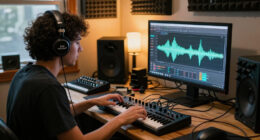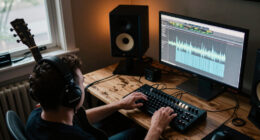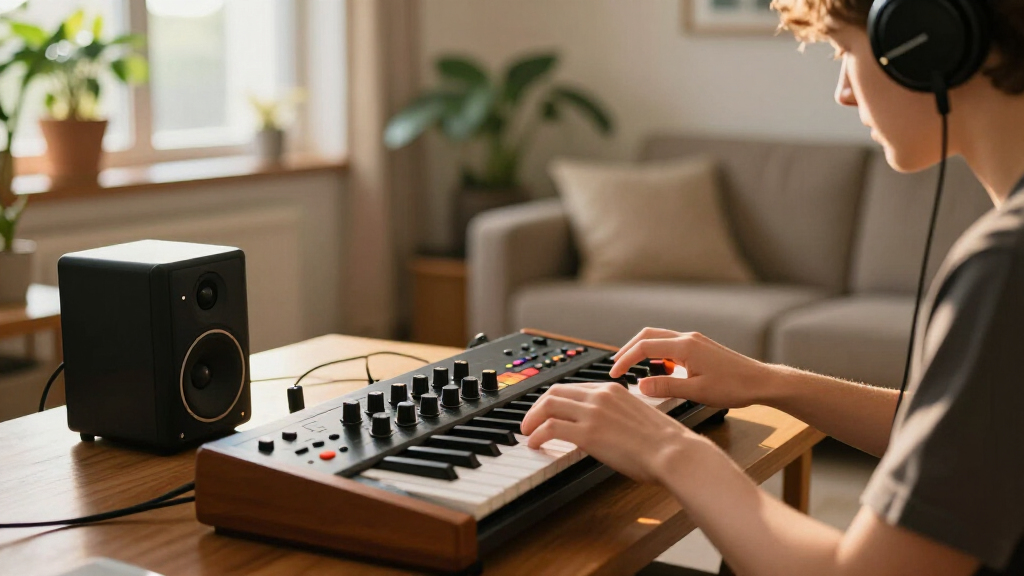
The best synthesizers for beginners balance easy sound shaping with enough range to keep learning rewarding. My best overall pick is the Yamaha Reface CS, whose keyboard and hands-on controls make subtractive synthesis approachable without limiting musical expression. The Arturia MicroFreak stands out for curious sound explorers, while the Stylophone GENX-2 suits buyers who want a compact, playful instrument. The main tradeoffs are keyboard size, how much sound design a beginner can comfortably manage, and whether portability matters more than performance flexibility. Read on for the full comparison and guidance on which strengths are worth prioritizing for your first synth.

Get audio and creator gear delivered free with Prime
- Fast, free delivery on millions of items
- Prime Video, Amazon Music and more included
- Member-only deals all year
Complete the kit


Key Takeaways
- The Yamaha Reface CS is the strongest all-round starting point: it combines a playable keyboard with direct controls, making it easier to connect knob movements to changes in sound.
- More synthesis options do not always make a better first synth: the MicroFreak and MiniFreak offer broader sound design, but their added depth can take more time to learn than the Reface CS.
- Small, self-contained synths trade performance comfort for portability: the Stylophone models and M-VAVE FM-1 options are easy to carry, but their compact playing surfaces are less suited to conventional keyboard practice.
- The lineup splits between exploration and immediate play: models such as the MicroFreak reward experimentation, while the Donner Essential B1 focuses on bass sounds and sequenced patterns.
- Some apparent alternatives serve different purposes: the green and standard M-VAVE FM-1 entries share a model name, while the FM001 adds a speaker and wireless operation; compare their specific configuration rather than treating them as wholly different synthesis platforms.
| Behringer PHARA-O MINI Compact Synthesizer |  | Best for a Compact Sound-Design Setup | Model: PHARA-O MINI | Body material: Alloy steel | Finish: Glossy | VIEW LATEST PRICE | See Our Full Breakdown |
| Yamaha Reface CS Portable Analog Modeling Synthesizer |  | Best Overall for Beginner-Friendly Hands-On Playing | Keys: 37 mini keys | Polyphony: 8-note | Synthesis: Analog physical modeling with five oscillator modules | VIEW LATEST PRICE | See Our Full Breakdown |
| Arturia MicroFreak Synthesizer |  | Best for Experimental Sound Exploration | Keys: 25 touch-plate keys with polyphonic aftertouch | Oscillator modes: 17 | Filter: State-variable 12 dB Oberheim SEM analog filter | VIEW LATEST PRICE | See Our Full Breakdown |
| M-VAVE FM-1 Portable FM Synthesizer, Green |  | Best for Preset-Led Portable FM | Synthesis: 6-operator FM | Algorithms: 32 | Presets: 128 | VIEW LATEST PRICE | See Our Full Breakdown |
| Bowie Stylophone Limited Edition Analog Synthesizer |  | Best Pocket Pick for Simple Analog Sounds | Type: Analog synthesizer | Modes: 3 | Sound profile: Classic analog | VIEW LATEST PRICE | See Our Full Breakdown |
| Stylophone Original Pocket Electronic Synthesizer |  | Best for First-Time Experimentation | Model: Original (DU05151) | Sound: Warm, retro analog; three octaves with optional vibrato | Playing surface: Touch-sensitive metal surface played with a stylus | VIEW LATEST PRICE | See Our Full Breakdown |
| M-VAVE FM-1 Portable FM Synthesizer |  | Best for Learning FM Synthesis | Synthesis: 6-operator FM; 32 algorithms | Presets: 128 factory presets | Keyboard: 27 silicone keys; spans 8 octaves | VIEW LATEST PRICE | See Our Full Breakdown |
| M-VAVE FM001 Portable Wireless FM Synthesizer with Built-In Speaker |  | Best Compact FM Synth with Speaker | Sound engine: 6 operators; 32 algorithms | Presets: 128 factory sounds | Keyboard: 27 silicone keys | VIEW LATEST PRICE | See Our Full Breakdown |
| Stylophone GENX-2 Portable Analog Synthesizer |  | Best for Hands-On Analog Sound Design | Keyboard: Two octaves; stylus operated | Sound controls: LFO with square and triangle waves, resonant low-pass filter, attack/decay envelope, and pulse-width modulation | Additional tone controls: Two sub-octave switches and analog delay | VIEW LATEST PRICE | See Our Full Breakdown |
| Donner Essential B1 Analog Bass Synthesizer and Sequencer |  | Best for Building Bass Patterns | Type: Analog bass synthesizer and sequencer | Oscillators: 1 VCO | Filter and amplifier: 1 VCF and 1 VCA | VIEW LATEST PRICE | See Our Full Breakdown |
| Arturia MiniFreak 37-Key 6-Voice Hybrid Synthesizer |  | Best for Growing Beginners | Brand: Arturia | Model: MiniFreak | Keys: 37 | VIEW LATEST PRICE | See Our Full Breakdown |
| synthesizers for beginner | Connectivity | Weight |
|---|---|---|
| Behringer PHARA-O MINI Compact | — | 0.65 kg |
| Yamaha Reface CS Portable Anal | MIDI and USB | 6 pounds |
| Arturia MicroFreak Synthesizer | CV outputs, USB, MIDI via break-out cables, 1/4-inch audio output, and 3.5 mm TRRS headphone jack | 2.3 pounds |
| M-VAVE FM-1 Portable FM Synthe | USB, Bluetooth, and 3.5 mm MIDI | — |
| Bowie Stylophone Limited Editi | — | 16 ounces |
| Stylophone Original Pocket Ele | Auxiliary; 3.5 mm stereo cable | 8.8 ounces |
| M-VAVE FM-1 Portable FM Synthe | USB-C, Bluetooth BLE MIDI, and 3.5 mm MIDI IN | — |
| M-VAVE FM001 Portable Wireless | — | — |
| Stylophone GENX-2 Portable Ana | — | — |
| Donner Essential B1 Analog Bas | USB-C, 5-pin MIDI I/O, and Sync I/O | — |
| Arturia MiniFreak 37-Key 6-Voi | USB | 2.94 kg |
More Details on Our Top Picks
Behringer PHARA-O MINI Compact Synthesizer
The PHARA-O MINI makes most sense for a beginner who wants a small sound-design instrument to pair with a computer or other MIDI gear, rather than a self-contained keyboard for learning songs. At 0.65 kg and just over nine inches long, it is easier to fit on a crowded desk than the Yamaha Reface CS, which adds keys, speakers, and a looper but takes up substantially more space. Its MIDI connection gives it a role in a wider setup, while the alloy-steel body adds a sturdier feel than a purely lightweight plastic shell might. The tradeoff is a sparse feature set in the supplied specifications: there is no listed keyboard, speaker, sequencer, or onboard sound-shaping detail to guide a first-time player. I’d choose it as a compact companion, not as the most complete first synth.
Pros:- Compact dimensions suit crowded desks and portable setups.
- MIDI connectivity allows it to work with compatible external equipment.
- Alloy-steel body offers a more substantial construction than its small footprint suggests.
Cons:- No keyboard or built-in speaker is listed, so it is not a self-contained way to start playing.
- The supplied details do not explain its synthesis controls or sound-shaping range.
- It offers fewer documented beginner-friendly learning features than the Yamaha Reface CS.
Best for: Beginners building a small desk-based setup who already have a MIDI controller or plan to use external MIDI gear.
Not ideal for: First-time buyers who want keys, built-in speakers, or clearly documented sound-shaping tools in one instrument.
- Model:PHARA-O MINI
- Body material:Alloy steel
- Finish:Glossy
- Dimensions:9.21 x 6.1 x 2.56 inches
- Weight:0.65 kg
- Connector:MIDI
Our verdict“Choose the PHARA-O MINI if a compact MIDI-connected sound-design tool matters more than having a complete beginner keyboard.”
Yamaha Reface CS Portable Analog Modeling Synthesizer
The Yamaha Reface CS is my strongest all-round pick here for a beginner who wants to play notes, shape sounds, and capture ideas without assembling a larger setup. Its 37-key keyboard, built-in speakers, and battery power make it more immediately playable than the PHARA-O MINI, while eight-note polyphony supports chords and pads rather than limiting every part to single notes. The five oscillator modules, filters, and onboard effects offer room to explore without relying solely on preset selection; the phrase looper also gives a new player a simple way to build up musical ideas. The main compromise is the mini-key format, which can feel cramped for piano-style practice. At six pounds and nearly 30 inches long, it is portable, but less pocketable than the MicroFreak or Stylophone.
Pros:- Eight-note polyphony lets beginners play chords and layered-sounding parts.
- Built-in speakers and battery power support playing away from a studio setup.
- Phrase looper helps capture and build on musical ideas without extra recording gear.
- Oscillator options, filters, and effects provide hands-on sound-shaping choices.
Cons:- Mini keys may feel limiting for piano-trained players or two-handed practice.
- Its nearly 30-inch length makes it less compact than the MicroFreak and pocket synthesizers.
- Six-pound weight is less convenient for frequent carrying than the lightest options in this roundup.
Best for: New players who want a self-contained instrument for learning synth controls, playing chords, and recording short musical ideas.
Not ideal for: Pianists who need full-size keys, or buyers prioritizing a very small instrument for bags and tight workspaces.
- Keys:37 mini keys
- Polyphony:8-note
- Synthesis:Analog physical modeling with five oscillator modules
- Special feature:Phrase looper
- Connectivity:MIDI and USB
- Power:Battery powered
- Headphone jack:3.5 mm
- Weight:6 pounds
Our verdict“Pick the Reface CS if you want the most rounded beginner experience here, provided mini keys suit your playing.”
Arturia MicroFreak Synthesizer
The Arturia MicroFreak suits a beginner who is more curious about unusual timbres and modulation than about a conventional keyboard experience. Its 17 oscillator modes feed an analog resonant filter, giving it a broader and more experimental sound-design direction than the Yamaha Reface CS’s more immediately playable, speaker-equipped format. A sequencer with automation and a modulation matrix let curious users build evolving patterns, while CV outputs connect the instrument to compatible modular gear. That flexibility comes with a genuine learning curve: beginners may need time to understand how its many controls interact. The flat PCB touch keyboard also differs sharply from the Reface CS’s mini keys and will not suit everyone’s playing technique. I’d rank it below the Yamaha as a first all-purpose synth, but ahead of simpler pocket instruments for exploratory learners.
Pros:- Seventeen oscillator modes offer a wide range of starting points for sound exploration.
- Analog resonant filter adds a distinct tone-shaping stage to its digital oscillators.
- Sequencer automation and a 5 x 7 modulation matrix support evolving patterns.
- CV outputs, USB, and MIDI provide room to connect with other music gear.
Cons:- Flat touch-plate keys feel unfamiliar to players used to conventional keyboards.
- The many oscillator and modulation options can make the learning curve steep.
- Unlike the Yamaha Reface CS, it has no built-in speaker listed for standalone listening.
Best for: Curious beginners who enjoy experimenting with sound, step sequencing, and connecting a synth to modular or computer-based setups.
Not ideal for: Players who want a familiar piano-style keyboard, built-in speakers, or a simple path from switching on to playing conventional parts.
- Keys:25 touch-plate keys with polyphonic aftertouch
- Oscillator modes:17
- Filter:State-variable 12 dB Oberheim SEM analog filter
- Sequencer:Spice and Dice step sequencer with automation recording
- Modulation matrix:5 x 7 user-assignable destinations
- Connectivity:CV outputs, USB, MIDI via break-out cables, 1/4-inch audio output, and 3.5 mm TRRS headphone jack
- Power:DC
- Weight:2.3 pounds
Our verdict“Choose the MicroFreak if you want a challenging, expressive sound-design instrument rather than a conventional first keyboard.”
M-VAVE FM-1 Portable FM Synthesizer, Green
The M-VAVE FM-1 is aimed at beginners who want portable playability and a menu of ready-to-use digital sounds. Its 128 presets, built-in speaker, rechargeable battery, and color display make it easier to start exploring than the PHARA-O MINI, whose supplied details focus on compact size and MIDI connectivity. The FM engine offers more depth than the FM-1’s approachable exterior suggests: six operators and 32 algorithms give sound designers many configurations to explore, while the sequencer and arpeggiator add ways to make patterns from the keys. That breadth may be more than a brand-new player wants to learn at once. The 27-key range also limits longer melodic parts compared with the Yamaha Reface CS’s 37 keys. It is a good portable choice, but not the simplest route into synthesis.
Pros:- Built-in speaker and rechargeable battery support playing without a separate audio setup.
- 128 presets provide ready-made sounds for exploring before editing them.
- Six-operator FM engine and 32 algorithms offer substantial sound-design scope.
- Arpeggiator, sequencer, and USB, Bluetooth, and MIDI connections support flexible use.
Cons:- Twenty-seven keys give less playing range than the Yamaha Reface CS’s 37-key keyboard.
- FM synthesis and its algorithm options may take time for a beginner to understand.
- The supplied specifications do not state the battery runtime.
Best for: Beginners who want a battery-powered instrument with presets, built-in sound, and hands-on sequencing for portable music-making.
Not ideal for: Players who need a longer keyboard, prefer a straightforward analog-style control layout, or want a less involved introduction to sound design.
- Synthesis:6-operator FM
- Algorithms:32
- Presets:128
- Keys:27 full-size silicone keys
- Effects:6
- Arpeggiator:7 modes
- Sequencer:16-step
- Connectivity:USB, Bluetooth, and 3.5 mm MIDI
- Power and speaker:Built-in rechargeable battery and speaker
Our verdict“Choose the FM-1 if portable presets and pattern tools appeal more than a longer keyboard or a simpler synthesis workflow.”
Bowie Stylophone Limited Edition Analog Synthesizer
The Bowie Stylophone is the most straightforwardly portable pick here: it is battery-powered, weighs one pound, and uses a stylus interface rather than a conventional keybed. Its three modes cover classic synth and bass sounds, making it a playful entry point for someone who wants to try a compact instrument without taking on the MicroFreak’s modulation matrix or the FM-1’s operator-based synthesis. That simplicity is also its limit. A stylus is a different way to play notes, and it offers less of the familiar keyboard practice available on the Yamaha Reface CS or M-VAVE FM-1. The listed auxiliary connector is also less flexible than broader MIDI connections for integrating with other gear. I’d pick this as a pocket-sized introduction or novelty instrument, not as the best choice for learning conventional keyboard technique.
Pros:- Small, battery-powered format makes it easy to carry and play in different spaces.
- Three modes give beginners a few distinct synth and bass sound options.
- Stylus interface offers a different and approachable alternative to a conventional keybed.
- White finish and embossed Bowie logo give this edition a distinctive appearance.
Cons:- Stylus playing differs from keyboard technique and may take time to get comfortable with.
- Auxiliary connection is less broadly useful for gear integration than the MIDI options on the Reface CS or FM-1.
- The supplied specifications do not give battery-life details.
Best for: Curious beginners who want a small, battery-powered instrument for simple analog synth and bass sounds, rather than keyboard practice.
Not ideal for: Aspiring keyboard players who want conventional keys, broader connectivity, or deeper sequencing and sound-design tools.
- Type:Analog synthesizer
- Modes:3
- Sound profile:Classic analog
- Interface:Stylus
- Power:Battery powered
- Connector:Auxiliary
- Body material:Bass wood
- Dimensions:7.09 x 4.16 x 1.82 inches
- Weight:16 ounces
Our verdict“Choose the Bowie Stylophone for compact, simple analog play, but pick the Reface CS if learning keyboard technique is a priority.”
Stylophone Original Pocket Electronic Synthesizer
The Stylophone Original is a low-friction way to explore pitch and melody: tap or slide its stylus across a metal surface, then hear the result through the built-in speaker or headphones. Its three-octave range and optional vibrato offer more melodic room than the two-octave keyboard on the Stylophone GENX-2, while the playing method keeps the instrument compact and distinctive. That simplicity is also the main limitation. The small touch surface can take practice, and it offers far less direct sound shaping than the GENX-2 or the Donner Essential B1’s sequencing and performance controls. I’d choose it for learning by ear and making quick, playful phrases, not as a conventional keyboard replacement. It also needs three AA batteries, so portable use means keeping spares on hand.
Pros:- Three-octave playing range gives it more melodic reach than the GENX-2’s two-octave stylus keyboard.
- Built-in speaker and headphone socket support both casual play and quiet practice.
- Warm, retro analog sound with optional vibrato makes simple phrases distinctive.
- Auxiliary connectivity allows recording or connection to other gear.
Cons:- The compact touch-sensitive surface can take practice and may feel imprecise to keyboard players.
- Requires three AA batteries for portable operation.
- Offers fewer sound-shaping controls than the Stylophone GENX-2.
Best for: Newcomers who want a small, self-contained instrument for trying melodies and retro-toned sounds without a conventional keyboard.
Not ideal for: Beginners who want piano-style keys, extensive hands-on sound design, or a sequencer for building complete patterns.
- Model:Original (DU05151)
- Sound:Warm, retro analog; three octaves with optional vibrato
- Playing surface:Touch-sensitive metal surface played with a stylus
- Power:3 AA batteries
- Audio:Built-in speaker and headphone socket
- Connectivity:Auxiliary; 3.5 mm stereo cable
- Dimensions:2.05 x 3.41 x 1.86 inches
- Weight:8.8 ounces
Our verdict“Choose the Stylophone Original if you want a portable, playful first instrument and can live with its unusual stylus-based playing surface.”
M-VAVE FM-1 Portable FM Synthesizer
The M-VAVE FM-1 gives beginners a broad palette to explore: its six-operator FM engine, 32 algorithms, and 128 presets make it possible to start from ready-made sounds before experimenting with how tones are built. The arpeggiator, 16-step sequencer, and six effects add ways to turn a sound into a musical idea, rather than leaving the player with a single-note practice tool like the Stylophone Original. It also has 12-voice polyphony, useful for chords, though its 27-key silicone keyboard is much shorter than a standard keyboard and may constrain two-handed parts. Compared with the FM001, the FM-1 specifies up to 12 hours of battery life and a rechargeable battery; the tradeoff is that the listed details do not confirm a built-in speaker. This suits curious learners who want sound design and portable sequencing more than a traditional keybed.
Pros:- Six-operator FM engine, 32 algorithms, and 128 presets offer plenty of sounds to explore.
- Arpeggiator, 16-step sequencer, and six effects support hands-on musical experiments.
- 12-voice polyphony allows chord playing.
- Rechargeable battery is specified for up to 12 hours, with USB-C and Bluetooth BLE MIDI for connecting to other gear.
Cons:- The 27-key silicone keyboard can restrict wider or two-handed parts.
- A built-in speaker is not specified in the product details.
- Included power accessories are not specified.
Best for: Beginners interested in FM sound design, preset exploration, and portable beat or melody sketches who are comfortable with a compact keyboard.
Not ideal for: Learners who need full-sized keys, a clearly specified built-in speaker, or an uncomplicated instrument focused mainly on piano-style practice.
- Synthesis:6-operator FM; 32 algorithms
- Presets:128 factory presets
- Keyboard:27 silicone keys; spans 8 octaves
- Polyphony:12 voices
- Sequencer:16 steps; 16 independent sequences
- Effects:Filter, reverb, delay, distortion, chorus, and phaser
- Connectivity:USB-C, Bluetooth BLE MIDI, and 3.5 mm MIDI IN
- Battery:2000 mAh; up to 12 hours
Our verdict“Pick the FM-1 if you want a portable, feature-rich introduction to FM synthesis and do not need a full-size keyboard.”
M-VAVE FM001 Portable Wireless FM Synthesizer with Built-In Speaker
The M-VAVE FM001 makes spontaneous practice easier by pairing a built-in speaker with battery operation, so a beginner can make sound without first setting up headphones or an external monitor. Its six-operator FM engine, 128 presets, effects, arpeggiator, and 16-step sequencer give it considerably more creative range than the Stylophone Original, whose appeal is its simpler stylus-played analog sound. The FM001’s USB, Bluetooth, and 3.5 mm MIDI options also make it more flexible as part of a wider setup. The short 27-key silicone keyboard is the main compromise: it works for compact sketches but is not a substitute for a conventional keyboard when learning two-handed parts. Unlike the FM-1, the provided information does not state battery life, so I’d favor the FM-1 if runtime certainty matters more than having a specified built-in speaker.
Pros:- Built-in speaker and battery operation make quick, untethered play possible.
- Six-operator FM engine, 32 algorithms, and 128 presets provide a wide range of starting sounds.
- Arpeggiator, 16-step sequencer, and six effects encourage experimentation.
- USB MIDI, Bluetooth MIDI, and 3.5 mm MIDI IN support connections to other equipment.
Cons:- Only 27 keys are available, limiting longer or two-handed parts.
- Battery life is not specified in the product details.
- Plastic construction may feel less substantial than instruments with a metal body.
Best for: Beginners who want to make sounds anywhere using a built-in speaker and explore FM presets, effects, and simple sequences.
Not ideal for: Keyboard learners who need a full-length keybed or buyers who need a stated battery runtime before choosing a portable instrument.
- Sound engine:6 operators; 32 algorithms
- Presets:128 factory sounds
- Keyboard:27 silicone keys
- Effects:Filter, reverb, delay, distortion, chorus, and phaser
- Sequencer:16 steps
- MIDI connectivity:USB MIDI, Bluetooth MIDI, and 3.5 mm MIDI IN
- Power and sound:Battery operation; built-in speaker
- Dimensions and weight:6.4 x 3.8 x 1.2 inches; 9.6 ounces
Our verdict“Choose the FM001 if a built-in speaker and portable FM sound-making matter more than a full keyboard or a stated battery runtime.”
Stylophone GENX-2 Portable Analog Synthesizer
The Stylophone GENX-2 is a stronger fit than the Original for beginners who want to learn how synth sounds change, not just play notes. Its resonant low-pass filter, LFO, envelope, pulse-width modulation, and analog delay expose useful sound-shaping ideas in a portable instrument with a built-in speaker. Compared with the Donner Essential B1, it offers more varied tone-shaping controls, while the B1 is better organized around bass patterns and sequencing. The GENX-2’s two-octave stylus keyboard is compact and expressive, but it will not feel natural to everyone; players used to regular keys may find it harder to perform accurately. Its CV/Gate connections also give it room to connect with modular or semi-modular gear, though that feature may be unnecessary for someone seeking a self-contained first synth. It rewards curiosity more than conventional keyboard practice.
Pros:- Filter, LFO, envelope, pulse-width modulation, and analog delay provide hands-on sound shaping.
- Built-in speaker and battery operation support portable play.
- CV/Gate connections allow integration with modular and semi-modular equipment.
- Can be controlled by external keyboards or a DAW.
Cons:- Two-octave stylus keyboard may be awkward for players accustomed to conventional keys.
- Its controls and connections may be more involved than a beginner seeking a simple plug-and-play instrument needs.
- The listed specifications do not state a battery runtime.
Best for: Beginners who want to experiment with analog tone shaping and may later connect the synth to a DAW, keyboard, or modular setup.
Not ideal for: Players who want standard piano-style keys, a broad keyboard range, or a simple preset-focused first instrument.
- Keyboard:Two octaves; stylus operated
- Sound controls:LFO with square and triangle waves, resonant low-pass filter, attack/decay envelope, and pulse-width modulation
- Additional tone controls:Two sub-octave switches and analog delay
- Power and speaker:Battery operated; built-in speaker
- Audio connections:Two 3.5 mm mini-jack sockets for headphones and audio
- CV/Gate connectivity:Five 3.5 mm jack sockets
Our verdict“Choose the GENX-2 if learning analog sound design matters more than playing on a conventional keyboard.”
Donner Essential B1 Analog Bass Synthesizer and Sequencer
The Donner Essential B1 is the most focused choice here: it pairs an analog bass voice with a step sequencer, 128 pattern slots, and Song Mode for chaining ideas. That workflow can make learning rhythm and repetition more immediate than programming the FM-1 or FM001, which offer broader timbral palettes but less of a dedicated bass-machine identity. The B1 adds haptic performance pads, an eight-mode arpeggiator, and saturation and delay, giving beginners several ways to shape and vary a pattern. Its main limitation is the single-oscillator engine: it is built for bass lines, not broad polyphonic playing or elaborate sound design. USB-C, MIDI, and sync connections help it join a computer-based or hardware setup, but this is a specialized first synth rather than the most versatile all-purpose option.
Pros:- Step sequencer and haptic performance pads make pattern creation and live variation approachable.
- Stores up to 128 patterns and supports chaining them in Song Mode.
- Analog saturation and delay provide onboard ways to color bass sounds.
- USB-C, 5-pin MIDI I/O, and Sync I/O support connection to computers and other music gear.
Cons:- Single VCO limits sound-design range compared with the FM-1 and FM001.
- Bass-focused design is less suited to broad melodic or chord-based practice.
- The provided specifications do not list a built-in speaker or battery operation.
Best for: Beginners focused on electronic bass lines, step sequencing, and learning how patterns fit together in a song.
Not ideal for: Learners seeking a general-purpose melodic keyboard, chord playing, or a synth with multiple oscillators for wider sound design.
- Type:Analog bass synthesizer and sequencer
- Oscillators:1 VCO
- Filter and amplifier:1 VCF and 1 VCA
- Pattern memory:128 patterns
- Arpeggiator:8 modes
- Effects:Analog saturation and delay
- Connectivity:USB-C, 5-pin MIDI I/O, and Sync I/O
- Warranty:1 year
Our verdict“Pick the Essential B1 if your first synth should teach bass sequencing and pattern building rather than serve as a general keyboard.”
Arturia MiniFreak 37-Key 6-Voice Hybrid Synthesizer
The MiniFreak is a strong fit for a beginner who wants room to explore beyond basic presets: its hybrid digital-and-analog sound and six voices support a broad range of tones, while the 37-key keyboard gives more playing space than the compact Arturia MicroFreak. The included MiniFreak VST counterpart also lets you work with its sounds in a computer-based setup, a useful bridge between hardware experimentation and music production.
That breadth comes with a steeper learning curve than simpler, pocketable choices such as the Stylophone Original. It is portable at 2.94 kg, but it needs corded power, so it is less suited to spontaneous battery-powered playing. I’d rank it for beginners who are ready to learn a more capable instrument, rather than those seeking the simplest possible first synth.
Pros:- Hybrid digital-and-analog sound profile offers varied sound-design options.
- 37 keys provide more room to play than compact options such as the Arturia MicroFreak.
- MiniFreak VST counterpart supports computer-based sound work.
- Portable 2.94 kg design and two-year manufacturer warranty.
Cons:- Requires corded electric power, limiting use away from an outlet.
- Its broader synthesis capabilities may take longer to learn than simpler beginner instruments.
Best for: New players who want a 37-key instrument with varied synthesis options and a software counterpart for learning both hardware and computer-based workflows.
Not ideal for: Beginners seeking a simple, battery-powered instrument for casual playing away from an outlet; its corded power and broader feature set may be a poor fit.
- Brand:Arturia
- Model:MiniFreak
- Keys:37
- Voices:6
- Sound profile:Hybrid digital and analog
- Connectivity:USB
- Power source:Corded electric
- Weight:2.94 kg
- Included software:MiniFreak VST counterpart
Our verdict“Choose the MiniFreak if you want a capable first synth with room to grow and do not need battery-powered operation.”

How We Picked
I ranked these synthesizers by how clearly they help a beginner make music and understand sound design, not by feature count alone. I weighed the accessibility of the controls, the playing interface, sound-shaping range, portability, and whether each instrument can support continued learning. A hands-on keyboard earns an advantage for someone building basic playing skills, while a specialist or pocket instrument can rank highly for a buyer whose needs match its focus.
The order reflects those differences: the Reface CS leads as a balanced first instrument, followed by options that offer strong learning value through distinct approaches. More specialized or unusually compact models rank lower for general beginners, even when they have appealing uses. I also accounted for the tradeoff between immediate simplicity and longer-term versatility, so a more complex instrument does not automatically outrank an easier one.
Factors to Consider When Choosing Best Synthesizers For Beginners
Before choosing a first synth, decide what you want to learn and how you expect to make music. A beginner who wants to practice melodies at a keyboard has different needs from someone who wants a portable sound toy or a bass-and-sequencer setup. These factors help separate genuine learning tools from instruments that are better as focused side options.
Choose a playing surface that supports your goal
A keyboard is useful if you want to learn notes, chords, and melody while exploring synthesis. Small or nontraditional interfaces can be inviting, but they may not build the same playing habits as a conventional keyboard. Think about whether you plan to perform parts live or mainly create sounds and sequences. A compact instrument can still be a good first synth if its interface matches the way you want to play. One common mistake is treating portability as a substitute for comfortable practice. If you are unsure, prioritize an interface you will enjoy using for more than short experiments.
Match synthesis depth to your appetite for learning
Some instruments make sound changes obvious through direct controls, while others provide a wider range of synthesis techniques that take longer to understand. More options can keep a curious beginner engaged, but they can also make it harder to learn which control caused a particular change. Start by asking whether you want to learn a specific style of synthesis or simply make sounds quickly. A focused instrument can teach useful fundamentals without requiring you to master every feature. Avoid choosing by the biggest feature list alone; an approachable signal path can be more educational than extra modes. Paying for depth makes sense when you are excited to explore it.
Decide whether the synth should stand alone
Built-in sound, speakers, or wireless features can make spontaneous practice easier, especially when you do not have a studio setup. A synth that depends on external amplification or other gear may still be a stronger choice for desk-based music making. Consider where you will use it most: at a computer, on a table, or away from your usual setup. Also check what connections and accessories your planned setup requires before buying. A frequent beginner mistake is to focus on the instrument and overlook the extra equipment needed to hear or record it. Convenience matters most when it removes a real barrier to regular practice.
Think about portability versus performance comfort
Compact synths are easier to store and carry, but small controls can feel cramped during longer sessions. If the instrument will live in a backpack or travel with you, portability may be worth the compromise. If it will stay at home, a roomier playing surface can make practice and live parts less fiddly. Consider hand size, the type of music you want to play, and how often you will use the device while standing or seated. Do not assume a pocket format is automatically more beginner-friendly; simpler controls and comfortable playability are separate qualities. Choose the smallest instrument that still feels natural for your intended use.
Buy for the music you want to make, not every possible use
Specialist synths can be a smart first purchase when their focus matches your goals, such as building bass lines or experimenting with a particular sound approach. They are less suitable if you expect one instrument to cover melodies, chords, bass, and broad sound design equally well. Before paying for extra flexibility, name the sounds or parts you want to create most often. This keeps a focused instrument from feeling limiting and helps prevent buying advanced features you may not use. If your tastes are still forming, a balanced general-purpose model gives you more room to change direction. If you already know your musical lane, a dedicated instrument may teach you more by keeping the workflow focused.
Frequently Asked Questions
Is a keyboard synth a better first choice than a pocket synth?
It depends on whether you want to develop keyboard skills alongside sound design. A keyboard gives you a familiar way to practice notes and melodies, while a pocket synth favors portability and quick experimentation. For a beginner who wants to play songs or build chord parts, the larger playing format is usually more practical. For casual sound exploration or travel, a pocket instrument may get used more often. Choose based on the way you expect to make music, not on size alone.
Should I pick the MicroFreak or the MiniFreak as my first Arturia synth?
Choose the MicroFreak if you want a compact route into unconventional sound design and are comfortable learning through experimentation. The MiniFreak is better suited to someone who wants a broader hybrid instrument and expects to spend time exploring its added capabilities. That extra range can be rewarding, but it may feel like unnecessary complexity if you mainly want a simple first keyboard. Consider how much you value an approachable starting workflow against room to grow. A beginner who already enjoys tweaking and comparing sounds may be more comfortable with the deeper option.
Do I need a separate speaker or amplifier for these synthesizers?
Not every synth in this lineup has the same built-in listening options, so check the exact model and its connections before buying. A model with a speaker can be convenient for quick practice, while other setups may call for headphones, an amplifier, or an audio interface. Headphones are often a practical way to practice without disturbing others, but they do not replace every recording or performance connection. Plan for where you will listen as well as where you will play. Including this setup in your decision can prevent an otherwise suitable instrument from sitting unused.
Is the Donner Essential B1 versatile enough as a first synth?
The Essential B1 makes the most sense if bass sounds and sequenced patterns are central to the music you want to create. Its focused approach can help a beginner build rhythmic parts without needing a general-purpose instrument. It is a less natural fit if you want to practice melodies across a keyboard or explore many kinds of sounds from one device. Ask whether you would use a dedicated bass instrument often enough to justify that narrower role. If you are still discovering your preferred style, a more broadly playable synth may be a safer first step.
How should I choose between the M-VAVE FM-1 listings?
Compare the stated configuration and included features rather than assuming the listings represent entirely different synthesis designs. The FM-1 appears in green and standard versions, while the FM001 listing calls out wireless operation and a built-in speaker. Confirm the exact model name, color, connections, and included accessories on the listing you plan to buy. Those details can matter more to a beginner than a small naming difference. If you mainly want a portable practice instrument, built-in listening features may influence your choice; if not, focus on the playing experience and setup compatibility.
Conclusion
For most first-time buyers, I recommend the Yamaha Reface CS as the best overall choice: its direct controls and keyboard offer a balanced place to learn and play. The M-VAVE FM-1 is the best value-style pick for someone seeking a compact, focused FM option, while the Arturia MiniFreak is the best premium choice for a beginner ready to explore a wider hybrid instrument. The Reface CS is also my best pick for beginners who want an approachable keyboard-based start; choose the Stylophone GENX-2 if portability and playful experimentation matter more than conventional keyboard practice. For bass-focused patterns, the Donner Essential B1 is the specialist choice. Match the instrument to how you want to play, and its tradeoffs are more likely to feel purposeful than limiting.
Halloween Picks
halloween
As an affiliate, we earn on qualifying purchases.