
The best wireless microphone systems depend on where and how you’ll use them: the Phenyx Pro PTU-7000-4H is my best overall pick for group events that need four handheld channels, while the JBL Wireless Two-Microphone System is a simpler fit for two-speaker setups. For phone-based recording, the USB-C lavalier sets are more portable, but they serve a different purpose from stage-ready UHF systems. The main tradeoffs are channel count, microphone style, receiver and device compatibility, and how much setup a venue requires. Read on for the full breakdown of all 15 picks and a guide to choosing the right system for your use.

Get audio and creator gear delivered free with Prime
- Fast, free delivery on millions of items
- Prime Video, Amazon Music and more included
- Member-only deals all year
Complete the kit



Key Takeaways
- Four-channel UHF receivers are the clearest fit for events with several speakers; the Phenyx Pro PTU-7000-4H and multi-mic Hiberr kits offer more simultaneous mic options than dual-channel systems.
- A higher channel count is not automatically the best choice: two-person presentations and small karaoke setups may be easier to manage with a dual-microphone system such as the JBL two-mic system or Phenyx Pro PTU-71-2H.
- Microphone style changes the job the system can do: handhelds suit hosts and singers, while headset and lavalier bodypacks keep hands free for instruction, presentations, or performance.
- Phone-oriented lavalier sets, including the USB-C charging-case set and NEEWER KM19, are aimed at mobile recording rather than connecting several performers to a venue sound system.
- The BONAOK Q37 is a self-contained karaoke speaker-and-microphone option, unlike receiver-based systems that need a separate speaker or PA; buyers should match the kit to the whole audio setup.
| Phenyx Pro PTU-5000-4H 4-Channel UHF Fixed Frequency Wireless Microphone System |  | Best for Straightforward Four-Mic Setups | Channels: 4 | Frequency range: 541.9–568.65 MHz | Microphone pattern: Cardioid, unidirectional | VIEW LATEST PRICE | See Our Full Breakdown |
| Phenyx Pro PTU-71-2H Dual UHF Auto Scan Handheld Wireless Microphone System |  | Best for Two-Mic Flexibility | Channels: 2 | Selectable frequencies: 100 per channel | Operating frequency ranges: Channel 1: 536.57–561.32 MHz; Channel 2: 562.37–587.12 MHz | VIEW LATEST PRICE | See Our Full Breakdown |
| Hiberr YU-E20 Dual-Channel UHF Handheld Wireless Microphone System |  | Best Simple Dual-Handheld Alternative | Channels: 2 | Frequency range: 520–569.750 MHz | Microphone type: Handheld | VIEW LATEST PRICE | See Our Full Breakdown |
| Phenyx Pro PTU-7000-4H 4-Channel UHF Wireless Microphone System |  | Best Four-Handheld Upgrade | Channels: 4 | Selectable frequencies: 40 per channel | Channel frequency ranges: 538.3–550 MHz; 554.8–566.5 MHz; 571.3–583 MHz; 587.8–599.5 MHz | VIEW LATEST PRICE | See Our Full Breakdown |
| Hiberr E40 4-Channel Wireless Microphone System with Headset and Lavalier Mics |  | Best for Hands-Free Presenters | Channels: 4 | Wireless frequency range: 520–569.750 MHz | Microphone types: Headset and lavalier | VIEW LATEST PRICE | See Our Full Breakdown |
| Hiberr 4-Channel UHF Wireless Microphone System with 2 Handheld and 2 Bodypack Microphones |  | Best for Mixed Microphone Setups | Wireless connectivity: UHF | Channels: 4 independent channels | Frequency range: 520–570 MHz | VIEW LATEST PRICE | See Our Full Breakdown |
| BONAOK Q37 Wireless Bluetooth Karaoke Microphone Speaker (Rose Gold) |  | Best for Casual Home Karaoke | Model: Q37 | Connectivity: Bluetooth and USB cable | Functions: Microphone, speaker, and MP3 player | VIEW LATEST PRICE | See Our Full Breakdown |
| Hiberr E40 4-Channel Wireless Microphone System with 4 Handheld Microphones |  | Best for Four-Handheld Events | Wireless connectivity: UHF | Channels: 4 | Frequency range: 520–569.750 MHz | VIEW LATEST PRICE | See Our Full Breakdown |
| JBL Wireless Two-Microphone System with Dual-Channel Receiver, Black |  | Best for JBL PartyBox Owners | Channels: 2 | Compatible devices: Select JBL PartyBox speakers | Microphone polar pattern: Unidirectional | VIEW LATEST PRICE | See Our Full Breakdown |
| GEARDON 2.4G Dual Wireless Microphone Set with Carrying Bag |  | Best Rechargeable Set for PA Inputs | Wireless technology: 2.4GHz | Channels: 2 | Wireless range: Up to 200 ft (60 m), line of sight | VIEW LATEST PRICE | See Our Full Breakdown |
| Phenyx Pro PTU-52-2H Dual UHF Wireless Microphone System |  | Best for Flexible PA Setups | Wireless band: UHF, 500–590 MHz | Tunable frequency groups: 30 per microphone | Channels: 60 | VIEW LATEST PRICE | See Our Full Breakdown |
| Wireless USB-C Lavalier Microphone Set with Charging Case |  | Best for Simple USB-C Recording | Connection: USB Type-C receiver | Microphone type: Lavalier | Channels: 1 | VIEW LATEST PRICE | See Our Full Breakdown |
| NEEWER KM19 Mini Wireless Lavalier Microphone, USB-C, Black |  | Best for Two-Person Mobile Recording | Wireless connection: 2.4 GHz | Included microphones: 2 transmitters | Receiver connector: USB Type-C | VIEW LATEST PRICE | See Our Full Breakdown |
| JBL PartyBox Wireless Microphones, 2-Pack |  | Best for JBL PartyBox Owners | Microphones: 2 handheld microphones | Wireless connection: 2.4 GHz dongle | Compatibility: JBL PartyBox speakers | VIEW LATEST PRICE | See Our Full Breakdown |
| Kaschun Dual UHF Wireless Microphone System (KA-328) | 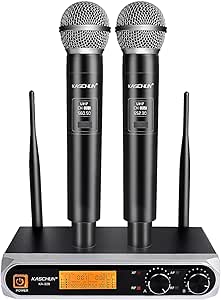 | Best for Straightforward Karaoke Setups | Model: KA-328 | Wireless technology: Fixed-frequency UHF | Included microphones: 2 handheld microphones | VIEW LATEST PRICE | See Our Full Breakdown |
| wireless microphone system | Channels | Signal-to-noise ratio |
|---|---|---|
| Phenyx Pro PTU-5000-4H 4-Chann | 4 | 105 dB |
| Phenyx Pro PTU-71-2H Dual UHF | 2 | 98 dB |
| Hiberr YU-E20 Dual-Channel UHF | 2 | 85 dB listed |
| Phenyx Pro PTU-7000-4H 4-Chann | 4 | — |
| Hiberr E40 4-Channel Wireless | 4 | 92 dB |
| Hiberr 4-Channel UHF Wireless | 4 independent channels | 92 dB |
| BONAOK Q37 Wireless Bluetooth | — | — |
| Hiberr E40 4-Channel Wireless | 4 | 92 dB |
| JBL Wireless Two-Microphone Sy | 2 | 60 dB |
| GEARDON 2.4G Dual Wireless Mic | 2 | 80 dB |
| Phenyx Pro PTU-52-2H Dual UHF | 60 | — |
| Wireless USB-C Lavalier Microp | 1 | — |
| NEEWER KM19 Mini Wireless Lava | — | — |
| JBL PartyBox Wireless Micropho | — | — |
| Kaschun Dual UHF Wireless Micr | — | — |
More Details on Our Top Picks
Phenyx Pro PTU-5000-4H 4-Channel UHF Fixed Frequency Wireless Microphone System
The PTU-5000-4H is the no-fuss choice here for venues that need four handheld microphones and can keep their setup in one RF environment. Its fixed frequencies and memory switch make startup simpler than the PTU-7000-4H, which adds scanning and IR pairing for more flexible frequency selection. Cardioid pickup helps limit ambient sound, while the metal receiver is suited to frequent use at churches, events, or karaoke gatherings. The tradeoff is that fixed frequencies give you less room to adapt if interference becomes a problem or you want to run multiple systems together. Its stated range is also shorter than the line-of-sight range claimed for the PTU-7000-4H. You will need an amplifier, mixer, or powered speaker to produce sound.
Pros:- Four cardioid dynamic handheld microphones suit group events and help reject off-axis room noise.
- Fixed-frequency setup and memory switch reduce setup steps.
- All-metal receiver is designed for regular handling.
- Includes eight AA batteries, antennas, and audio cables.
Cons:- Fixed frequencies limit adjustment when interference occurs.
- Not suited to multi-set operation in environments where frequency coordination matters.
- Requires an external amplifier, mixer, or speaker for sound output.
Best for: Churches, event hosts, and karaoke operators who need four handheld mics and prefer simple setup over frequency adjustment.
Not ideal for: Users in RF-crowded venues or anyone planning to operate multiple wireless sets, since its frequencies are fixed.
- Channels:4
- Frequency range:541.9–568.65 MHz
- Microphone pattern:Cardioid, unidirectional
- Claimed range:Up to 260 ft
- Connections:XLR and 6.35 mm jack
- Battery life:Up to 8 hours
- Signal-to-noise ratio:105 dB
- Receiver enclosure:Metal
Our verdict“Choose the PTU-5000-4H for a simple four-handheld setup in a stable RF environment, but choose the PTU-7000-4H if frequency scanning matters more.”
Phenyx Pro PTU-71-2H Dual UHF Auto Scan Handheld Wireless Microphone System
For two speakers who may need to work around changing RF conditions, the PTU-71-2H offers a useful middle ground: it has auto scan, selectable UHF frequencies, and IR synchronization, unlike the fixed-frequency PTU-5000-4H. That flexibility can make setup more adaptable at performances or events, while cardioid handheld mics suit speech and karaoke better than a room-picking omnidirectional design such as the Hiberr YU-E20. The stated 290–328-foot range applies to line of sight, so walls and other obstructions can reduce the practical distance. Its frequency details are also inconsistent across the supplied product information, which makes it harder to plan around other wireless gear. With just two channels, it is not a substitute for the four-mic PTU-7000-4H.
Pros:- Auto scan and selectable frequencies provide more adjustment than a fixed-frequency system.
- IR synchronization simplifies pairing the microphones with the receiver.
- Cardioid handheld mics are suited to speech and singing in front of an audience.
- Claimed battery life is up to 16 hours.
Cons:- The stated range depends on line-of-sight conditions.
- Supplied frequency specifications differ across the product information.
- Two channels cannot cover larger groups as the four-channel PTU-7000-4H can.
Best for: DJs, small event hosts, and presenters who need two handheld microphones and want frequency scanning for changing venues.
Not ideal for: Choirs, panels, or larger events needing four simultaneous handheld microphones, or buyers who need clearly consistent frequency documentation.
- Channels:2
- Selectable frequencies:100 per channel
- Operating frequency ranges:Channel 1: 536.57–561.32 MHz; Channel 2: 562.37–587.12 MHz
- Microphone type:Handheld dynamic
- Pickup pattern:Cardioid, unidirectional
- Claimed operating range:290–328 ft line of sight
- Battery life:Up to 16 hours
- Signal-to-noise ratio:98 dB
Our verdict“Pick the PTU-71-2H for two-mic events where scan-and-sync flexibility matters more than the four-channel capacity of the PTU-7000-4H.”
Hiberr YU-E20 Dual-Channel UHF Handheld Wireless Microphone System
The Hiberr YU-E20 is a basic two-handheld option for karaoke and small performances, with automatic frequency scanning and a claimed range over 328 feet. That range is longer on paper than the PTU-5000-4H’s stated 260 feet, but the Hiberr’s listed 85 dB signal-to-noise ratio is lower than the Phenyx system’s 105 dB figure. Its frequency information also conflicts: the listed range tops out at 569.750 MHz, while another specification gives a 570 MHz maximum, and the description’s signal-to-noise claim differs from the spec. The omnidirectional pickup pattern is a meaningful distinction from the cardioid mics on the PTU-71-2H; it may capture more surrounding sound, which can be less helpful in an echo-prone room. I’d favor it when simplicity matters more than firm performance specifications.
Pros:- Includes two handheld microphones for dual-channel use.
- Automatic frequency scanning can simplify setup.
- Metal enclosure is specified for the system.
- Includes a 6.35 mm audio cable, antennas, and power adapter.
Cons:- Listed signal-to-noise ratio is 85 dB, while the description claims at least 95 dB.
- Frequency specifications vary within the supplied product information.
- Omnidirectional pickup can capture more room sound than the cardioid Phenyx handheld systems.
Best for: Karaoke users and small performance groups seeking two handheld mics with automatic scanning and a metal receiver.
Not ideal for: Speakers in echo-prone spaces or buyers who need consistent, clearly documented audio and frequency specifications.
- Channels:2
- Frequency range:520–569.750 MHz
- Microphone type:Handheld
- Pickup pattern:Omnidirectional
- Claimed range:Over 328 ft
- Claimed battery life:8–10 hours
- Signal-to-noise ratio:85 dB listed
- Connections:6.35 mm jack and XLR
Our verdict“Choose the YU-E20 for straightforward two-mic karaoke, but favor the PTU-71-2H if cardioid pickup and clearer stated audio specifications matter more.”
Phenyx Pro PTU-7000-4H 4-Channel UHF Wireless Microphone System
The PTU-7000-4H is the more adaptable four-handheld choice in this group. Unlike the PTU-5000-4H, it pairs auto scan with IR synchronization, giving users a way to select and pair frequencies rather than relying on fixed ones. Four channels and 40 selectable frequencies per channel suit events where several speakers need independent microphones; cardioid pickup helps keep each mic focused on its speaker. The receiver and microphones have metal construction, and replaceable microphone heads support upkeep. The tradeoff is that its listed 290–328-foot range is for line of sight, not a promise of the same coverage through walls. Frequency documentation is also inconsistent: channel ranges extend beyond the separately stated 530–580 MHz range. For a simpler fixed-frequency setup, the PTU-5000-4H has fewer adjustment steps.
Pros:- Four handheld channels support panels, events, and group performances.
- Auto scan and IR synchronization simplify frequency selection and pairing.
- Forty selectable frequencies per channel offer more adjustment than the PTU-5000-4H.
- Includes eight AA batteries, connection adapters, and setup accessories.
Cons:- Frequency specifications conflict between the channel ranges and the separately listed range.
- The 290–328-foot operating range is specified for line-of-sight use.
- More frequency setup options may be unnecessary for buyers who want a fixed, plug-and-go system.
Best for: Event venues, churches, and presenters who need four handheld microphones and want scanning and synchronization for frequency setup.
Not ideal for: Buyers who need fully consistent frequency documentation or expect the stated range to hold through walls and obstructions.
- Channels:4
- Selectable frequencies:40 per channel
- Channel frequency ranges:538.3–550 MHz; 554.8–566.5 MHz; 571.3–583 MHz; 587.8–599.5 MHz
- Microphone type:Handheld dynamic
- Pickup pattern:Cardioid, unidirectional
- Claimed range:290–328 ft line of sight
- Battery life:Up to 16 hours
- Connections:6.35 mm jack and XLR
Our verdict“Choose the PTU-7000-4H when four handhelds and adjustable frequency setup are priorities, and the PTU-5000-4H when a simpler fixed-frequency system will do.”
Hiberr E40 4-Channel Wireless Microphone System with Headset and Lavalier Mics
The Hiberr E40 serves a different job from the handheld Phenyx systems: each of its four bodypacks comes with both a headset and lavalier mic, leaving presenters’ hands free for teaching, demonstrations, or movement on stage. Its receiver also provides four independent XLR outputs, so an audio operator can adjust each speaker separately; the Phenyx PTU-7000-4H instead focuses on four handheld mics and includes a mixed-use connection setup. The E40’s half-rack metal receiver saves space, but its bodypacks need two AA batteries each, and batteries are not included. The supplied description advises aiming the directional microphones toward the mouth to reduce room echo, while the spec lists an omnidirectional pattern, so buyers should check the pickup behavior against their venue needs. This is a presenter-focused system, not a handheld karaoke kit.
Pros:- Each of four bodypacks includes both a headset and a lavalier microphone.
- Four independent XLR outputs allow separate channel processing.
- Mixed 6.35 mm output offers an additional connection option.
- Half-rack metal receiver saves rack and tabletop space.
Cons:- Each bodypack requires two AA batteries, which are not included.
- Pickup-pattern information is unclear: the spec lists omnidirectional while the description refers to directional microphones.
- Headset and lavalier bodypacks are less suited to karaoke than handheld systems such as the PTU-7000-4H.
Best for: Teachers, fitness instructors, tour guides, and event crews who need four hands-free speakers with separate mixer channels.
Not ideal for: Karaoke users who want handheld microphones, or buyers who need batteries included and unambiguous pickup-pattern information.
- Channels:4
- Wireless frequency range:520–569.750 MHz
- Microphone types:Headset and lavalier
- Pickup pattern:Omnidirectional listed
- Receiver outputs:4 XLR outputs and 1 mixed 6.35 mm output
- Bodypack power:2 AA batteries per bodypack; not included
- Signal-to-noise ratio:92 dB
- Receiver dimensions:8 × 4.8 × 1.8 in
Our verdict“Pick the E40 for four hands-free presenters who need separate XLR feeds, not for groups seeking handheld mics or a ready-to-go battery bundle.”
Hiberr 4-Channel UHF Wireless Microphone System with 2 Handheld and 2 Bodypack Microphones
The Hiberr stands out for groups that need four simultaneous channels but don’t want every performer tied to a handheld mic. Its two handhelds suit singing or announcements, while the bodypacks pair with included headset and lavalier microphones for presenters who need their hands free. Compared with the Hiberr E40, which supplies four handhelds, this kit is more adaptable for speech and mixed-format events, though it gives you fewer handhelds for group singing. Automatic frequency scanning can simplify channel setup, and the receiver’s four independent XLR outputs let a mixer operator adjust each voice separately. The tradeoff is a more involved setup than a plug-and-play speaker-oriented option like the JBL system, plus transmitters require AA batteries. I’d choose it for community events and presentations where microphone style matters as much as channel count.
Pros:- Combines two handheld microphones with two bodypack transmitters and headset and lavalier mics
- Four independent UHF channels support simultaneous users
- Automatic frequency scanning assists with setup
- Four independent XLR outputs plus a 6.35 mm connection support mixer and PA integration
Cons:- Battery-powered transmitters require AA batteries
- A receiver, mixer, or compatible PA setup makes this less plug-and-play than the JBL system
- The mixed selection provides only two handheld microphones
Best for: Event organizers and presenters who need four users at once, including speakers who prefer headset or lavalier microphones.
Not ideal for: Groups that need four handheld mics for karaoke, or buyers seeking a self-contained system without a mixer or PA.
- Wireless connectivity:UHF
- Channels:4 independent channels
- Frequency range:520–570 MHz
- Microphones:2 handheld, 2 bodypack; includes headset and lavalier microphones
- Outputs:4 independent XLR outputs; 6.35 mm jack
- Signal-to-noise ratio:92 dB
- Receiver dimensions:8 × 4.8 × 1.8 inches
- Power:Battery powered; 2 AA batteries required
Our verdict“Choose this Hiberr when four-channel capacity and a mix of hands-free and handheld microphones matter more than a four-handheld setup.”
BONAOK Q37 Wireless Bluetooth Karaoke Microphone Speaker (Rose Gold)
The BONAOK Q37 is the most self-contained option here: it combines a microphone, speaker, and MP3 player in one portable unit. Bluetooth or a cable connects it to phones, tablets, and PCs, while onboard echo and volume controls let singers adjust the sound without adding a mixer. That makes it simpler for casual home karaoke than the GEARDON set, which needs a compatible microphone input on an amplifier, speaker, or karaoke machine. The difference is also the limitation: the Q37 is a personal karaoke gadget, not a multi-mic UHF system for a PA or event. Its stated wireless range is 10 meters, and the microSD card needed for card playback is not included. I’d pick it for informal singing and skip it for live presentations or larger groups needing independent microphones.
Pros:- Combines microphone, speaker, and MP3 player in a portable unit
- Connects to compatible devices via Bluetooth or cable
- Onboard echo and volume controls offer simple vocal adjustments
- Supports microSD cards up to 32GB
Cons:- The stated 10-meter wireless range is more limited than the GEARDON set’s claimed line-of-sight range
- A microSD card is not included
- Not a multi-channel receiver system for PA or event use
Best for: Families and casual singers who want a portable karaoke mic that connects directly to a phone or tablet.
Not ideal for: Presenters, performers, or event hosts who need multiple wireless channels or integration with a PA system.
- Model:Q37
- Connectivity:Bluetooth and USB cable
- Functions:Microphone, speaker, and MP3 player
- Wireless range:10 meters
- MicroSD support:Up to 32GB
- Battery type:Lithium polymer
- Frequency response:10 kHz
- Warranty:1 year
Our verdict“Pick the Q37 for casual, phone-connected karaoke, not for events that need separate wireless microphones and PA integration.”
Hiberr E40 4-Channel Wireless Microphone System with 4 Handheld Microphones
When all four speakers or singers need the same style of microphone, the E40 keeps the setup straightforward: it includes four handheld dynamic microphones and a receiver with one balanced XLR output per channel. Separate outputs give a mixer operator control over each voice, while the additional mixed 6.35 mm output offers a simpler connection to compatible equipment. Compared with the other Hiberr four-channel kit in this roundup, this model trades headset and lavalier options for a full set of handhelds. That makes it a better match for panels, karaoke, and group performances, but a weaker fit for presenters who need hands-free mics. The metal construction is a practical plus for regular event handling; the tradeoffs are AA-powered microphones and the need to check whether its listed UHF frequency range is permitted locally.
Pros:- Includes four handheld dynamic microphones for simultaneous users
- Four balanced XLR outputs allow separate channel control
- Mixed 6.35 mm output provides another connection option
- Metal construction and replaceable AA microphone batteries
Cons:- Microphones require AA batteries, which are not included
- No headset or lavalier microphone option in this kit
- The listed 520–569.750 MHz range may be subject to local wireless regulations
Best for: Karaoke hosts, small venues, and panel organizers who need four handheld microphones with individual mixer outputs.
Not ideal for: Presenters who need headset or lavalier microphones, or buyers who cannot use the listed frequency range in their area.
- Wireless connectivity:UHF
- Channels:4
- Frequency range:520–569.750 MHz
- Microphone type:Handheld dynamic
- Outputs:4 balanced XLR; 1 mixed 6.35 mm
- Polar pattern:Hypercardioid
- Signal-to-noise ratio:92 dB
- Microphone power:2 AA batteries required
- Construction:Metal
Our verdict“Choose the E40 when four handhelds and separate XLR feeds matter more than hands-free microphone options.”
JBL Wireless Two-Microphone System with Dual-Channel Receiver, Black
The JBL system makes the most sense when the sound system is already a compatible PartyBox: its dual-channel receiver handles two microphones together, with a plug-and-play approach that avoids the rack receiver and channel setup of the Hiberr UHF kits. That simplicity suits announcements, small gatherings, and casual duets. It is not as flexible for a broader PA setup, since compatibility is limited to select JBL PartyBox speakers; the Hiberr E40, by contrast, offers separate XLR outputs for mixer-based systems. JBL lists up to six hours of receiver playback, so event planners should factor that limit into longer sessions. The microphones use replaceable AA batteries, which are easy to swap, but this is a focused accessory rather than a general-purpose wireless microphone system.
Pros:- Two microphones can operate through a dual-channel receiver
- Plug-and-play setup is simpler than the Hiberr four-channel systems
- Designed to work with select JBL PartyBox speakers
- Microphones use replaceable AA batteries
Cons:- Compatibility is limited to select JBL PartyBox speakers
- Receiver playback is listed for up to 6 hours
- Does not provide the four channels or individual XLR outputs found on the Hiberr E40
Best for: Owners of compatible JBL PartyBox speakers who want two microphones for gatherings, karaoke, or announcements.
Not ideal for: Buyers with non-JBL PA systems, mixers, or speakers, and event crews needing four channels or separate XLR outputs.
- Channels:2
- Compatible devices:Select JBL PartyBox speakers
- Microphone polar pattern:Unidirectional
- Frequency range:65–15,000 Hz
- Signal-to-noise ratio:60 dB
- Microphone batteries:Replaceable AA batteries
- Receiver playback:Up to 6 hours
- Included components:Wireless receiver, 2 microphones, USB-C cable
Our verdict“Choose this JBL set if you own a compatible PartyBox and want a simple two-mic add-on without a full PA system setup.”
GEARDON 2.4G Dual Wireless Microphone Set with Carrying Bag
The GEARDON set offers a practical alternative to AA-powered systems for users who want two rechargeable handheld microphones and a receiver they can pack away in the included bag. Its 2.4GHz connection has a claimed range of up to 200 feet in line-of-sight conditions, and the manufacturer lists more than seven hours of playback. Compared with the JBL system, it is aimed at a wider range of compatible amplifiers, mixers, karaoke machines, and PA speakers rather than select PartyBox models. But that flexibility does not extend to every audio input: it does not work with AUX inputs, phones, or laptops, so buyers need a microphone input and the right connector. The stated range also depends on a clear path. I’d choose it for mobile PA users who value rechargeable operation, not for direct laptop or phone recording.
Pros:- Includes two handheld microphones and a receiver
- Built-in 1200mAh batteries are rated for over 7 hours of playback
- Claimed wireless range reaches up to 200 feet under line-of-sight conditions
- Includes a carrying bag, silicone rings, and cables
Cons:- Not compatible with AUX inputs, phones, or laptops
- The 200-foot range claim applies to line-of-sight use
- Requires a compatible microphone input on a PA, mixer, amplifier, speaker, or karaoke machine
Best for: Karaoke hosts and mobile PA users who have a compatible microphone input and want rechargeable handhelds with a carrying bag.
Not ideal for: Phone, laptop, and AUX-input users, or buyers who need wireless performance through obstacles rather than line-of-sight.
- Wireless technology:2.4GHz
- Channels:2
- Wireless range:Up to 200 ft (60 m), line of sight
- Microphones:2 handheld
- Battery capacity:1200mAh built-in batteries
- Playback time:Over 7 hours
- Connectors:1/4-inch TRS; 3.5 mm adapter
- Signal-to-noise ratio:80 dB
- Pickup pattern:Unidirectional
Our verdict“Pick GEARDON for rechargeable dual-mic use with a compatible PA input, but skip it if you need direct phone, laptop, or AUX connectivity.”
Phenyx Pro PTU-52-2H Dual UHF Wireless Microphone System
The PTU-52-2H is a strong fit for small events that need two handheld mics and practical ways to connect to a sound system. Its two separate XLR outputs let a mixer control each microphone independently, while the mixed 1/4-inch output offers a simpler connection for compatible speakers. That routing flexibility sets it apart from the Kaschun KA-328, which offers XLR and 1/4-inch connections but uses fixed frequencies. Here, 30 tunable frequency groups per mic and frequency hopping give buyers more ways to respond to interference. The tradeoff is a receiver with a specified 200-foot range only in open line of sight, plus four AA batteries to manage. I’d choose it for a modest PA rig, not a compact phone-recording setup or a venue needing a more advanced multi-mic system.
Pros:- Two handheld microphones are included for duet or host-and-guest use.
- Separate XLR outputs allow independent control at a mixer.
- Thirty tunable frequency groups per microphone and frequency hopping help manage interference.
- Mixed 1/4-inch output provides an additional connection option.
Cons:- The 200-foot range applies to open line-of-sight conditions, not every room or venue.
- Four AA batteries are required for the microphones.
- The receiver and two-mic setup take more space than compact creator-oriented wireless kits.
Best for: Karaoke hosts, community venues, and small-event operators who want two handheld mics with separate mixer control.
Not ideal for: Mobile creators seeking a pocketable phone mic, or venues that need several microphone channels in one receiver.
- Wireless band:UHF, 500–590 MHz
- Tunable frequency groups:30 per microphone
- Channels:60
- Operating range:Up to 200 ft in open line of sight
- Outputs:2 XLR outputs and 1 mixed 1/4-inch output
- Frequency response:40 Hz–15 kHz
- Microphone power:4 AA batteries
- Receiver dimensions:13.98 × 12.72 × 3.31 in
Our verdict“Choose the PTU-52-2H if your two-mic PA setup benefits from separate XLR control and adjustable UHF frequencies.”
Wireless USB-C Lavalier Microphone Set with Charging Case
This set favors quick phone recording over the venue flexibility of the Phenyx Pro PTU-52-2H. Plug the USB-C receiver into a compatible phone or tablet and the microphones pair automatically, with no Bluetooth setup or app required. That makes it appealing for solo creators who want a clip-on mic and a fast start. Three adjustable noise-cancellation levels offer some control over surrounding sound, while the case raises total stated runtime to 36 hours. The key limitation is that the microphone itself runs for up to six hours per charge; the case helps between sessions but does not remove the need to recharge during longer recording days. It also has one channel, so it is not the right substitute for a two-person kit such as the NEEWER KM19. USB-C compatibility may require an adapter on other devices.
Pros:- Pairs automatically through its USB-C receiver without Bluetooth or an app.
- Three adjustable noise-cancellation levels provide options for different surroundings.
- Charging case supports up to 36 hours of total use.
- Wireless range is specified up to 164 feet.
Cons:- The microphone runtime is up to six hours per charge.
- Single-channel design is less suited to recording two speakers than the NEEWER KM19.
- USB-C connector may require an adapter for devices without a USB-C port.
Best for: Solo smartphone or tablet creators who want a clip-on mic with automatic USB-C pairing and a charging case.
Not ideal for: Two-person interviewers, users with devices lacking USB-C, or anyone needing handheld mics for a PA system.
- Connection:USB Type-C receiver
- Microphone type:Lavalier
- Channels:1
- Noise cancellation:3 adjustable levels
- Wireless range:Up to 164 ft (50 m)
- Microphone runtime:Up to 6 hours
- Total runtime with case:Up to 36 hours
- Recharge time:About 1 hour
Our verdict“Pick this set for straightforward, single-person recording on a compatible USB-C phone or tablet.”
NEEWER KM19 Mini Wireless Lavalier Microphone, USB-C, Black
For interviews and paired social videos, the KM19 has a more useful layout than the single-channel USB-C set above: two transmitters let two people wear separate microphones, with stereo or mono output to suit the recording. Its charging case provides up to 30 hours of total runtime, and the kit includes OTG adapters for compatible devices. The stated 328-foot range is longer than the 164-foot figure listed for the Wireless USB-C Lavalier Microphone Set, though real-world reach can vary with obstacles and interference. This is still a creator-focused kit, not a replacement for the handheld UHF systems from Phenyx Pro or Kaschun. Compatibility also needs checking: some Android phones require OTG activation, GoPro is unsupported, and the described interactive app controls are for Android; iOS supports phone recording.
Pros:- Two transmitters support recording two speakers at once.
- Stereo or mono output and mute control offer useful recording options.
- Charging case provides up to 30 hours of total runtime.
- Includes OTG adapters and a receiver for compatible devices.
Cons:- Not compatible with GoPro.
- Some Android phones require OTG activation before use.
- Interactive app controls are for Android; iOS supports phone recording.
Best for: Two-person interview, podcast, or video creators recording on compatible USB-C phones, tablets, Macs, or PCs.
Not ideal for: GoPro users, buyers who need a PA-connected handheld system, or creators who rely on interactive app controls on iOS.
- Wireless connection:2.4 GHz
- Included microphones:2 transmitters
- Receiver connector:USB Type-C
- Sampling:48 kHz, 24-bit
- Frequency response:20 Hz–20 kHz
- Wireless range:Up to 328 ft (100 m)
- Runtime:Up to 6 hours per transmitter; up to 30 hours with case
- Included adapters:2 OTG adapters
Our verdict“Choose the KM19 for two-person mobile recording if your device is compatible and you do not need a PA microphone system.”
JBL PartyBox Wireless Microphones, 2-Pack
These microphones are the most straightforward match in this group for someone who already owns a JBL PartyBox. The two handheld mics use cardioid pickup, a built-in pop filter, and shock mounts to help tame plosive sounds and handling noise during casual singing or announcements. Unlike the Phenyx Pro PTU-52-2H, which is built around receiver outputs for broader PA and mixer setups, this pair is aimed at PartyBox use and relies on its wireless dongle. The dongle connection reaches up to 30 meters, but reduces stated playtime from up to 20 hours to up to 12. Rechargeable batteries and use while charging help with longer gatherings, though the dongle requirement adds a piece to keep track of. Buyers seeking a general-purpose system for mixed audio equipment should look at the UHF options instead.
Pros:- Designed to work with JBL PartyBox speakers.
- Two handheld microphones suit duets and shared hosting.
- Cardioid pickup, pop filters, and shock mounts help reduce unwanted vocal and handling noise.
- Rechargeable and usable while charging.
Cons:- Wireless use requires the digital dongle.
- Stated playtime drops to up to 12 hours when using the dongle.
- PartyBox-focused compatibility makes it less adaptable than the Phenyx Pro PTU-52-2H for broader PA setups.
Best for: JBL PartyBox owners who want two wireless handheld microphones for karaoke, parties, and announcements.
Not ideal for: Buyers without a compatible PartyBox or anyone seeking a flexible receiver with separate XLR outputs for a mixer.
- Microphones:2 handheld microphones
- Wireless connection:2.4 GHz dongle
- Compatibility:JBL PartyBox speakers
- Pickup pattern:Unidirectional cardioid
- Wireless range:Up to 30 m
- Battery life:Up to 20 hours; up to 12 hours with wireless dongle
- Charging:USB-C; usable while charging
- Frequency range:50–15,000 Hz
Our verdict“Buy this pair if you want a simple two-mic karaoke setup for a JBL PartyBox and can work with its dongle-based connection.”
Kaschun Dual UHF Wireless Microphone System (KA-328)
The KA-328 keeps a two-mic UHF setup simple: connect its receiver to a compatible PA, speaker, or karaoke machine through 6.35 mm or XLR, then use the included handheld microphones. Its stated range reaches 200 feet and each mic is rated for more than eight hours of battery life, making it a practical choice for gatherings that run beyond a short session. Compared with the Phenyx Pro PTU-52-2H, the Kaschun is easier to frame as a fixed-frequency plug-and-play option, but it gives up the Phenyx’s tunable frequency groups and frequency hopping. That difference matters in crowded RF environments, where limited frequency flexibility may make interference harder to address. It also does not connect through Bluetooth or an AUX port, so buyers should check their sound system’s inputs before choosing it.
Pros:- Includes two handheld microphones and a receiver for shared singing or announcements.
- Provides 6.35 mm and XLR connection options.
- Specified 200-foot wireless range and more than eight hours of battery life per microphone.
- Metal enclosure and included AA batteries support a ready-to-connect setup.
Cons:- Fixed-frequency operation offers less flexibility than the tunable Phenyx Pro PTU-52-2H.
- Not compatible with Bluetooth or AUX-only connections.
- The 200-foot range may not reflect performance through obstacles or in congested spaces.
Best for: Karaoke hosts and small-event organizers with a PA or speaker that accepts a 6.35 mm or XLR connection.
Not ideal for: Users with Bluetooth- or AUX-only speakers, or operators who need tunable frequencies for busy RF environments.
- Model:KA-328
- Wireless technology:Fixed-frequency UHF
- Included microphones:2 handheld microphones
- Connections:6.35 mm jack and XLR
- Wireless range:200 ft
- Microphone battery life:More than 8 hours
- Power:4 AA batteries included
- Enclosure material:Metal
Our verdict“Choose the KA-328 for a simple two-mic karaoke or PA setup when fixed UHF frequencies and wired audio inputs suit your venue.”

How We Picked
I ranked these 15 options by how well their design matches real wireless-microphone jobs: live speech, group events, karaoke, and mobile recording. My main criteria were channel count and microphone types, the receiver or device connections each format calls for, likely setup demands, and whether a buyer can use the included components without adding an unsuitable adapter or audio system. I also weighed portability and the practical difference between a complete speaker-and-mic product and a microphone kit that needs external sound equipment.
The ranking favors systems with a clear, useful role and enough flexibility for that role, not simply the largest number of microphones. Four-channel UHF kits rank well for multi-person events, but they may be unnecessary for a two-person setup; phone lavaliers rank lower for PA use because they solve a different recording problem. Since product names alone do not establish real-world range, battery life, frequency availability, or compatibility with every sound system, buyers should check the manufacturer’s specifications and local wireless requirements before purchase.
Factors to Consider When Choosing Best Wireless Microphone Systems
Before choosing a system, start with the full audio path—not just the microphone. A wireless mic has to connect to a receiver or recording device, and that output must work with the speaker, mixer, camera, or phone you plan to use. The following checks help prevent common mismatches that a product’s channel count alone cannot reveal.
Count simultaneous speakers, not microphones in the box
Decide how many people need to speak or sing at the same time, rather than counting everyone who might take a turn during an event. A dual-channel receiver can serve two simultaneous users, while a four-channel system is useful when several presenters or performers need open mics together. Extra channels bring more transmitters to manage and more receiver outputs to fit into the sound setup. If speakers take turns, a smaller kit may be simpler to store, set up, and troubleshoot. Check whether the advertised number of mics refers to included units or independent channels; these are not always interchangeable. Leave room for occasional guest speakers only if the added capacity has a real use.
Match the microphone format to the way people perform
Handheld microphones are straightforward for singers, hosts, and panelists who can hold a mic near their mouth. Headsets and lavaliers keep hands free, but placement and clothing can affect how consistently the voice is captured. Bodypack systems also add small transmitters that users must wear and manage, so they can be less convenient for quick handoffs. For exercise instruction or demonstrations, hands-free operation may matter more than having several handhelds. For a shared karaoke night, handhelds are usually easier to pass between singers. Avoid choosing a mixed-format set solely for the number of accessories; make sure the intended users will wear and handle them comfortably.
Check every connection in the audio chain
A receiver-based UHF kit and a USB-C phone lavalier do not connect to the same kinds of equipment. Before buying, identify the input on the PA, powered speaker, mixer, camera, or phone and confirm that the receiver’s output or the wireless mic’s connector matches it. A plug that physically fits can still be the wrong signal type, so check the manuals rather than relying on connector shape alone. For a phone, verify operating-system and recording-app support, especially if the device lacks a headphone jack or uses a case that blocks the port. For a venue, check whether the speaker has a suitable mic input and whether it can accept the number of receiver outputs you plan to use. This compatibility check can matter more than buying a kit with additional channels.
Choose UHF or 2.4 GHz for the setting, not the label
Wireless systems use different frequency bands and approaches, so a band name alone does not guarantee dependable performance in every room. UHF receiver kits are common for event and stage setups, while compact 2.4 GHz products often target portable use and direct connections to personal devices. Nearby wireless equipment, venue rules, and the number of systems operating at once can affect which option makes sense. For recurring events, confirm that the system offers a usable frequency-selection process and that its band is permitted where you plan to use it. Do not assume every product can coordinate with other wireless kits simply because both are UHF. If you work across venues, check the manufacturer’s frequency details before committing.
Account for setup, power, and storage
A system that fits the event on paper still needs to be ready when the event starts. Consider how the receiver is powered, how transmitters are charged or supplied with batteries, and whether the kit includes a case or needs one for safe transport. More microphones mean more batteries or charging routines and more chances for a transmitter to be missing or uncharged. A charging case can suit mobile recording, while a larger receiver-based set may need a dedicated place in an audio rack or carry bag. For occasional use, choose controls that are easy to identify without an audio technician; for repeated events, prioritize clear channel labeling and a repeatable setup process. Check what accessories are included rather than assuming cables, adapters, or batteries come with every kit.
Pay for useful flexibility, not unused capacity
Spending more can make sense when it provides channels, microphone formats, or connections that solve a recurring problem. A four-channel kit may save time for a panel with several simultaneous speakers, but it adds little for a two-person interview recorded on a phone. A self-contained karaoke speaker microphone can reduce the amount of separate equipment to assemble, while a receiver-based system can suit someone who already owns a PA. Think about the cost of any missing components as part of the purchase decision, without assuming a microphone system includes speakers or recording hardware. If your needs may grow, look for clearly documented expandability and compatible add-ons rather than relying on a general claim of versatility. The best fit is the system whose extra capability you will actually use.
Frequently Asked Questions
Can I connect a wireless microphone system directly to a powered speaker?
Often, but the receiver must have an output compatible with an input on the speaker. Check both manuals for the connector and signal type, and confirm whether the speaker has a mic-level input or expects a different signal. Some systems need a mixer or another audio interface between the receiver and speaker. A USB-C phone lavalier is generally intended for a compatible recording device, not as a direct replacement for a receiver-based PA microphone. Test the complete connection chain before an event rather than discovering a mismatch on site.
Should I choose a four-channel system if I only need two microphones now?
Choose four channels if several people will regularly speak at once or if you have a clear plan to add compatible transmitters. Extra channels can be useful for panels and group events, but they also mean more setup, power management, and receiver connections. If two people are the normal maximum, a dual-channel kit may be easier to operate and transport. Check whether a product can actually accept additional compatible microphones; an advertised channel count does not always mean expansion is supported. Match capacity to your usual event, not a rare scenario.
Are USB-C wireless lavaliers a good substitute for a UHF microphone system?
They can be a good choice for phone-based video, interviews, and other mobile recordings, but they are not a direct substitute for a stage or PA system. A lavalier set is designed around a compatible recording device, while a UHF receiver kit is typically intended to feed audio equipment such as a mixer or speaker. The formats also differ in how microphones are worn, connected, and monitored. Check phone and app compatibility before choosing a USB-C set, and confirm the venue connections before choosing UHF. If you need both recording and amplified sound, verify that the system supports both jobs rather than assuming one output covers them.
What should I check before using a wireless mic at a venue or public event?
Check the system’s published frequency range, the venue’s wireless policies, and local rules for operating that band. Other wireless microphones and nearby devices can affect performance, so ask whether the venue coordinates frequencies for events with multiple systems. Confirm that your receiver can select or scan usable channels if the manufacturer specifies those functions. Also verify that your sound setup has enough compatible inputs and that the receiver can be placed where it has a suitable connection to the transmitters. A short sound check in the actual room is a useful final step.
Do wireless microphone kits include everything needed to make sound?
Not always. Many receiver-based systems provide microphones and a receiver but still need a compatible powered speaker, PA, or mixer to amplify the sound. Phone lavaliers may need a compatible phone or recording device, and connector or app support can vary. A self-contained karaoke microphone-speaker product is a different format, but it is not a general replacement for a multi-channel PA system. Read the included-items list and connection details, then make a checklist of any cables, batteries, adapters, or speakers your setup requires.
Conclusion
For a flexible event setup with several simultaneous speakers, my best overall pick is the Phenyx Pro PTU-7000-4H; its four-channel format is a stronger match for group use than a dual-mic kit. For a two-person sound setup, the JBL Wireless Two-Microphone System is a more focused option, while the Phenyx Pro PTU-71-2H is another dual-UHF choice to compare. I’d treat the Phenyx Pro PTU-5000-4H as a value-oriented multi-mic alternative only after checking its fixed-frequency design against the intended venue. For beginners who want a ready-made karaoke format rather than a receiver and separate PA, the BONAOK Q37 is the clearest starting point. For hands-free event use, compare the Hiberr E40 headset-and-lavalier kit with its four-handheld version; for phone recording, choose between the USB-C lavalier set and NEEWER KM19 based on device fit and the accessories you need. The best choice is the one that matches your actual sound system, number of simultaneous users, and recording or performance style.
Halloween Picks
halloween
As an affiliate, we earn on qualifying purchases.