
The Donner Wireless DMX 8-Piece Kit is my best overall pick for a multi-fixture setup because its seven receivers can serve several lights from one transmitter. The Lixada DMX512 stands out for users who want an LCD and adjustable power, while the CHINLY battery-powered receiver set suits rigs where outlets are inconvenient. The main tradeoff is between receiver quantity and simpler, smaller sets, along with useful controls and portability. Compatibility, channel grouping, and power arrangements can matter as much as the number of pieces in the box. Read on for the full comparison and guidance on matching a transmitter kit to your lighting setup.

Get audio and creator gear delivered free with Prime
- Fast, free delivery on millions of items
- Prime Video, Amazon Music and more included
- Member-only deals all year
Complete the kit


Key Takeaways
- Multi-receiver kits dominate this lineup: several options pair one transmitter with seven receivers, making them a natural fit for rigs with many wireless fixtures.
- Receiver power changes placement flexibility: CHINLY’s battery-powered receiver set can reduce dependence on nearby outlets, while conventional kits require a power plan at each fixture.
- Controls distinguish the Lixada: its LCD and adjustable power repeater give users more visible setup information than the simpler kit listings describe.
- Small sets can be the sensible choice: the Donner transmitter-and-receiver pair and compact JERRAY kits suit limited fixture counts without leaving several receivers unused.
- Product names alone do not establish compatibility: these 2.4 GHz DMX products still need verification against fixture connectors, wireless modes, and group settings before purchase.




More Details on Our Top Picks
8-Piece Wireless DMX512 Kit – Metal 2.4GHz Transmitter with 7 Female Receivers for Stage Lighting and DJ Equipment (Silver)
I’d shortlist this kit for a rig that needs to reach several fixtures across a large, open venue. Its one transmitter and seven female receivers can replace long DMX cable runs, while the stated 400 m line-of-sight range gives more room to place fixtures than a small-room setup usually needs. Like the CHINLY Wireless DMX512 Transmitter and 7 Receivers, it offers 126 channels and seven group IDs; the zinc-alloy housing and LED indicators give this model a clear setup and status-checking angle. That reach depends on an unobstructed path, and the units need external power adapters, so it is less convenient for temporary placements without nearby outlets. I’d choose it for a spread-out stage, but compare the Donner Wireless DMX 8-Piece Kit if its stated 500 m range matters more than this kit’s compact listed dimensions.
Pros:- Includes one transmitter and seven female receivers for a multi-fixture rig
- Stated 400 m line-of-sight communication distance
- 126 channels and seven settable groups support separate wireless setups
- Zinc-alloy housing and LED indicators aid durability and status checks
Cons:- Requires external power adapters and has no built-in battery
- The stated range depends on clear line of sight
- The listed DMX connector is 3-pin male, which may not suit every fixture connection
Best for: Lighting crews placing DMX512 fixtures across a large venue with clear sightlines and power available at each unit.
Not ideal for: Mobile DJs or outdoor crews who need battery-powered receivers or must send signals through walls and obstructions.
- Protocol:DMX512
- Set contents:1 transmitter and 7 female receivers
- Frequency band:2.4 GHz ISM
- Channels:126
- Communication distance:Up to 400 m, visible distance
- Groups:7 settable groups
- Operating voltage:AC 100–240 V
- Material:Zinc alloy and plastic
Our verdict“Choose this kit when you need seven receivers and long, clear-line-of-sight coverage for a powered DMX512 rig.”
CHINLY Wireless DMX512 Transmitter and 7 Receivers, 2.4 GHz
The CHINLY kit makes sense when the main job is connecting several DMX fixtures without building a cable run: it bundles one transmitter, seven receivers, and eight adapters. Automatic frequency hopping across 126 channels is intended to help the signal find a usable path, while seven ID groups let crews keep separate rigs distinct. Its stated 400 m range matches the 8-Piece Silver Kit, so I would decide between them by checking the supplied hardware, dimensions, and connector fit rather than assuming one reaches farther. CHINLY lists a 3-pin XLR connector and zinc-alloy-and-plastic construction, but its long-range claim applies to visible line of sight. Matching group settings across the units also takes care during setup. Compared with the single-pair Donner set, this package suits a larger rig; it is less appealing if you only need to link one fixture.
Pros:- Includes seven receivers and eight adapters
- Automatic frequency hopping across 126 channels
- Seven ID groups for keeping wireless setups separate
- 3-pin XLR connector and 100–240 V operating voltage are specified
Cons:- The 400 m range is specified for visible line of sight
- Transmitter and receivers need matching ID group settings
- The 1.92 lb kit is less compact than a single-pair system
Best for: Venue technicians who need a ready-to-deploy transmitter-and-seven-receiver DMX512 kit with adapters included.
Not ideal for: Lighting owners with just one fixture to link, or crews whose transmitter and fixtures cannot maintain line of sight.
- Protocol:DMX512
- Set contents:1 transmitter, 7 receivers, and 8 adapters
- Frequency:2.4 GHz ISM
- Channels:126 with automatic frequency hopping
- Communication range:Up to 400 m, visible distance
- ID groups:7
- Connector:3-pin XLR
- Materials:Zinc alloy and plastic
Our verdict“Pick CHINLY when you need seven receivers and included adapters for a multi-fixture DMX512 setup.”
Lixada DMX512 2.4GHz Wireless Transmitter & Receiver with LCD Display and Adjustable Power Repeater
I’d look at the Lixada when setup flexibility matters more than getting a receiver for every fixture in one box. Its LCD display gives you a visible interface for configuration, while 16 ID-coded groups provide more grouping options than the seven offered by the CHINLY kit or either Donner set here. Four output power levels let an operator adjust transmission to the installation, though the product data does not specify a range or a receiver count beyond the transmitter-and-receiver pairing. That makes it harder to judge coverage against the 400 m CHINLY and Silver kits. The extra configuration options can suit a lighting operator who manages several wireless systems, but they may add setup work for someone who wants a simple plug-in link. I’d favor this pair for adjustable control, not for a large receiver bundle.
Pros:- LCD display provides a visible configuration interface
- 16 ID-coded groups exceed the seven groups in the CHINLY and Donner kits
- Four power output levels allow adjustments for different setups
- Supports DMX512 across 126 channels
Cons:- Group and channel configuration may require programming knowledge
- Product data does not state a communication range
- The listed transmitter-and-receiver pairing does not provide the seven receivers bundled with CHINLY
Best for: Lighting operators who configure multiple wireless DMX groups and want an LCD plus adjustable transmission power.
Not ideal for: Beginners seeking a simple multi-receiver kit or buyers who need a published range figure before choosing coverage.
- Protocol:DMX512
- Set:Transmitter and receiver
- Frequency:2.4 GHz
- Channels:126
- Groups:16 ID-coded groups
- Power output:4 levels
- Display:LCD
- Anti-jamming:High, as described in product data
Our verdict“Choose Lixada if you value an LCD, 16 groups, and adjustable output more than a large receiver bundle or stated range.”
Donner Wireless DMX 8-Piece Kit – 7 Receivers + 1 Transmitter, Black Metal, 2.4GHz DMX512 Controller for LED Stage and Party Lighting
For an open venue where fixtures sit far from the control position, Donner’s stated 500 m line-of-sight range is the standout claim in this group. The kit also supplies seven receivers and eight power adapters, so a crew can connect multiple fixtures without sourcing adapters separately. That makes it a more coverage-focused alternative to the CHINLY and Silver kits, both of which list a 400 m range. The difference only helps when the signal path is clear; walls, crowds, and other obstacles can limit wireless reach. Like those kits, Donner supports 126 channels and is intended for DMX512 fixtures, so it will not suit non-DMX lighting. External adapters also tie the units to available power. I’d choose this package for a powered, spread-out LED rig, while the single-pair Donner set makes more sense for one transmitter-to-receiver link.
Pros:- One transmitter and seven receivers support a multi-fixture rig
- Stated 500 m visible-distance range exceeds the 400 m figures listed for CHINLY and the Silver kit
- Eight power adapters are included
- Metal construction and 126-channel support
Cons:- The 500 m range depends on visible line of sight
- Requires external power; no built-in battery is listed
- Works only with devices that support DMX512
Best for: Stage crews running several DMX512 LED fixtures across a large venue with clear sightlines and outlets near the units.
Not ideal for: Portable lighting operators who need battery power, or buyers whose fixtures do not support DMX512.
- Protocol:DMX512
- Set contents:1 transmitter and 7 receivers
- Frequency:2.4 GHz
- Channels:126
- Wireless range:Up to 500 m, visible distance
- Power adapters:8 included
- Material:Metal
- Item weight:2.51 lb
Our verdict“Choose this Donner kit for a multi-fixture DMX512 rig where its stated 500 m clear-line-of-sight range is useful.”
Donner 2.4 GHz Wireless DMX512 Transmitter and Receiver Set
When you only need to send DMX from a controller to one fixture or receiver point, this Donner set keeps the package focused: one transmitter and one receiver, rather than the seven receivers supplied with the Donner 8-Piece Kit. It uses 126 automatically hopping channels and seven selectable ID groups, giving it the same basic frequency-management approach as the larger CHINLY kit. The smaller set can suit a compact rig without leaving you with unused receivers, but it offers no listed communication range, so I would not choose it for a long venue run without checking the seller’s current documentation. External power is required, and compatibility is limited to DMX512 devices. For a growing stage rig, the seven-receiver Donner package is the more practical buy; this one fits a simple point-to-point link better.
Pros:- Simple one-transmitter, one-receiver package for a point-to-point link
- 126 automatically hopping channels
- Seven selectable ID groups
- Metal construction
Cons:- Only one receiver is included, unlike the Donner 8-Piece Kit
- Requires an external power adapter and has no built-in battery
- Product data does not specify a communication range
Best for: DJs or venue operators linking one DMX512 fixture or receiver position to a wireless controller.
Not ideal for: Crews outfitting several fixtures at once or buyers who need a specified wireless range or battery operation.
- Protocol:DMX512
- Set contents:1 transmitter and 1 receiver
- Frequency:2.4 GHz ISM
- Channels:126 with automatic frequency hopping
- ID groups:7 selectable groups
- Material:Metal
- Power:External power adapter required; no built-in battery
- Weight:10.5 oz
Our verdict“Choose this Donner set for one powered DMX512 link when you do not need the seven receivers in its larger companion kit.”
CHINLY 2.4 GHz Wireless DMX512 Transmitter for LED Stage Lights
The CHINLY standalone transmitter suits a rig that already has compatible receivers and needs a replacement or additional signal source. Its 126-channel automatic frequency hopping and seven selectable groups give it the same core interference-management options as CHINLY’s larger five-receiver kit, without adding receivers you may not need. The stated 400 m range is based on visible-range conditions, so walls, fixtures, and crowded venues can reduce practical reach. Compared with the JERRAY 3-Piece Set, this is a transmitter-only choice: it keeps the purchase focused but does not give you receivers to connect lights right away. Choose it when receiver compatibility is already covered; skip it if you need a complete wireless link.
Pros:- Sends standard DMX512 data in real time
- Automatic frequency hopping across 126 channels
- Seven selectable wireless ID groups
- Up to 400 m stated visible-range communication distance
Cons:- No receiver is included
- The stated range assumes visible-range conditions
Best for: Lighting operators who already own compatible DMX wireless receivers and need a standalone transmitter
Not ideal for: First-time buyers who need receivers included to connect multiple fixtures
- Protocol:DMX512
- Operating frequency:2.4 GHz ISM
- Communication distance:Up to 400 m, visible range
- Frequency hopping:126 channels, automatic
- Wireless ID groups:7 settable groups
- Modulation:GFSK
Our verdict“Choose this transmitter if you already have compatible receivers and want frequency hopping without buying another full kit.”
CHINLY Wireless DMX512 Lighting Control Kit with 5 Receivers and 1 Transmitter
For a small stage with several fixtures spread away from the console, this five-receiver kit offers a practical middle ground between a transmitter-only unit and CHINLY’s seven-receiver set. The receivers have built-in rechargeable batteries, run for up to eight hours, and can operate while charging, which helps when outlets are scarce. A roughly two-hour charge suits short event turnarounds, though a full day may require charging or power access. The transmitter itself has no built-in battery, so it still needs external power. Like the CHINLY seven-receiver kit, it uses 126 hopping channels and seven ID groups, but includes two fewer receivers. Its 400 m claim assumes clear line of sight, a meaningful limit in obstructed venues.
Pros:- Five receivers are included
- Receivers offer up to eight hours of operation
- Receivers can operate while charging
- Seven ID groups and automatic frequency hopping
Cons:- The transmitter needs external power
- The 400 m range is specified for unobstructed line of sight
- Five receivers may not cover larger multi-fixture rigs
Best for: Mobile DJs and small event crews who need five receivers with rechargeable power for fixtures away from outlets
Not ideal for: Operators who need a battery-powered transmitter or more than five receiver positions
- Wireless frequency:2.4 GHz ISM
- Kit contents:5 receivers, 1 transmitter, 6 adapters, instruction book
- Receiver battery:Built-in rechargeable battery
- Charging time:About 2 hours
- Receiver operating time:Up to 8 hours
- Communication range:400 m line of sight
- Frequency channels:126
- Selectable ID groups:7
- Input voltage:5 V DC, 500 mA minimum
Our verdict“Pick this kit for a modest wireless lighting setup where rechargeable receivers matter more than maximum receiver count.”
Wireless DMX Built-in Battery DJ 2.4G Wireless DMX512 Transmitter Receiver
The EYTSE kit is aimed at crews that need longer receiver runtime between charging stops: the listing claims up to 15 hours after a two-hour charge, exceeding the CHINLY five-receiver kit’s stated eight hours. It also claims a 500 m range, compared with 400 m for the CHINLY kits, though the supplied details do not specify the conditions behind that figure. The battery setup needs a closer look: the product description calls the receivers rechargeable, while the listed battery spec says five 9V batteries are included. That ambiguity makes battery replacement and charging expectations less clear than on CHINLY’s built-in rechargeable receivers. The transmitter also needs an external adapter, so this is not a fully battery-powered signal chain.
Pros:- Listed receiver battery life is up to 15 hours
- Claims communication range up to 500 m
- Supports 126 channels and automatic frequency hopping
- Includes five receivers and a carrying case
Cons:- The battery details are unclear: the description says rechargeable, while the spec lists five 9V batteries
- The transmitter requires an external power adapter
- Range conditions are not specified in the supplied product data
Best for: Event crews prioritizing the listed 15-hour receiver runtime and a carrying case for a multi-light setup
Not ideal for: Buyers who need clearly specified rechargeable receiver batteries or a transmitter that runs on battery power
- Brand:EYTSE
- Channels:126
- Range:Up to 500 m
- Charging time:2 hours
- Battery life:Up to 15 hours
- ID groups:7
- Batteries listed:5 × 9V batteries included
- Item weight:4.4 pounds
Our verdict“Consider this kit if its stated runtime and range fit your event, but confirm the receiver battery arrangement before choosing it over CHINLY’s clearer rechargeable setup.”
CHINLY Wireless DMX512 Lighting Control Set with 1 Transmitter and 7 Battery-Powered Receivers
When a rig needs wireless control at seven fixture positions, this CHINLY set bundles more receivers than the five-receiver CHINLY kit while retaining built-in lithium-ion batteries. The receivers are listed for up to eight hours per charge and can operate while charging, giving crews options when a show runs longer than expected. That extra coverage comes with a transmitter that still needs external power; adding battery-powered receivers does not make the whole system cordless. The 126 hopping channels and seven ID groups match the five-receiver set, while the stated 400 m range also depends on clear line of sight. Compared with the EYTSE kit, CHINLY specifies its receiver battery type and runtime more clearly, though EYTSE claims longer operation.
Pros:- Seven receivers and eight adapters are included
- Receivers use built-in lithium-ion batteries
- Receivers can operate while charging
- 126 hopping channels and seven selectable ID groups
Cons:- The transmitter has no built-in battery
- Receiver runtime is listed at up to eight hours
- The 400 m range requires line of sight
Best for: Stage and event operators connecting up to seven fixtures in locations where receiver outlets are limited
Not ideal for: Small rigs needing only a couple of receivers or crews seeking a battery-powered transmitter
- Protocol:DMX512
- Frequency:2.4 GHz ISM
- Set contents:1 transmitter, 7 receivers, 8 adapters, instruction book
- Receiver battery:Built-in lithium-ion
- Charging time:About 2 hours
- Receiver operating time:Up to 8 hours
- Frequency channels:126
- Selectable ID groups:7
- Communication range:Up to 400 m line of sight
Our verdict“Choose this set when seven battery-powered receiver positions justify the larger kit and the transmitter can stay near external power.”
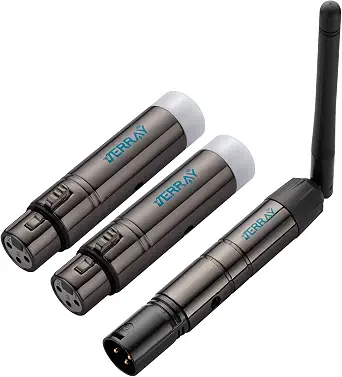
JERRAY 3-Piece Wireless DMX512 Transmitter and Receiver Set
The JERRAY set keeps the system to one transmitter and two receivers, a useful fit for a DJ or small venue linking a few lights without running DMX XLR cables between them. All three units have included power adapters, so it is ready for fixed powered positions, but none has a built-in battery. That makes it less flexible for fixtures far from outlets than CHINLY’s five-receiver kit, whose receivers can run on their internal batteries. JERRAY still includes the familiar 126-channel frequency hopping and seven group IDs, giving small setups room to separate wireless networks. Its claimed 1,000 ft range is presented without conditions in the supplied data, so buyers should not treat it as directly comparable to the line-of-sight figures listed for CHINLY.
Pros:- Includes one transmitter and two receivers
- Adapters are included for all three units
- Supports 126-channel frequency hopping
- Seven group IDs allow separate wireless setups
Cons:- All units require external power during operation
- Only two receivers are included
- The claimed 1,000 ft range has no stated test conditions
Best for: DJs and small venue operators connecting two DMX fixtures near available power outlets
Not ideal for: Mobile crews placing fixtures away from outlets or needing more than two receivers
- Quantity:3 units
- Included units:1 transmitter and 2 receivers
- Wireless frequency:2.4 GHz ISM
- Frequency hopping:126 channels
- Group IDs:7
- Claimed range:1,000 ft
- Power:3 power adapters included; no built-in battery
- Compatibility:DMX512 lighting
Our verdict“Pick this compact set for a few powered fixtures, but choose a battery-equipped CHINLY kit when outlet access is limited.”
Rockville DMX-WTR 2.4GHz Wireless DMX Lighting Transmitter
The Rockville DMX-WTR stands out for a stated range of up to 1,968 feet, the longest distance listed among these picks. Its support for up to 25 receivers and seven groups suits a venue that needs to send control data to many fixtures across a wide area. Frequency hopping across 126 channels is intended to help manage interference, while the LED display gives a quick view of status. Compared with the JERRAY Wireless DMX512 Kit with 1 Transmitter and 3 Receivers, Rockville prioritizes reach and receiver capacity over an included multi-receiver package. The tradeoff is battery power: buyers need to plan for power and runtime, and the stated maximum range may depend on clear conditions. Its compact 0.4-pound body is easier to place than a larger kit, but this listing provides no battery runtime details.
Pros:- Stated wireless range reaches up to 1,968 feet
- Supports up to 25 receivers
- Seven lighting groups allow separate setups
- Compact 0.4-pound body with a three-color LED display
Cons:- Battery power requires planning for runtime and replacement or recharging
- No battery runtime is specified
- The long stated range depends on operating conditions
Best for: Lighting operators who need to link many DMX receivers across a large venue and can manage battery power.
Not ideal for: Installers who need continuous, unattended operation or a ready-to-run transmitter-and-receiver bundle with specified adapters.
- Wireless frequency:2.4 GHz
- DMX protocol:DMX512
- Wireless range:Up to 1,968 ft (600 m)
- Lighting groups:Up to 7
- Receivers per transmitter:Up to 25
- Frequency hopping:126 channels; 1,100 hops per second
- Power:Lithium-based battery
- Dimensions and weight:4.7 × 3.7 × 3.7 in; 0.4 lb
Our verdict“Choose the Rockville DMX-WTR when long stated range and support for many receivers matter more than continuous AC power.”
JERRAY Wireless DMX512 Kit with 1 Transmitter and 3 Receivers
The JERRAY kit is a practical fit for fixed or long-running setups because its four included adapters power the transmitter and three receivers without charging batteries. Its 400-meter line-of-sight range, seven groups, and frequency hopping cover the core needs of a modest stage rig. Compared with the Donner DMX512 Wireless Controller with Light Dome, it includes fewer receivers, but its AC-powered design is clearer for installations where units stay plugged in. The limitation is placement: every unit needs access to AC power, so a cable-free DMX link still leaves power cables to route. The range is specified for line of sight, which may not match a crowded venue with obstacles. For a compact system with three remote endpoints and dependable mains access, the included adapters make this a more straightforward package than products with unclear contents.
Pros:- Includes one transmitter, three receivers, and four power adapters
- AC power supports operation without battery charging
- Seven independent groups support separate lighting setups
- Uses 2.4 GHz frequency hopping across 126 channels
Cons:- Every transmitter and receiver needs access to AC power
- The stated 400-meter range is line of sight
- Three included receivers may not cover larger rigs
Best for: Installers and small venue operators with outlets near each fixture who want a multi-receiver system for long sessions.
Not ideal for: Mobile lighting crews placing fixtures far from outlets or needing more than three receivers in the box.
- Wireless frequency:2.4 GHz ISM
- Transmission range:Up to 400 meters line of sight
- Frequency hopping channels:126
- Group IDs:7
- Connectors:3-pin XLR male and female
- Power:AC-powered
- In the box:1 transmitter, 3 receivers, 4 power adapters
- Warranty:1 year
Our verdict“Pick this JERRAY kit for a three-receiver setup that can stay plugged into AC power throughout a show or installation.”
Donner DMX512 Wireless Controller with Light Dome – 1 Transmitter & 7 Receivers for LED Stage Lighting
With seven receivers included, this Donner kit is aimed at operators who want to connect several fixtures without assembling a system from separate parts. Each receiver has a light dome and tricolor LED indicators, which can make unit status easier to see around a stage. Its stated 500-meter visible range and 126-channel automatic frequency jumping give it more reach on paper than the three-receiver JERRAY kit, while also covering seven selectable groups. That larger bundle comes with a power-planning cost: all eight units rely on external adapters, with no built-in battery. Compared with the Rockville DMX-WTR, Donner supplies more receivers in the box, while Rockville claims a longer range and supports up to 25 receivers. This Donner makes the most sense when the seven included endpoints match the rig; it is less flexible for battery-powered placement.
Pros:- Includes seven receivers for connecting multiple fixtures
- Light domes and tricolor LEDs provide visible receiver status
- Stated visible range is up to 500 meters
- 126 channels and seven selectable groups support multiple links
Cons:- All units require external power adapters
- No built-in battery for fixtures placed away from outlets
- Compatibility is limited to DMX512 devices
Best for: Small stage and event crews who need one transmitter and seven receivers for DMX512 fixtures near available power.
Not ideal for: Mobile operators who need battery-powered endpoints or buyers whose fixtures do not support DMX512.
- Wireless frequency:2.4 GHz
- Channels:126
- Communication distance:500 m (visible)
- Group IDs:7 selectable groups
- Transmitter count:1
- Receiver count:7
- Power supply:External power adapters required; no built-in battery
- Package contents:1 transmitter, 7 receivers, 8 power adapters
Our verdict“Choose the Donner kit when seven included receivers and visible status indicators suit your DMX512 rig and AC power is available.”
JERRAY 2.4 GHz Wireless DMX512 Transmitter and Receiver Set for Stage Lighting, 8 Pieces
The JERRAY 8-piece listing describes a familiar wireless DMX approach: 2.4 GHz operation, automatic hopping across 126 channels, and seven ID groups. A seven-color status display is a useful distinction from the three-color indicators on the Rockville DMX-WTR, giving operators more visible status cues. But the package description is inconsistent: the title says eight pieces, while the listed contents specify one receiver and one adapter. That uncertainty makes it harder to compare this with the Donner kit, whose one-transmitter, seven-receiver package is explicitly stated. Like both JERRAY and Donner alternatives, this set also requires external power and has no built-in battery. It may suit a buyer who can confirm the actual contents before purchase, but the available data does not establish how many fixtures the set will serve.
Pros:- Automatic frequency hopping across 126 channels
- Seven wireless ID groups
- Seven-color status display
- Supports wireless DMX512 control without long DMX cable runs
Cons:- Package contents conflict between the eight-piece title and the listed one-receiver contents
- Requires power adapters and has no built-in battery
- Receiver capacity cannot be determined from the listed contents
Best for: Buyers who can confirm the package contents with the seller and want a 2.4 GHz DMX512 link with visible status.
Not ideal for: Production crews who need a known receiver count, battery-powered placement, or a complete multi-fixture kit without verifying its contents.
- Protocol:DMX512
- Frequency:2.4 GHz
- Frequency channels:126 with automatic frequency hopping
- Wireless ID groups:7
- Status display:Seven colors
- Power:Power adapter required; no built-in battery
- Listed weight:1.96 lb
- Dimensions:6.69 × 6.3 × 3.15 in
Our verdict“Consider this JERRAY set only if you can verify the receiver count first and have power available at each unit.”
Wireless DMX512 Transmitter Receiver Kit, 2.4GHz Stage Lighting Control System – 1 Transmitter & 3 Receivers, 7 Groups ID, 126 Channels
This kit pairs one transmitter with three receivers, giving a small rig a direct path to wireless DMX control without the larger bundle of the seven-receiver Donner system. Its listed plug-and-play ID matching can help beginners get a basic setup running, and seven group IDs provide some separation when multiple systems share a venue. The product data gives no transmission range, power method, connector details, or frequency-hopping behavior, so it is harder to judge against the JERRAY three-receiver kit, which specifies AC power, 3-pin XLR connectors, and line-of-sight range. The listing claims stable operation in busy wireless environments, but does not provide specific supporting range or interference figures. This is a concise option for a straightforward three-receiver setup, though buyers who need firm installation details should favor a better-specified kit.
Pros:- Includes one transmitter and three receivers
- Seven group IDs allow separate system assignments
- ID matching is described as a simple setup process
- Supports up to 126 DMX channels
Cons:- No wireless range is specified
- Power method and connector details are not provided
- The busy-venue stability claim is not accompanied by hopping or interference specifications
Best for: Beginner DJs and small event operators who need wireless DMX for three fixtures and value a simple ID-matching setup.
Not ideal for: Installers who need a stated range, defined power and connector details, or evidence of interference handling before planning a venue.
- Frequency:2.4 GHz
- Channels supported:126
- Transmitter count:1
- Receiver count:3
- Groups ID:7
- Weight:1.48 lb
- Package dimensions:7.05 × 5.98 × 2.72 in
Our verdict“Choose this kit for a basic three-receiver setup if the seller can confirm its power, connector, and range details for your rig.”

How We Picked
I compared the 15 listed products by the factors that affect a wireless DMX setup: how many receivers are included, whether receiver power is described, what control features are specified, and how easily a buyer can match the kit to a small or large fixture count. I gave more weight to clearly stated distinctions, such as Lixada’s LCD and adjustable power repeater or CHINLY’s battery-powered receivers, than to broad claims shared by many 2.4 GHz kits. Build descriptions such as metal housings were treated as useful context, but not as proof of range or reliability.
The ranking reflects practical fit rather than a claim that every product has been independently tested. The Donner eight-piece kit leads as a broadly useful multi-fixture package; Lixada ranks highly for hands-on control information; and battery-powered CHINLY is a targeted pick for flexible placement. Smaller receiver bundles rank better for lean rigs, while products whose listings disclose fewer distinguishing details are harder to recommend ahead of comparable sets. Buyers should confirm connector type, operating mode, power needs, and group behavior with the seller before choosing.
Factors to Consider When Choosing Wireless DMX Lighting Transmitters
Choosing wireless DMX is a system decision: the transmitter, receivers, fixtures, and power plan all need to work together. I would start with the layout and operating conditions, then compare feature claims against the details your lights require.
Count fixtures before choosing receiver quantity
Write down how many fixtures need wireless DMX and whether any will remain wired. A one-transmitter, seven-receiver bundle can simplify a larger rig, but unused receivers add little value if you only control two lights. Also check whether each fixture needs its own receiver or can share a DMX link through its output; fixture manuals usually settle this. Leave room for a spare if a failed receiver would interrupt a show. Small three-piece sets can be easier to pack and manage for a compact rig. Match the included receiver count to your actual signal layout, not the kit’s headline piece count.
Check fixture compatibility at the connector and mode level
“DMX512” and “2.4 GHz” do not guarantee that every transmitter will pair with every wireless fixture. Confirm the connector gender and pin configuration, whether the product acts as transmitter, receiver, or both, and what pairing or group modes your lights support. Some fixtures have wireless DMX built in, which may avoid the need for a separate receiver but only if their wireless mode matches the controller. Ask the seller for the manual when a listing leaves these details unclear. Avoid assuming that a familiar brand name resolves compatibility. A quick compatibility check can prevent buying a bundle that cannot join your existing system.
Plan power and placement together
Every receiver needs power somehow, and a wireless link does not remove that requirement. Battery-powered receivers can help when fixtures sit far from convenient outlets, though battery runtime, charging method, and replacement needs deserve a close look. For powered receivers, count the outlets and extension runs in the planned positions before setting up. Keep adapters and receiver bodies accessible so a loose connection can be fixed quickly during a show. A compact kit may reduce clutter, while a larger multi-receiver bundle can add more individual power points to manage. Choose based on the actual venue layout rather than the word “wireless” alone.
Treat range claims as venue dependent
Wireless performance changes with walls, crowds, other 2.4 GHz equipment, and transmitter placement. A range figure measured in open space may not reflect a packed venue with metal structures and competing wireless traffic. Position the transmitter with a clear path to receivers where possible, and test the complete rig at the venue before relying on it for a performance. Adjustable transmitter power, as listed for the Lixada, can offer more control over how the link is used, but it does not remove interference. For critical events, retain a wired fallback or spare receiver. Prioritize a reliable layout over the largest advertised distance.
Choose controls that fit your troubleshooting style
An LCD can make status and adjustments easier to read than a minimal transmitter with few visible indicators. Group IDs or channel options can help separate systems when multiple rigs operate nearby, but only if the fixtures and receivers support the same scheme. Before buying, find out how pairing is performed and whether settings survive a power cycle. Simple devices can be faster for a fixed, familiar setup; more controls may help when the rig changes often. Make sure the available controls solve a problem you actually have. Clear setup instructions may matter more than a long feature list when the equipment is shared among crew.
Pay for features that reduce setup friction
Spending more makes sense when a feature removes repeated work or solves a venue constraint, such as a receiver count that fits the whole rig or battery power for lights without outlet access. Metal construction may suit frequent transport, but it does not by itself prove stronger radio performance. An LCD or adjustable power is useful when you expect to change settings and need feedback during setup. For a fixed two-light arrangement, a simpler pair may be easier to pack and maintain. Consider the cost of missing pieces too: extra cables, power supplies, or replacement receivers can shape the real system expense. Compare complete setup needs rather than judging a transmitter by one headline specification.
Frequently Asked Questions
Can I pair one transmitter with receivers from different kits?
Possibly, but the shared 2.4 GHz label alone does not establish compatibility. Wireless DMX products can use different pairing methods, group settings, or protocols even when their connectors look alike. Check both manuals for an explicit compatibility statement and matching mode or ID options. If the manuals are unavailable, ask the seller before combining equipment for a live setup. For a dependable system, matching transmitter and receiver models is the safer starting point.
Do I need one receiver for every light?
That depends on the DMX input and output connections on your fixtures. If a light can pass the DMX signal onward, several fixtures may share a receiver in a wired daisy chain, subject to the fixtures’ instructions and the overall DMX layout. A receiver at each light gives more placement freedom but adds hardware and power needs. Confirm whether the wireless receiver supports the intended connection chain before reducing your receiver count. The number of fixtures alone does not determine how many receivers you need.
Are battery-powered receivers a better choice for mobile DJ setups?
They can be a strong fit when lights move around or sit where outlets are scarce, as with the CHINLY battery-powered set listed here. The tradeoff is another item to charge and monitor, and the product listing should be checked for runtime and charging details. Powered receivers avoid battery upkeep but require accessible outlets or extension runs at each placement. Think through a full event’s operating time, including setup and teardown. Battery operation is useful when it simplifies the venue layout, not automatically for every mobile rig.
Will a wireless DMX transmitter work with lights that have built-in wireless DMX?
It may, if the fixture’s built-in receiver uses a compatible wireless mode and pairing method. Some lights require a specific ecosystem or manufacturer mode, so a generic 2.4 GHz transmitter may not connect. Check the fixture manual for supported transmitters, receiver modes, and group settings before buying an external kit. If the lights already include compatible wireless control, separate receivers may be unnecessary. Verify the exact fixture model rather than relying on a product family name.
Should I use wireless DMX for every fixture at a live event?
That depends on the venue, interference conditions, and how disruptive a signal issue would be. Wireless links can reduce long cable runs and simplify placement, while wired DMX offers a direct connection that avoids radio congestion. A mixed setup can keep fixed or critical fixtures wired and use wireless where cable routing is difficult. Test the full wireless rig in the event space with other equipment running. Keep a practical fallback for the lights that matter most to the show.
Conclusion
For most larger rigs, I recommend the Donner Wireless DMX 8-Piece Kit as the best overall choice because its seven receivers suit multi-fixture setups. The Donner transmitter-and-receiver set is my best value direction for buyers who only need a compact link, while the Lixada is the best premium-style pick here for users who want an LCD and adjustable power. Beginners with a small setup can start with a straightforward two-unit set after checking fixture compatibility and pairing steps. For venue layouts with limited outlets, the CHINLY battery-powered receiver kit is the specific-use choice. Confirm the operating mode, receiver power, and fixture connections before ordering, then choose the bundle that matches your actual layout.
Halloween Picks
halloween
As an affiliate, we earn on qualifying purchases.