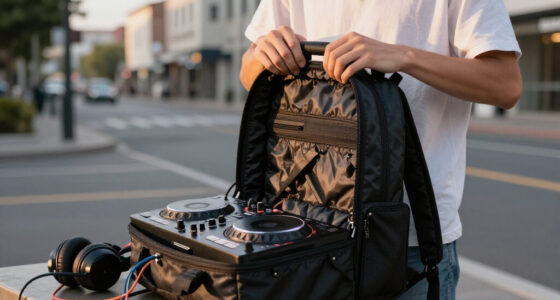
For most compact DJ booths, I’d start with the Pioneer DJ DM-50D: its 5-inch active design balances booth-friendly size with more room to hear a mix than the smaller DM-40D. The Pioneer DJ VM-70 is a stronger fit when you need a larger monitor for a bigger booth, while the Yamaha HS4 suits DJs who want a compact pair for both cueing and critical listening. Choosing between these speakers comes down to booth space, listening distance, connection needs, and how much low-end output you expect from the monitors. Read on for the full comparison, including where Bluetooth, compact drivers, and a PA-style speaker make sense—and where they involve tradeoffs.

Get audio and creator gear delivered free with Prime
- Fast, free delivery on millions of items
- Prime Video, Amazon Music and more included
- Member-only deals all year
Complete the kit


Key Takeaways
- The DM-50D is the most balanced booth pick: its 5-inch format is a practical middle ground between the smaller DM-40D and larger VM-70.
- VM models serve a different purpose from DM desktop speakers: VM-50, VM-70, and VM-80 offer a studio-monitor approach, with larger models better suited to more space and listening distance.
- Bluetooth is a convenience, not a booth requirement: the DM-50D-BT variants suit wireless playback, but DJs should still plan their primary mixer connection around wired inputs.
- Small speakers bring placement advantages with low-end limits: the DM-40D and Hercules DJMonitor 32 are easier to fit in tight spaces, but they are less suited to filling a large booth with bass.
- The Alto TX410 is the outlier: it is a powered PA speaker rather than a nearfield monitor pair, so it fits louder, room-filling needs better than close-range booth monitoring.
| Pioneer DM-50D Active 5-Inch Desktop Monitor and DJ Speakers with TRS Cables, Black |  | Best Overall for a Wired Desktop Booth | Speaker configuration: 2-way active desktop monitor | Woofer: 5 inches | Tweeter: 0.75-inch dome | VIEW LATEST PRICE | See Our Full Breakdown |
| Pioneer DJ DM-40D 4-Inch Active Desktop Monitor Speakers, Pair, Black |  | Best for Beginners and Tight Booths | Quantity: 2 speakers | Speaker size: 4 inches | Tweeter: 19 millimeters | VIEW LATEST PRICE | See Our Full Breakdown |
| Pioneer DJ VM-50 5-Inch Active Studio Monitor Speaker, White |  | Best for a Dedicated DJ Booth Monitor | Speaker type: Active monitor speaker | Woofer: 5.25 inches | Tweeter: 1 inch | VIEW LATEST PRICE | See Our Full Breakdown |
| Ortizan C7 Powered Studio Monitor Speakers, Pair, Black |  | Best Connectivity for a Compact Booth | Quantity: Pair | Mid-bass driver: 3.5 inches | Tweeter: 0.75 inches | VIEW LATEST PRICE | See Our Full Breakdown |
| Pioneer DJ VM-80 8-Inch Active Studio Monitor Speaker |  | Best for Bass-Forward, Larger Booths | Speaker size: 8 inches | Speaker type: Active studio monitor | Amplifier: Class D | VIEW LATEST PRICE | See Our Full Breakdown |
| Pioneer DJ DM-50D-BT 5-Inch Active Bluetooth Monitors, White (Pair) |  | Best Bluetooth Desktop Pick | Speaker type: Active studio monitors | Quantity: 2 speakers | Speaker size: 5 inches | VIEW LATEST PRICE | See Our Full Breakdown |
| Hercules DJMonitor 32 Active Studio Monitor Speakers, 2 x 15 W RMS, Black |  | Best Compact Starter Pair | Speaker type: Active two-way monitor | RMS power: 15 W per speaker | Woofer diameter: 3 inches | VIEW LATEST PRICE | See Our Full Breakdown |
| Pioneer DJ DM-50D 5-Inch Active Desktop Monitor Speakers, Pair, Black |  | Best for DJ and Production Switching | Speaker type: Active desktop monitor speakers | Quantity: 2 monitors | Woofer diameter: 5 inches | VIEW LATEST PRICE | See Our Full Breakdown |
| Pioneer DJ DM-50D-BT 5-Inch Active Monitor Speakers with Bluetooth (Pair) |  | Best Connected Feature Set | Speaker type: Monitor | Quantity: Pair | Woofer diameter: 5 inches | VIEW LATEST PRICE | See Our Full Breakdown |
| Alto TX410 350W 10-Inch Powered PA Speaker |  | Best for Event Booth Monitoring | Speaker type: Powered PA speaker | Amplifier power: 350 W Class-D | Woofer: 10-inch LF driver with 1.4-inch voice coil | VIEW LATEST PRICE | See Our Full Breakdown |
| Pioneer DJ DM-50D 5-Inch Active Desktop Monitor Speakers, Pair, White |  | Best for Flexible Desktop Booths | Quantity: 2 monitors | Woofer: 5 inches | Tweeter: 0.75 inches | VIEW LATEST PRICE | See Our Full Breakdown |
| Pioneer DJ VM-70 6.5-Inch Active Studio Monitor Speaker |  | Best for Larger Booths and Stronger Bass | Woofer: 6.5 inches | Tweeter: 1 inch | Amplifier: Class D | VIEW LATEST PRICE | See Our Full Breakdown |
| Yamaha HS4 Powered Studio Monitors, Black, Pair |  | Best Compact Pair for Tight Booths | Quantity: Pair | Configuration: Two-way, bass-reflex | Woofer: 4.5-inch cone | VIEW LATEST PRICE | See Our Full Breakdown |
| Pioneer DJ VM-50 5.25-Inch Active Studio Monitor Speaker, Black |  | Best for Room-Tuned DJ and Production Use | Woofer: 5.25 inches | Tweeter: 1 inch | Amplifier: Class D | VIEW LATEST PRICE | See Our Full Breakdown |
| DJ monitor speakers for booth setup | Tweeter | Connectivity | Woofer | Amplifier |
|---|---|---|---|---|
| Pioneer DM-50D Active 5-Inch D | 0.75-inch dome | — | 5 inches | Class D |
| Pioneer DJ DM-40D 4-Inch Activ | 19 millimeters | — | — | — |
| Pioneer DJ VM-50 5-Inch Active | 1 inch | RCA | 5.25 inches | Class D |
| Ortizan C7 Powered Studio Moni | 0.75 inches | — | — | — |
| Pioneer DJ VM-80 8-Inch Active | — | — | — | Class D |
| Pioneer DJ DM-50D-BT 5-Inch Ac | — | Bluetooth | — | Built-in Class D |
| Hercules DJMonitor 32 Active S | — | Wired RCA | — | — |
| Pioneer DJ DM-50D 5-Inch Activ | — | Auxiliary, wired | — | Class D |
| Pioneer DJ DM-50D-BT 5-Inch Ac | — | Bluetooth, RCA, mini-jack | — | — |
| Alto TX410 350W 10-Inch Powere | — | Bluetooth streaming and True Wireless Stereo linking | 10-inch LF driver with 1.4-inch voice coil | — |
| Pioneer DJ DM-50D 5-Inch Activ | 0.75 inches | — | 5 inches | — |
| Pioneer DJ VM-70 6.5-Inch Acti | 1 inch | Auxiliary, Bluetooth | 6.5 inches | Class D |
| Yamaha HS4 Powered Studio Moni | 1-inch dome | — | 4.5-inch cone | — |
| Pioneer DJ VM-50 5.25-Inch Act | 1 inch | USB; Bluetooth listed | 5.25 inches | Class D |
More Details on Our Top Picks
Pioneer DM-50D Active 5-Inch Desktop Monitor and DJ Speakers with TRS Cables, Black
The Pioneer DM-50D makes the most sense for a compact booth where you want useful input flexibility and more driver area than a small desktop pair. Its 5-inch woofer and bass-reflex cabinet are better suited to conveying kick and bass than the 4-inch Pioneer DJ DM-40D, while the RCA, mini-jack, and TRS inputs make it easier to connect different booth sources without an extra adapter stage. The included TRS cables are a practical bonus for a compatible balanced connection. This is still a near-field desktop speaker, not a solution for filling a large room, and it offers no wireless input. Choose it over the Ortizan C7 if booth monitoring and straightforward wired connections matter more than Bluetooth and USB; choose the C7 if those digital and wireless options are priorities.
Pros:- RCA, mini-jack, and TRS inputs accommodate a range of wired booth sources.
- Five-inch woofers offer more low-frequency reach than the DM-40D’s 4-inch drivers.
- Bass-reflex design supports fuller bass response in near-field use.
- Included TRS-to-TRS cables simplify compatible connections.
Cons:- Desktop-oriented design is not intended to provide broad coverage in a large space.
- No Bluetooth or other wireless connectivity.
- The listed dimensions call for meaningful tabletop space.
Best for: DJs building a compact, wired tabletop booth who want 5-inch drivers and multiple analog input options.
Not ideal for: DJs who need wireless playback or speakers to cover a large booth or room.
- Speaker configuration:2-way active desktop monitor
- Woofer:5 inches
- Tweeter:0.75-inch dome
- Amplifier:Class D
- DSP sampling rate:96 kHz
- Maximum output power:150 watts
- Inputs:RCA, mini-jack, and TRS
- Dimensions:10.11 x 6.88 x 10.31 inches (D x W x H)
- Included accessories:TRS-to-TRS cables
Our verdict“Choose the DM-50D for a compact wired booth where flexible analog inputs and larger drivers matter more than wireless playback or room-filling output.”
Pioneer DJ DM-40D 4-Inch Active Desktop Monitor Speakers, Pair, Black
The Pioneer DJ DM-40D is the space-conscious choice here: its 4-inch drivers and tabletop format suit a small home booth where larger cabinets would crowd the mixer or laptop. Its switchable DJ and Production modes let a beginner change the voicing for practice or music work without adding separate gear. RCA and auxiliary inputs keep connections simple, and the front headphone socket and level knob make quick booth adjustments convenient. Compared with the 5-inch Pioneer DM-50D, the DM-40D gives up some woofer area and input flexibility, so it is less compelling when low-end presence or TRS connectivity is a priority. It is a practical entry point, but the compact drivers are not a substitute for larger monitors when you need stronger bass monitoring.
Pros:- Compact tabletop cabinets fit crowded desktop DJ setups.
- DJ and Production modes adapt the sound for different tasks.
- Built-in amplification avoids the need for a separate amp.
- Front headphone socket and level control are convenient during practice.
Cons:- Four-inch drivers offer less low-frequency reach than the DM-50D’s 5-inch woofers.
- Inputs are limited to RCA and auxiliary connections.
- Wired-only design has no Bluetooth playback.
Best for: New bedroom and home-booth DJs with limited desk space who want simple powered speakers and switchable sound modes.
Not ideal for: DJs who need stronger low-frequency monitoring, balanced TRS inputs, or wireless playback.
- Quantity:2 speakers
- Speaker size:4 inches
- Tweeter:19 millimeters
- Audio output mode:Stereo
- Sound modes:DJ and Production
- Inputs:RCA and auxiliary
- Mounting type:Tabletop
- Wireless connectivity:Wired only
Our verdict“Pick the DM-40D for an uncomplicated starter booth where compact size and easy controls outweigh deeper bass and broader connectivity.”
Pioneer DJ VM-50 5-Inch Active Studio Monitor Speaker, White
For a booth that needs a monitor designed around DJ and near-field work, the Pioneer DJ VM-50 is a more focused pick than the desktop-oriented DM-40D. Its 5.25-inch woofer, Class D amplification, and DSP are intended to provide balanced sound with a defined low end, helping a DJ hear changes in bass and kick without moving up to a much larger cabinet. The compact shape also suits tabletop placement. Compared with the DM-50D, this listing specifies RCA connectivity rather than a broader range of inputs, so check that it matches your mixer or interface. The single-speaker listing is another key distinction: buyers building stereo monitoring will need to account for that, unlike the DM-40D pair. Its plastic enclosure and lack of water resistance also make it a poor fit for exposed or damp locations.
Pros:- Designed for DJ booth and near-field studio monitoring.
- DSP and Class D amplification support clear, balanced playback.
- A 5.25-inch woofer is larger than the DM-40D’s 4-inch driver.
- Compact cabinet supports flexible tabletop placement.
Cons:- Listing describes a single speaker, unlike the DM-40D pair.
- RCA is the only listed connectivity option.
- Plastic enclosure is not water resistant.
Best for: DJs setting up a dedicated near-field booth who want a compact monitor with a defined low end and can match its RCA connection.
Not ideal for: Buyers seeking a ready-made stereo pair, multiple listed input types, or a speaker for exposed environments.
- Speaker type:Active monitor speaker
- Woofer:5.25 inches
- Tweeter:1 inch
- Amplifier:Class D
- Connectivity:RCA
- Mounting type:Tabletop
- Enclosure material:Plastic
- Color:White
- Warranty:1 year manufacturer
Our verdict“Choose the VM-50 when you want a dedicated compact booth monitor and are comfortable sourcing a second unit for stereo use.”
Ortizan C7 Powered Studio Monitor Speakers, Pair, Black
The Ortizan C7 stands apart from the Pioneer DM-50D by prioritizing connection options in a smaller cabinet. Bluetooth 5.3, USB, RCA, 3.5 mm AUX, and balanced 6.35 mm TRS inputs let a DJ connect a laptop, mixer, or other source with less switching between cables and devices. The 24-bit USB DAC is useful when feeding digital audio directly from a compatible computer. Its 3.5-inch mid-bass drivers and compact dimensions make it easier to fit into a crowded booth than the DM-50D, but that smaller driver size limits low-frequency authority. For bass-heavy DJ material, these are better suited to close-range cue and general monitoring than to judging deep bass with confidence. They also need corded power despite their wireless audio option.
Pros:- Broad connectivity includes Bluetooth 5.3, USB, RCA, AUX, and balanced TRS.
- 24-bit USB DAC supports direct digital audio input.
- Small dimensions can fit tighter surfaces than the Pioneer DM-50D.
- Headphone output adds a convenient monitoring option.
Cons:- Three-and-a-half-inch mid-bass drivers limit low-frequency output compared with 5-inch monitors.
- Bluetooth audio does not remove the need for corded power.
- Not waterproof.
Best for: DJs with a small booth who connect several devices and value Bluetooth, USB, and balanced TRS input flexibility.
Not ideal for: Bass-focused DJs who want fuller low-end monitoring or anyone needing speakers that run without a power cord.
- Quantity:Pair
- Mid-bass driver:3.5 inches
- Tweeter:0.75 inches
- DAC:24-bit
- Bluetooth:Version 5.3
- Inputs:USB, RCA, 3.5 mm AUX, and 6.35 mm balanced TRS
- Output:Headphone output
- Dimensions:5.11 x 5.9 x 7.67 inches
- Power source:Corded electric
Our verdict“Choose the C7 for a cramped booth with varied audio sources, but pick a larger woofer model if dependable low-end monitoring comes first.”
Pioneer DJ VM-80 8-Inch Active Studio Monitor Speaker
The Pioneer DJ VM-80 is the largest-driver option in this batch, making it the better fit when a booth has room for a more substantial monitor and the DJ wants stronger bass presence than the DM-50D or VM-50 can offer. Its 8-inch size and punchy, fast-attacking bass are aimed at clear playback for both DJing and production, while room-tuning options provide a way to adapt its sound to the surrounding space. That flexibility comes with more setup work: unlike the compact DM-40D, the VM-80 may need adjustment before it sounds right in a particular booth. The supplied product data does not specify its inputs, dimensions, or output power, so buyers should verify those details against their intended placement and equipment. This is a single-speaker listing, not a ready-made pair.
Pros:- Eight-inch speaker size offers a larger-driver alternative to the VM-50 and DM-50D.
- Punchy, fast-attacking bass suits DJ playback and music production.
- Room-tuning options allow sound adjustment for the booth.
- Designed for both DJing and production.
Cons:- Larger size may be difficult to accommodate on a compact desktop booth.
- Room tuning can require setup adjustments.
- Product data does not specify connectivity or dimensions, and the listing is for one speaker.
Best for: DJs with a larger booth who want more substantial bass monitoring and are willing to adjust room tuning.
Not ideal for: Small desktop setups, buyers seeking a stereo pair in one listing, or anyone needing clearly specified connection details before purchase.
- Speaker size:8 inches
- Speaker type:Active studio monitor
- Amplifier:Class D
- Color:Black
- Intended uses:DJing and music production
- Sound characteristics:Clear audio with punchy, fast-attacking bass
- Tuning:Room tuning options
Our verdict“Choose the VM-80 for a roomier booth where larger-driver bass and room adjustment matter more than compact placement or plug-and-play simplicity.”
Pioneer DJ DM-50D-BT 5-Inch Active Bluetooth Monitors, White (Pair)
The DM-50D-BT suits a compact DJ booth that doubles as a listening or production desk. Its 5-inch drivers and DSP tuning aim for balanced monitoring with more low-end presence than the smaller Hercules DJMonitor 32, while Bluetooth makes casual playback from a phone or laptop simple. Built-in Class D amplification also means you can connect compatible audio gear without adding a separate amp. The tradeoff is that this remains a tabletop monitor pair, not a room-filling PA like the Alto TX410; it is better suited to nearfield listening than sound for a crowd. You will also need a power outlet, and the listed dimensions and 18.9-pound weight call for a stable desk or booth surface. Choose it for wireless convenience, not portability or weather protection.
Pros:- DSP tuning supports clear, balanced monitoring for DJ practice and production.
- Bluetooth adds convenient wireless playback from compatible devices.
- Built-in Class D amplification removes the need for a separate amplifier.
- 5-inch drivers and DJ-tuned low frequencies add bass presence in small rooms.
Cons:- Nearfield desktop design is not a substitute for a PA speaker at events.
- Requires corded electric power and is not water resistant.
- The pair’s listed size and weight require a sturdy booth or desk.
Best for: Bedroom and home DJs who want 5-inch nearfield monitors for booth practice, with Bluetooth for casual wireless playback.
Not ideal for: Mobile DJs needing loud audience coverage or frequent outdoor use; this pair is tabletop-oriented, cord-powered, and not water resistant.
- Speaker type:Active studio monitors
- Quantity:2 speakers
- Speaker size:5 inches
- Amplifier:Built-in Class D
- Connectivity:Bluetooth
- Audio output:Stereo
- Mounting:Tabletop
- Color:White
- Weight:18.9 pounds
Our verdict“Choose this pair if you want Bluetooth-enabled 5-inch monitors for a home DJ booth, rather than speakers for audience coverage.”
Hercules DJMonitor 32 Active Studio Monitor Speakers, 2 x 15 W RMS, Black
The Hercules DJMonitor 32 is the small-footprint choice for a first DJ booth or a desk where larger monitors will not fit. Its 3-inch woofers, shifted tweeters, and dual bass ports provide stereo monitoring in a two-way design, while the included speaker-to-speaker cable simplifies setup. Compared with the Pioneer DJ DM-50D, it gives up driver size and selectable DJ/Production modes, so it is less suited to buyers seeking fuller bass or more adaptable listening. Its 15 W RMS per speaker is aimed at personal listening and small setups, not playing over a room full of people. RCA-only wired connectivity also rules out Bluetooth convenience. I would pick it for space-conscious practice, but skip it if you need substantial low-end output or flexible device connections.
Pros:- Compact 3-inch two-way design fits smaller desks and booth surfaces.
- Dual bass ports support low-frequency output from the small enclosures.
- Includes power and speaker-to-speaker cables for a straightforward wired setup.
- Stereo active monitors suit personal DJ practice and music listening.
Cons:- RCA wired connectivity provides no Bluetooth option.
- 3-inch woofers offer less bass scale than the Pioneer DJ DM-50D’s 5-inch drivers.
- 15 W RMS per speaker is intended for personal listening, not crowd coverage.
Best for: New bedroom DJs and desk-based learners who need a compact stereo pair for practicing at close range.
Not ideal for: DJs who want deeper bass, wireless playback, or enough output to cover an event space; its 3-inch woofers and RCA connection limit that use.
- Speaker type:Active two-way monitor
- RMS power:15 W per speaker
- Woofer diameter:3 inches
- Tweeter diameter:1 inch
- Frequency response:60 Hz
- Impedance:8 ohms
- Connectivity:Wired RCA
- Bass ports:Dual
- Weight:3 kg
Our verdict“Pick the DJMonitor 32 for a compact, wired practice setup when desk space matters more than bass depth or event-level output.”
Pioneer DJ DM-50D 5-Inch Active Desktop Monitor Speakers, Pair, Black
For a booth that also serves as a production desk, the DM-50D earns its place through selectable DJ and Production modes. Those presets let you change the speaker voicing for practice or production without adding another pair, while Class D amplification and 5-inch woofers provide a practical nearfield setup. Its convex diffuser is designed to help high frequencies spread clearly across the listening position. Unlike the Bluetooth-equipped DM-50D-BT, this version is wired only, so phone playback needs a cable and compatible connection. It also cannot match the Alto TX410 for filling a venue: the DM-50D is a tabletop monitor, not a powered PA. I would choose this black pair when switching between booth duties and desk work matters more than wireless convenience or event coverage.
Pros:- Selectable DJ and Production modes adapt the sound to different listening tasks.
- 5-inch woofers provide fuller bass presence than the Hercules DJMonitor 32’s 3-inch drivers.
- Built-in Class D amplification connects directly to compatible audio equipment.
- Convex diffuser design supports clear high-frequency listening.
Cons:- No wireless connectivity, unlike the DM-50D-BT.
- Tabletop nearfield design is not intended for audience coverage.
- Not water resistant.
Best for: Home DJs who also produce music at the same desk and want DJ and Production sound modes in one wired pair.
Not ideal for: Buyers who need Bluetooth playback or speakers to project across a venue; this is a wired tabletop monitor, not a PA.
- Speaker type:Active desktop monitor speakers
- Quantity:2 monitors
- Woofer diameter:5 inches
- Tweeter diameter:0.75 inches
- Amplifier:Class D
- Audio modes:Production and DJ
- Connectivity:Auxiliary, wired
- Maximum output power:25 watts
- Color:Black
Our verdict“Choose the DM-50D if your booth doubles as a production desk and wired mode-switching matters more than Bluetooth.”
Pioneer DJ DM-50D-BT 5-Inch Active Monitor Speakers with Bluetooth (Pair)
This DM-50D-BT pair is the most flexible desktop option here for DJs who use several sources. Alongside Bluetooth, RCA, and mini-jack inputs, it has a front-panel level knob and headphone socket, making quick listening changes easier at a crowded booth. DJ and Production modes also help it serve both practice and music work. Compared with the wired DM-50D, this version adds wireless playback and more connection choices; compared with the Hercules DJMonitor 32, its 5-inch woofers offer a larger driver platform for nearfield monitoring. Those conveniences do not turn it into a PA, though: the Alto TX410 is the better fit when the goal is venue coverage. It remains cord-powered and is not water resistant, so I would keep it in a home or indoor booth setup.
Pros:- Bluetooth, RCA, and mini-jack inputs accommodate several playback sources.
- DJ and Production modes support booth practice and music work.
- Front-panel level control and headphone socket make quick adjustments convenient.
- 5-inch woofers offer a larger monitor platform than the Hercules DJMonitor 32.
Cons:- Requires corded electric power.
- Not water resistant, limiting use around exposed outdoor setups.
- Tabletop monitors are not a replacement for the Alto TX410’s PA-style venue coverage.
Best for: Home DJs with a mixer, computer, and phone who want multiple wired inputs, Bluetooth, and front-panel headphone access.
Not ideal for: Mobile and outdoor DJs who need crowd-filling output or water protection; this is a cord-powered tabletop monitor pair.
- Speaker type:Monitor
- Quantity:Pair
- Woofer diameter:5 inches
- Tweeter diameter:0.75 inches
- Connectivity:Bluetooth, RCA, mini-jack
- Audio output:Stereo
- Controls:Buttons and front-panel level knob
- Headphone output:Front-panel headphone socket
- Weight:20.5 pounds
Our verdict“Choose this version if a home booth needs several connection options and front-panel controls more than portable PA output.”
Alto TX410 350W 10-Inch Powered PA Speaker
The Alto TX410 fills a different role from the desktop pairs: it is a powered PA speaker that can serve as a floor monitor or a pole-mounted sound source. Its 10-inch woofer and 350 W Class-D amplification make it a stronger match for mobile DJs who need sound beyond the booth, while the built-in two-channel mixer handles microphone, line-level, and Bluetooth inputs. True Wireless Stereo linking adds a way to pair compatible speakers without an audio cable between them. Compared with the Pioneer DJ DM-50D-BT, the TX410 is built for event-scale use, not precise close-range desk monitoring; it also takes up more booth space and is a single speaker rather than a stereo monitor pair. Its power cord and lack of water resistance limit where it can be used.
Pros:- 10-inch woofer and 350 W Class-D amplification suit event and practice-space use.
- Can operate as a floor wedge monitor or mount on a pole.
- Two-channel mixer supports microphone, line-level, and Bluetooth inputs.
- Bluetooth streaming and True Wireless Stereo linking support flexible playback setups.
Cons:- A single PA speaker does not provide the same stereo nearfield setup as the Pioneer DJ DM-50D pair.
- Larger PA format is less suited to a compact desktop booth.
- Requires corded power and is not water resistant.
Best for: Mobile DJs who need one powered speaker for floor monitoring or pole-mounted event sound, with onboard mixing and Bluetooth.
Not ideal for: Desk-based producers seeking a compact stereo nearfield pair or anyone needing water-resistant, battery-powered outdoor gear.
- Speaker type:Powered PA speaker
- Amplifier power:350 W Class-D
- Woofer:10-inch LF driver with 1.4-inch voice coil
- HF driver:1-inch titanium diaphragm compression driver
- Dispersion:90° x 60°
- Mixer:Built-in 2-channel mixer
- Connectivity:Bluetooth streaming and True Wireless Stereo linking
- Mounting:36 mm pole socket or wedge monitor
- Weight:6.8 kg
Our verdict“Choose the TX410 when your booth speaker must also serve as an event PA or floor monitor, not as a compact production reference pair.”
Pioneer DJ DM-50D 5-Inch Active Desktop Monitor Speakers, Pair, White
The DM-50D is a practical choice for a compact booth that doubles as a production desk. Its DJ/Production mode switch lets you change the speaker’s tuning for mixing or closer listening to recordings, while the 5-inch woofers offer a more substantial desktop setup than the smaller Yamaha HS4. Multiple inputs make it easier to connect different sources, and the front headphone output and level knob keep routine adjustments within reach. Compared with the Pioneer DJ VM-50, this pair emphasizes convenient controls and connections over a more room-adaptable studio-monitor setup. Its tabletop design and corded power make it a fit for a fixed indoor station, not a portable or outdoor rig. Choose it for flexibility; skip it if you need wireless listening or a small footprint above all.
Pros:- Selectable DJ and Production modes suit booth playback and production listening.
- RCA, 3.5 mm mini-jack, and TRS inputs accommodate varied audio sources.
- Front-panel headphone output and level knob simplify quick adjustments.
- Built-in amplification avoids the need for a separate amplifier.
Cons:- The tabletop speakers require a fixed, indoor setup and corded power.
- The 5-inch cabinet takes more desk space than the compact Yamaha HS4 pair.
Best for: Home and bedroom DJs who want a stationary 5-inch pair for both booth practice and occasional music production, with easy-access headphone and level controls.
Not ideal for: DJs who need battery-powered or weather-resistant speakers, or who have very limited tabletop space.
- Quantity:2 monitors
- Woofer:5 inches
- Tweeter:0.75 inches
- Maximum output power:25 watts
- Inputs:RCA, 3.5 mm mini jack, TRS
- Controls:Production/DJ mode switch; front-panel level knob
- Headphone output:Yes
- Dimensions:7 × 11 × 10 inches
Our verdict“Choose the DM-50D if you want a versatile, easy-to-control desktop pair for a fixed DJ and production station.”
Pioneer DJ VM-70 6.5-Inch Active Studio Monitor Speaker
For a booth with room for larger cabinets, the VM-70 is the lineup’s bass-forward choice. Its 6.5-inch woofer and 100-watt maximum output give it more headroom on paper than the 5.25-inch Pioneer DJ VM-50, making the VM-70 a better fit for DJs who want fuller low-end presence without moving to a large PA speaker. DSP tuning also helps adapt the sound to the room, which is useful when speakers sit close to walls or in an irregular booth. It is designed to serve both DJ monitoring and music production, rather than focusing on desktop convenience like the DM-50D’s front controls. The tradeoff is size and power dependence: at 21 pounds, it is less suited to tight desks or frequent repositioning, and it needs a corded connection.
Pros:- 6.5-inch woofer offers a larger low-frequency driver than the VM-50.
- 100-watt maximum output provides greater stated headroom than the smaller models here.
- DSP tuning can help tailor playback to the room.
- Built for both DJ monitoring and music production.
Cons:- Its 21-pound weight and larger cabinet demand more booth space.
- Corded electric power limits placement away from outlets.
- Bluetooth range is listed as 10 meters.
Best for: DJs with a roomy fixed booth who want a larger woofer, more stated output, and DSP room adjustment for DJ monitoring and production.
Not ideal for: Bedroom DJs with shallow desks, or mobile users who need lightweight speakers that can operate without mains power.
- Woofer:6.5 inches
- Tweeter:1 inch
- Amplifier:Class D
- Maximum output power:100 watts
- Frequency response:36 kHz (as listed)
- Connectivity:Auxiliary, Bluetooth
- Weight:21 pounds
- Power source:Corded electric
Our verdict“Pick the VM-70 for a spacious, fixed booth where its larger woofer and higher stated output matter more than compact placement.”
Yamaha HS4 Powered Studio Monitors, Black, Pair
The Yamaha HS4 earns its place for booths where monitor size is the main constraint. Each speaker uses a 4.5-inch woofer and 1-inch tweeter, giving you a two-way powered pair in a more compact format than the Pioneer DJ DM-50D or the larger VM-70. Room-control and high-trim response controls offer some adjustment for placement and room character, while XLR/TRS, RCA, and stereo mini inputs make it adaptable to different booth sources. The supplied anti-slip pads and cables are useful for a straightforward tabletop setup. Compared with the DM-50D, though, the HS4 does not list a dedicated DJ/Production mode switch or a front headphone output, so it gives up some booth-side convenience. Its 4.5-inch woofer and 26-watt output also make it a more restrained choice for DJs seeking strong low-end impact.
Pros:- Compact 4.5-inch two-way design suits limited desk and booth space.
- Room-control and high-trim settings allow response adjustments.
- XLR/TRS combo, RCA, and stereo mini inputs support several source types.
- Includes anti-slip pads and connection cables for tabletop placement.
Cons:- The 26-watt output and 4.5-inch woofer are less suited to bass-heavy, high-level booth playback than the VM-70.
- No front headphone output or DJ/Production mode switch is listed.
- Designed for indoor use and not water resistant.
Best for: Bedroom DJs and compact-controller users who need a small powered pair with multiple wired inputs and basic room-response adjustment.
Not ideal for: DJs who prioritize forceful bass, higher output, or front-panel headphone monitoring in a busy booth.
- Quantity:Pair
- Configuration:Two-way, bass-reflex
- Woofer:4.5-inch cone
- Tweeter:1-inch dome
- Frequency response:60 Hz–22 kHz (-10 dB)
- Output power:26 W
- Inputs:XLR/TRS combo, RCA, stereo mini
- Controls:Room control and high-trim response
Our verdict“Choose the HS4 when saving booth space and keeping flexible wired connections matter more than low-end weight or dedicated DJ controls.”
Pioneer DJ VM-50 5.25-Inch Active Studio Monitor Speaker, Black
The VM-50 is a middle ground for DJs who want a monitor built for booth use but also value room adjustment for production. Its 5.25-inch woofer sits between the compact Yamaha HS4 and the larger Pioneer DJ VM-70, while DSP and room-tuning options let you tailor playback to the listening space. Class D amplification and a tabletop cabinet keep it suited to near-field monitoring without the VM-70’s larger footprint. Compared with the DM-50D, the VM-50 leans more toward adjustable studio monitoring than quick desktop operation: the DM-50D lists a front headphone output and level control, while those conveniences are not specified here. The VM-50’s listed USB connectivity and Bluetooth may appeal to flexible setups, but the supplied data does not detail its input selection. Its corded power and indoor-only build also rule out outdoor use.
Pros:- 5.25-inch woofer offers a midpoint in size between the HS4 and VM-70.
- DSP and room-tuning options help adapt playback to the listening space.
- Designed for both DJ monitoring and near-field music production.
- Aluminum enclosure and 12.2-pound weight suit a fixed tabletop setup.
Cons:- Corded electric power limits placement flexibility.
- Not water resistant, so it is unsuitable for outdoor booth setups.
- The listed connectivity details do not specify a full set of wired input types.
Best for: DJs and home producers who want a tabletop monitor between compact desktop speakers and larger 6.5-inch models, with DSP room tuning.
Not ideal for: Buyers who need a clearly documented range of wired inputs, front-panel headphone convenience, or speakers for outdoor/mobile use.
- Woofer:5.25 inches
- Tweeter:1 inch
- Amplifier:Class D
- Maximum output power:60 watts
- Audio output mode:Stereo
- Enclosure material:Aluminum
- Connectivity:USB; Bluetooth listed
- Weight:12.2 pounds
Our verdict“Choose the VM-50 if you want a room-adjustable 5.25-inch monitor for a fixed DJ and production setup, rather than the DM-50D’s more accessible desktop controls.”
How We Picked
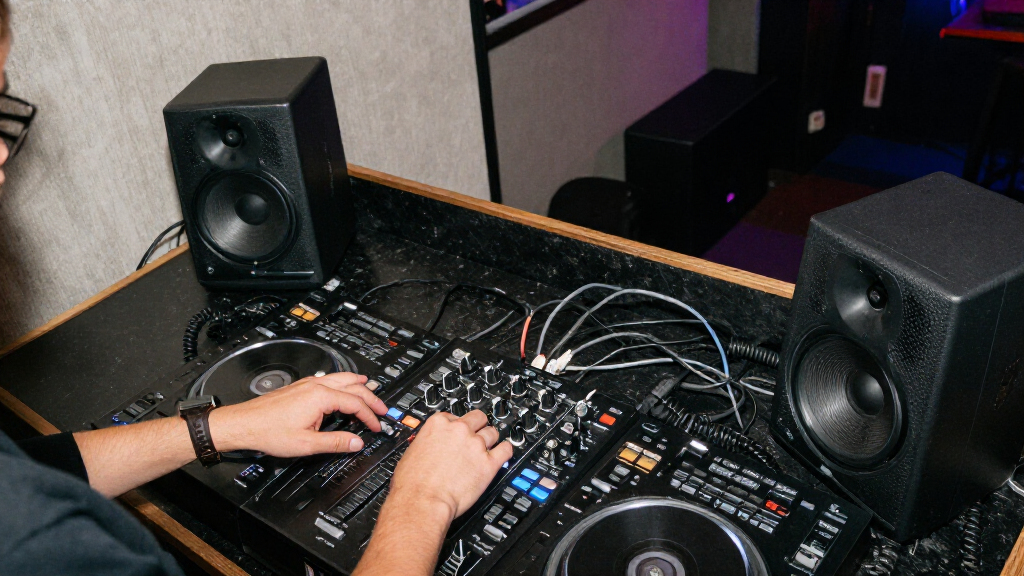
I ranked these options for booth use, not for studio mixing in isolation. The main criteria were footprint and likely fit near decks, driver size as a guide to output and low-frequency reach, active-speaker convenience, and the usefulness of available connections for a DJ mixer and secondary playback sources. I also separated nearfield monitor pairs from the Alto TX410, whose PA format serves a different listening distance and coverage goal.
The ranking favors models that offer a practical balance for common home and compact booth setups. Smaller speakers rank well when space and close listening matter, but not when buyers expect substantial bass or high output. Larger VM models rank higher for booths that can accommodate them, while Bluetooth versions gain convenience rather than a blanket performance advantage. Product names in this lineup include duplicate DM-50D configurations and color variants; I treat them as distinct listings, but their shared core model does not make each one a separate acoustic category.
| DJ monitor speakers for booth setup | Amplifier |
|---|---|
| Pioneer DM-50D Active 5-Inch D | Class D |
| Pioneer DJ DM-40D 4-Inch Activ | — |
| Pioneer DJ VM-50 5-Inch Active | Class D |
| Ortizan C7 Powered Studio Moni | — |
| Pioneer DJ VM-80 8-Inch Active | Class D |
| Pioneer DJ DM-50D-BT 5-Inch Ac | Built-in Class D |
| Hercules DJMonitor 32 Active S | — |
| Pioneer DJ DM-50D 5-Inch Activ | Class D |
| Pioneer DJ DM-50D-BT 5-Inch Ac | — |
| Alto TX410 350W 10-Inch Powere | — |
| Pioneer DJ DM-50D 5-Inch Activ | — |
| Pioneer DJ VM-70 6.5-Inch Acti | Class D |
| Yamaha HS4 Powered Studio Moni | — |
| Pioneer DJ VM-50 5.25-Inch Act | Class D |
Factors to Consider When Choosing DJ Monitor Speakers For Booth Setups
Before choosing a model, I’d match the speaker to the booth and the way you listen. Driver size alone cannot tell you whether a speaker will work well at your position: distance, room reflections, mixer outputs, and placement all change the result.
Match Speaker Size to Listening Distance
A booth monitor usually sits closer to the listener than a living-room speaker, so a compact model can work well without filling the whole room. As the distance grows, a small speaker may sound less convincing at the same listening level, especially when the booth is open to a larger space. Larger drivers can offer more output and low-frequency reach, but they need room and sensible positioning. Avoid buying the biggest speaker simply because the number looks reassuring; excessive output close to your ears can make long sessions tiring. Measure the distance from the speaker fronts to your usual standing or seated position before choosing. If you also want sound for guests across the room, treat that as a separate coverage need rather than assuming nearfield monitors will do both jobs.
Plan Around the Mixer’s Outputs
Check what your mixer actually provides before choosing speakers, including connector type and whether you need a cable for each channel. A speaker may have the right general category of input yet still require an adapter or a different cable to connect cleanly. Keep the left and right signal paths simple, and avoid relying on Bluetooth as the main monitoring link when timing and dependable playback matter. Wireless playback can be useful for a phone or casual listening, but it does not replace a planned wired connection from the DJ setup. Leave room for cable bends and power leads behind the speakers, particularly in a booth pushed against a wall. A little connection planning can prevent a compact setup from becoming cluttered or awkward to troubleshoot.
Treat Bass Expectations Separately From Driver Size
Small monitors can make cueing and beatmatching clear at close range, but that does not mean they will reproduce deep bass with the weight of a subwoofer or a larger system. Booth surfaces and nearby walls can also exaggerate some bass notes while masking others, so a louder or boomier sound is not automatically more accurate. If low-end detail matters, prioritize clear placement and listening position before adding more output. A subwoofer may be an option in a room-based setup, but it adds space, cabling, and level-matching work that may not suit a compact booth. Avoid choosing solely by wattage or driver diameter; neither figure alone describes how the speaker will sound at your distance. Decide whether you need bass for checking a mix or bass for room impact, since those are different jobs.
Account for Booth Placement and Isolation
Speakers placed directly on a hard desk or shelf can send vibration into the booth and change what you hear. Leave space around the cabinets where the design and room allow, and avoid blocking ports or controls with decks and other gear. Angling the speakers toward your listening position can help keep the sound balanced without turning the level up unnecessarily. Stands or isolation pads may reduce mechanical coupling, but they also need to fit securely and keep the speakers at a useful height. If the booth is shallow, check cabinet depth as well as width; rear connections and cables need space too. Good placement can improve a modest pair more than upgrading to a larger model that does not fit properly.
Choose Between Nearfield Monitors and PA Speakers
Nearfield monitors are designed to make sense at close listening distances, which suits a booth where the DJ stands just in front of the speakers. A powered PA speaker is a different tool: it is built to project sound farther and may suit a room where one cabinet needs to cover more people. That coverage can be excessive for a small booth, where a PA speaker’s size and output may be harder to manage. Conversely, a compact monitor pair should not be expected to fill a busy room like a PA system. Decide who needs to hear the speakers and from where before comparing specifications. If the goal is booth monitoring plus audience sound, a dedicated monitor-and-PA arrangement may work better than asking one speaker type to cover both roles.
Pay for Features You Will Use
Spend more when a larger format, useful connection options, or a better fit for your room solves a real problem. Do not pay extra for wireless convenience if the speakers will always stay wired to a mixer. Likewise, a larger studio monitor may be a poor use of space if your listening distance is short and your booth is already crowded. New DJs often benefit more from straightforward setup and a suitable pair than from chasing features they will not use. Think about your next setup change too: a pair that works for both booth listening and basic production may justify a different choice from a speaker used only for cueing. The right purchase is the one that fits your current booth without creating a mismatch in output, placement, or connections.
Frequently Asked Questions
Are the DM-50D and DM-50D-BT different enough to change my choice?
The main practical difference in these listings is Bluetooth availability on the DM-50D-BT versions. If you expect to play audio from a phone or other wireless source, that can be convenient for casual listening or checking music. For a DJ booth, I would still plan to connect the mixer by cable rather than treating Bluetooth as the primary monitoring path. If wireless playback has no role in your setup, the standard DM-50D is the simpler match. Check the exact listing and included accessories, since the lineup also includes color and bundle variations.
Can the DM-40D or Hercules DJMonitor 32 handle a small home booth?
Both are compact options that can suit a tight booth and close listening position. Their smaller formats are easier to place around decks than the VM-70 or VM-80, but they are not the picks I would favor for strong bass or high output across a larger room. Think about the distance between you and the speakers, then consider how much low end you need to hear while mixing. If space is your main constraint, compact monitors can be a sensible start; if you expect more room-filling sound, look at a larger speaker or a separate PA solution. Placement and listening level matter as much as the model name.
Should I choose a VM-50, VM-70, or VM-80 for my booth?
Start with the available space and listening distance rather than assuming the largest model is best. The VM-50 is the more compact studio-monitor option in this group, while the VM-70 and VM-80 are better candidates when a larger booth can accommodate more substantial speakers. Larger models may provide more output and low-frequency presence, but close placement can make them excessive for a small work area. Check cabinet dimensions, rear clearance, and whether you can aim the speakers toward your position. If your booth is compact and you listen nearby, the smaller VM model may be easier to live with.
Is the Alto TX410 a good substitute for a pair of booth monitors?
It can suit a buyer whose priority is projecting sound into a room, but it is not a like-for-like substitute for a nearfield monitor pair. The TX410 is a powered PA speaker, while the other options here are primarily compact monitor speakers for closer listening. A single PA speaker may not provide the same left-right monitoring image as a pair, and its size can be awkward in a small booth. If your goal is audience coverage, the PA format makes more sense; if your goal is hearing your mix clearly at close range, choose monitors designed for that use. Decide whether you need booth monitoring or room sound before committing to one speaker type.
Do I need Bluetooth or extra cables for a DJ monitor setup?
Bluetooth is optional, and a wired mixer connection is the more direct choice for primary booth monitoring. Cable needs depend on the outputs on your mixer and the inputs on the speakers, so check both before buying rather than assuming a cable in a bundle will fit. You may need a matched pair of signal cables, plus power connections for active speakers. Keep power and audio wiring organized to reduce clutter around the decks and make faults easier to trace. If you also want to stream music from a phone, Bluetooth can add convenience without changing the core wired setup.
Conclusion
For most home and compact booth setups, I’d choose the Pioneer DJ DM-50D as the best overall because its 5-inch format offers a practical middle ground for close listening. The Ortizan C7 is my best value-style pick for buyers seeking a powered monitor pair, while the Pioneer DJ VM-80 is the best premium fit for a larger booth that can make use of its bigger format. Beginners with very limited space should look at the Pioneer DJ DM-40D or Hercules DJMonitor 32, accepting their more limited low-end reach. For wireless playback, choose a DM-50D-BT; for room-filling sound rather than nearfield monitoring, the Alto TX410 is the specific-use alternative. Match the speaker to your listening distance, room, and mixer connections, and the right choice becomes much clearer.