TL;DR

Get audio and creator gear delivered free — and shop member deals
- Fast, free delivery on millions of items
- Access to Prime Big Deal Days deals on October 6–7
- Prime Video, Amazon Music and more included
Mounting moving heads correctly involves choosing strong hardware, following safety guidelines, and considering the fixture’s features. This guide covers everything from hardware selection to modern tech updates, helping beginner DJs create safe, dynamic light shows.
Moving head lights are a staple for DJs wanting to add dynamic, professional lighting to their shows. But mounting these powerful fixtures isn’t just about aesthetics—it’s about safety, reliability, and maximizing their creative potential.
If you’re new to DJ lighting, knowing how to securely attach your moving heads can make or break your setup. This guide walks you through the essentials, so you can hang your lights confidently and focus on creating a show that dazzles.
Always match your mounting hardware’s weight rating with your fixture’s weight—over-spec is safer.
Use safety cables as a second line of defense—never rely solely on clamps.
Modern fixtures support wireless DMX, making setup cleaner and more flexible.
Regular maintenance and inspections prevent accidents and gear failure.
Choose your mounting location based on flexibility, venue constraints, and safety considerations.
Guide to Mounting Moving Heads
Moving heads can transform a DJ set—but suspended fixtures introduce real risk. Build every rig around verified load capacity, approved hardware, secondary retention and a complete pre-show inspection.
Approved, compatible and correctly rated
Independent fail-safe attachment
From load check to motion test
Stop if anything shifts, squeaks or loosens
Five rules that protect people and gear
Safe mounting is a complete system. The fixture, clamp, safety cable, truss, stand and every connection must be suitable for the combined load and operating environment.
Over-spec the hardware
Match the clamp to the fixture and keep at least a 50% capacity margin.
Add secondary retention
Never rely on a clamp alone. Attach an approved safety cable independently.
Verify the whole structure
Account for total fixture weight, spacing, cables, accessories and load distribution.
Inspect every show
Check fasteners, corrosion, deformation, wear, movement and unexpected noise.
Test before doors open
Run full pan and tilt while the area below is clear and controlled.
Know the weight before anything leaves the ground
A support system must handle more than a fixture’s static weight. Movement, vibration, accessories and an uneven load can increase stress throughout the rig.
The spectrum is a planning guide, not a hardware specification. Always use the exact fixture, clamp, truss and stand ratings supplied by their manufacturers.
Seven steps from specification to show-ready
Keep the area below controlled during installation. Heavy or awkward fixtures require a second person or suitable lifting equipment.
Check fixture data
Confirm the exact weight, dimensions, mounting points and approved operating orientation in the fixture manual.
Calculate the total load
Include every fixture, clamp, cable and accessory. Verify the truss, stand and support points can safely carry the distributed load.
Select compatible hardware
Choose an approved clamp that fits both the fixture bracket and the truss tube. Confirm its rating exceeds the planned load.
Attach clamp to fixture
Secure the clamp to the designated yoke or bracket using the specified fastener. Tighten it according to manufacturer guidance.
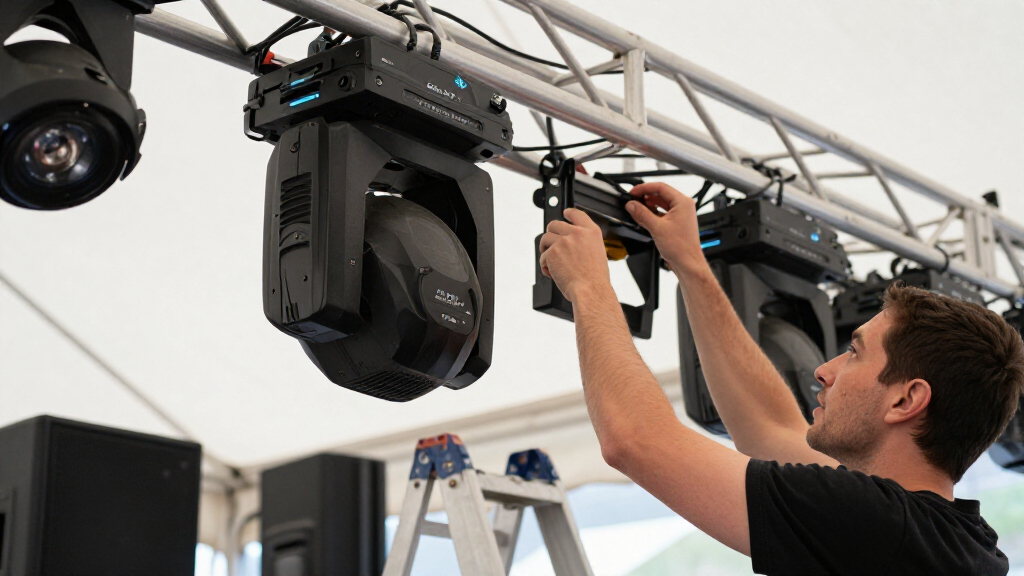
Lift and fasten
Use a partner or proper lifting method. Position the fixture, fasten the clamp fully and check that the unit cannot slip or rotate.
Add the safety cable
Connect an approved secondary retention cable from the fixture’s designated safety point directly around the support structure.
Connect, test and observe
Route power and data clear of moving parts and airflow. Run full pan and tilt while checking for wobble, interference or loosening.
Truss or ceiling? Match the method to the venue
Mobile DJs usually benefit from a correctly engineered truss system. Ceiling mounting is better suited to permanent venues with verified structural attachment points.
| Feature | Truss mount | Ceiling mount | Beginner decision |
|---|---|---|---|
| Support | +Supports flexible layouts when the truss and stands are correctly rated, assembled and distributed. | ~Requires a verified structural point; decorative ceilings and unknown anchors are not acceptable supports. | Use only a system with documented capacities and compatible hardware. |
| Safety | +Clamp and independent safety cable are required, with regular inspection of every connection. | !May require reinforcement, specialist anchors and professional structural assessment. | If the support rating is uncertain, do not mount the fixture overhead. |
| Flexibility | +Fixtures can be repositioned and re-angled for different rooms and performances. | ~Usually fixed once installed; changes may require new mounting points or reinstallation. | Truss generally suits mobile setups; ceiling mounts suit planned permanent installations. |
| Complexity | ~Needs more hardware, load planning, ballast or outriggers, and careful assembly. | !Looks simple but structural verification can make installation highly specialized. | Neither option is safe without a complete load path from fixture to structure. |
| Best use | +Touring DJs, temporary stages and changing venue layouts. | +Clubs and venues with engineered, documented mounting points. | Choose for verified safety first, then flexibility and speed. |
Approved fixture clamp
Must fit the bracket, fastener and truss profile. Do not substitute improvised hardware.
Rated safety cable
Attach to the designated safety point and support structure with minimal slack while preserving fixture movement.
Professional truss or rig
Confirm load capacity, span, stand rating, stability, ballast requirements and correct weight distribution.
New technology simplifies control—not structural safety
Wireless control and quick-release systems can shorten setup time, but they never replace verified supports, rated clamps or secondary retention.
Wireless DMX
Reduces data-cable clutter and allows more flexible placement. Test signal reliability and interference before the performance.
Precise pan and tilt
Smoother motors create more fluid effects, but full-range movement still demands clearance from cables and nearby fixtures.
LED and laser effects
Brighter outputs expand creative options. Aim beams responsibly and observe venue, audience and laser-safety requirements.
Quick-release systems
Can speed changes when manufacturer-approved. Confirm every latch is fully engaged and still use secondary retention.
Control tip: Multiple moving heads can be programmed through a DMX controller or compatible lighting software. Secure all power and data lines so they cannot enter the fixture’s moving envelope.
Every safe light show follows one connected path
A failure anywhere in this chain can compromise the whole installation. Trace each fixture from its specification through to the final motion test.
Fixture specification
Weight, dimensions, mounting points and orientation
Rated hardware
Compatible clamp, fastener and safety cable
Verified structure
Truss, stand, span and load distribution
Safe connections
Power and data clear of motion and airflow
Inspection and test
Full movement with no wobble, contact or noise
Small warning signs deserve an immediate stop
Do not continue operating a rig that shifts, squeaks, deforms or has undocumented load capacity. Lower the fixture safely and correct the issue first.
Wear, cracks or corrosion
Remove damaged clamps, cables, bolts and brackets from service instead of attempting a temporary repair.
Wobble or slipping
Power down and lower the fixture. Recheck hardware compatibility, fastening and the support system.
Blocked airflow or motion
Keep vents open and route cables beyond the complete pan-and-tilt envelope.
Wind, impact or instability
Outdoor use and exposed rigs require additional engineering. Never assume an indoor setup is suitable outside.
How to Choose the Right Mounting Hardware for Moving Heads
Choosing the right hardware is your first step. Your fixture’s weight, size, and mounting environment determine what clamps, safety cables, and support structures to use.
For example, a compact moving head like the CHAUVET DJ Intimidator Spot 260 weighs around 4 kg, while a larger fixture like the Robe MegaPointe can tip the scales at over 20 kg. Use clamps rated for at least 50% more than your fixture’s weight.
Secure your fixture with a sturdy, approved clamp—never cheap out here. Always attach a safety cable as a backup, even if the clamp feels tight. It’s a simple step that saves lives and gear.
Why does this matter? Proper hardware ensures your fixture stays mounted during operation, preventing accidents that could harm people or damage equipment. Overloading clamps or using inferior support can lead to catastrophic failures, especially during vigorous movements or high winds. The tradeoff is between cost and safety; investing in quality hardware might seem expensive initially but saves you from costly repairs or injuries in the long run.
DJ moving head light mounting hardware
As an affiliate, we earn on qualifying purchases.
As an affiliate, we earn on qualifying purchases.
Step-by-Step Guide to Mounting Moving Heads on Trusses
- Check your fixture’s weight and dimensions. Confirm your truss can support the load, considering the total weight and distribution. Overloading can cause structural failure, risking injury or equipment loss.
- Select a compatible clamp rated for your fixture’s weight. An undersized clamp may deform or fail under stress, leading to dangerous falls.
- Attach the clamp securely to the fixture’s mounting point, typically the yoke or bracket. Ensure it’s tightened properly to prevent slipping during operation.
- Lift the fixture safely and position it on the truss. Use a partner or lifting equipment if necessary to avoid strain or accidental dropping.
- Fasten the clamp tightly to the truss. Double-check all connections for stability; loose fittings are a major safety hazard.
- Attach a safety cable from the fixture to the truss or support structure. This secondary support acts as a fail-safe if the clamp fails, preventing the fixture from falling.
- Power up and run a test to confirm stability before the show. Observe for any wobbling or unusual movement, which could indicate improper mounting.
Imagine hanging a Chauvet Intimidator Beam LED on a 20-foot truss—every step counts not only for safety but also for ensuring your lighting effects perform flawlessly. Proper mounting reduces the risk of accidents, minimizes equipment downtime, and ensures your creative vision is realized without compromise.
safety cables for DJ lighting fixtures
As an affiliate, we earn on qualifying purchases.
As an affiliate, we earn on qualifying purchases.
Comparison of Mounting Options: Truss vs. Ceiling Mount
| Feature | Truss Mount | Ceiling Mount |
|---|---|---|
| Support | Highly adjustable, supports large fixtures with proper hardware and structural integrity, allowing for dynamic positioning and flexibility in design. | Fixed, limited adjustability. Best suited for permanent installations where the fixture’s position remains constant, but requires careful assessment of ceiling strength and load capacity to prevent accidents. |
| Safety | Requires secure clamps combined with safety cables. Proper hardware and regular inspections are critical to prevent accidental drops. | Must ensure the ceiling can bear the weight, often requiring reinforcement or specialized mounting points. Inadequate support can lead to catastrophic failure, especially with heavy fixtures. |
| Flexibility | Offers the ability to reposition and angle fixtures easily, enabling creative lighting setups and adjustments during performances. | Less flexible; typically fixed once installed. Adjustments may require reinstallation or additional mounting points, limiting quick changes during a show. |
| Setup Complexity | Requires more hardware, planning, and safety considerations but provides superior control and safety for large or multiple fixtures. | Simpler to install but less adaptable. Suitable for static, permanent setups where flexibility is not a priority. |
For mobile DJ setups, truss mounting offers the advantage of flexibility and safety for large or multiple fixtures, especially when combined with proper hardware and safety procedures. Ceiling mounts are ideal for permanent venues with fixed lighting needs, but they demand careful structural assessment to ensure safety. Understanding these tradeoffs helps you design a setup that balances safety, flexibility, and ease of installation, ultimately protecting your investment and audience.
As an affiliate, we earn on qualifying purchases.
Modern Tech Enhances Your Mounting and Control
Wireless DMX is a game-changer. Moving heads like the Chauvet Intimidator Hybrid 140SR support wireless control, reducing cable clutter and making positioning easier. This technology allows for quicker setup and more flexible arrangements, especially in complex or temporary venues where running cables can be cumbersome or visually distracting.
Plus, newer fixtures feature smoother pan/tilt motors—think of a dancer gracefully twirling—making your light movements more fluid and natural. This reduces mechanical strain on the fixtures and results in more professional-looking effects. Bright LEDs and integrated lasers add punch and vibrancy, turning your stage into a spectacle that captures attention and elevates your performance.
Some fixtures now offer quick-release mounting systems, letting you swap or adjust fixtures in seconds—saving time during setup and takedown, and reducing the risk of improper mounting. These innovations not only streamline your workflow but also enhance safety, as secure quick-release systems are designed with safety standards in mind.
According to Disco Flight, these advances help DJs craft complex light shows with less hassle and more reliability, especially in mobile setups where space and time are limited. Embracing these technologies ensures your lighting setup is future-proof, adaptable, and safe, giving you greater creative freedom and peace of mind.
wireless DMX controller for moving heads
As an affiliate, we earn on qualifying purchases.
As an affiliate, we earn on qualifying purchases.
Important Safety Tips You Might Overlook
Safety isn’t just a checkbox. It’s about preventing accidents that can injure people or damage gear, and understanding the implications of your mounting choices. Always verify your mounting hardware’s weight rating. If your fixture weighs 15 kg, use clamps rated for 25 kg or more—this margin accounts for dynamic forces like movement, vibrations, or accidental bumps that can occur during operation.
Regularly inspect hardware—look for wear, corrosion, or loose fittings. Don’t ignore squeaks or wobbling fixtures; these are signs that something may be compromised. Clean moving parts to prevent motor strain and failure, especially in dusty or humid environments. Neglecting maintenance can lead to unexpected hardware failure, risking injury or damage to your equipment.
And never forget to attach safety cables—think of them as your fixture’s seatbelt. When used correctly, they provide a critical backup if the clamp or mounting point fails. Always double-check hardware before hanging fixtures, and consider additional safety measures like secondary supports for heavy or high-mounted fixtures. In high-traffic or public venues, following local safety standards like ANSI or OSHA guidelines is essential to prevent liability and ensure everyone’s safety.
Imagine a busy wedding reception—your fixture suddenly falling because of a loose clamp? That’s a scene best avoided, and proper safety practices are the best defense against such accidents. Investing time in safety protocols protects not only your equipment but also your reputation as a professional DJ or event organizer.
Frequently Asked Questions
How do I know if my truss can support my moving head?
Check the fixture’s weight and compare it to your truss’s load capacity, which is usually stamped on the truss or in its specifications. When in doubt, consult a professional or the manufacturer’s guidelines.Can I mount moving heads on the ceiling without special equipment?
Yes, but only if your ceiling mount can support the fixture’s weight and you use hardware rated for that load. Always ensure the mount is secure and follow safety standards.What safety gear do I need besides clamps and safety cables?
Besides clamps and safety cables, consider a secondary support like a safety chain or secondary support wire, especially for heavy fixtures or high mounts. Always double-check hardware before hanging fixtures.How do I control multiple moving heads during a gig?
Use a DMX controller or lighting software that supports multiple fixtures, allowing you to synchronize movements, colors, and effects seamlessly across all fixtures.Are wireless DMX systems reliable for live events?
When set up properly in environments with minimal interference, wireless DMX can be very reliable. Always test your system beforehand to prevent surprises during your show.Conclusion
Mounting your moving heads correctly isn’t just a safety check—it’s the foundation for creative, reliable lighting. Take your time, follow safety rules, and embrace new tech to make your shows truly stand out.
Every great light show starts with a solid mount. Secure your fixtures well, and let your creativity shine—literally.
Fall Picks
fall essentials
As an affiliate, we earn on qualifying purchases.