
TL;DR

Get audio and creator gear delivered free — and shop member deals
- Fast, free delivery on millions of items
- Access to Prime Big Deal Days deals on October 6–7
- Prime Video, Amazon Music and more included
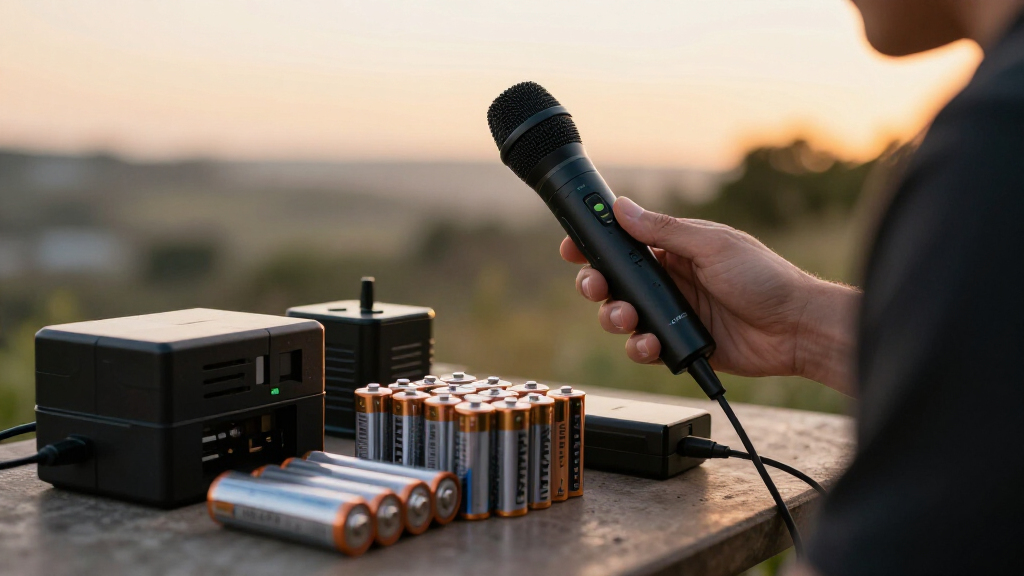
Battery choice directly impacts your wireless mic’s runtime and reliability in remote spots. Rechargeable lithium-ion batteries are most common, but environmental factors and charging options also matter. Modern tech now offers longer life and real-time monitoring, making remote gigs smoother.
Imagine setting up your wireless mic in a mountain cabin or a festival field, miles from any outlet. The last thing you want is for your batteries to die mid-performance, leaving you scrambling. Your choice of battery isn’t just about size or cost; it’s about dependable performance when the stakes are high and power sources scarce.
In this guide, you’ll learn about the best battery options, how to maximize their lifespan, and the latest tech trends that keep your wireless mics running longer in remote locations. Whether you rely on AA batteries or high-tech rechargeable packs, understanding your options can save your gig—and your sanity.
Choose lithium-ion rechargeable batteries for the best mix of capacity and convenience in remote locations.
Always bring extra batteries and consider portable recharging options like power banks or solar panels.
Modern batteries include smart tech that helps monitor health and alert you before failure.
Environmental factors—cold, heat, humidity—significantly influence battery performance; store and handle accordingly.
Planning your power supply with extra capacity reduces stress and keeps your event running smoothly.
Battery options for portable wireless mics in remote locations
When the nearest outlet is miles away, battery choice becomes part of the performance plan. Match runtime, rechargeability, environmental resilience and spare capacity to keep every transmitter live through the final cue.
High energy density, fast recharging and dependable full-day runtime.
Runtime varies widely by chemistry, capacity, temperature and transmitter draw.
Carry half again as much capacity as the expected operating requirement.
01 / Choose the chemistry
Four practical routes to reliable field audio
No single battery wins every assignment. Availability favors AA formats, while long events and difficult access favor rechargeable or system-specific packs.
AA alkaline
Best for: short gigs and emergency reserves. Easy to find almost anywhere, but runtime and cold-weather performance are limited.
AA lithium
Best for: cold locations and longer sessions. Lightweight with steadier output, though the per-use cost is higher.
Rechargeable lithium-ion
Best for: full-day outdoor work. Combines long runtime, quick charging and consistent voltage with lower repeat waste.
Specialized battery packs
Best for: demanding remote productions. Higher capacity and durable housings reduce swaps when access is difficult.
| Battery type | Typical runtime | Rechargeable | Field advantage | Primary tradeoff |
|---|---|---|---|---|
| AA alkaline | 4–6 hours | ✗ No | Low cost and broad availability | Frequent swaps; weaker in cold |
| AA lithium | 8–12 hours | ✗ No | Longer life and cold resilience | Higher disposable cost |
| Rechargeable Li-ion | 15–20 hours | ✓ Yes | Capacity, convenience and fast charging | Higher initial investment |
| Custom battery pack | 20+ hours | ✓ Yes | Maximum endurance and ruggedness | System-specific hardware |
02 / Read the runtime
More capacity means fewer failure points
Actual runtime depends on transmitter efficiency, battery quality, radio settings and environmental conditions. Treat published figures as planning inputs—not guarantees.
Typical operating time
Temperature changes the usable capacity equation
Cold: available capacity falls and alkaline performance can deteriorate quickly.
Moderate: room-temperature storage supports predictable runtime and charging.
Heat: chemical aging accelerates; never leave packs exposed in hot vehicles or direct sun.
03 / Build the field power plan
A five-step chain from calculation to clean audio
Reliable operation comes from the whole system: measured demand, reserve capacity, organized swaps, safe storage and a tested charging route.
Estimate demand
Multiply every transmitter’s runtime by the full event window.
Add 50%
Cover delays, cold loss, degraded cells and unexpected retakes.
Stage spares
Label charged sets and keep each microphone’s pack easy to identify.
Recharge off-line
Use a power bank, solar panel or dedicated field charging station.
Monitor live
Watch remaining time and swap before a critical performance window.
Carry extra capacity
Plan for at least 50% beyond the expected runtime.
Power down
Turn off transmitters whenever they are genuinely not required.
Use saving modes
Disable unnecessary features and reduce avoidable power draw.
Insulate storage
Keep batteries dry and protected from severe heat or cold.
Label every set
Separate charged, active and depleted packs for fast swaps.
04 / Technology horizon
Smarter packs are replacing battery guesswork
Modern systems increasingly report health, temperature, cycle count and remaining runtime, giving crews time to act before voltage becomes an audio problem.
Smart monitoring
Bluetooth or networked status data can surface voltage, temperature and health warnings in a control app.
Fast charging
Newer packs can approach 80% charge in under an hour when paired with compatible charging hardware.
Quick-swap packs
Modular pack designs let crews exchange depleted units rapidly between performance windows.
Solid-state promise
Prototype technologies point toward higher energy density and potential operating windows beyond 30 hours.
Solar hybrids
Foldable panels paired with high-capacity storage can extend operation when daylight is dependable.
Rechargeable systems
Reusable packs reduce disposable battery consumption while making performance more predictable over time.
High-quality lithium-ion batteries, careful storage and disciplined power management can extend practical operation substantially. The safest remote setup combines long-life primary packs, organized spares and at least one independent charging method.
What are the best battery types for remote wireless mic use?
The ideal battery type depends on your needs, but for remote wireless mics, lithium-ion rechargeable batteries lead the pack. They pack a punch—offering high energy density, quick recharge times, and long lifespan. These qualities are crucial when operating in remote locations where access to power is limited; a longer-lasting, quick-charging battery minimizes downtime and ensures continuous operation. However, they tend to be more expensive upfront, so weighing cost against reliability is key.
High-quality AA batteries, such as lithium variants, are still popular for their convenience and affordability. Alkaline AA batteries are readily available and cost-effective but tend to last only 4-6 hours, which might be insufficient for lengthy events. Lithium AA batteries, like Energizer Ultimate Lithium, can extend that to around 8-12 hours, especially in cold weather, where traditional batteries lose capacity. Specialized battery packs—designed specifically for wireless systems—often feature higher capacities and rugged casings, making them ideal for challenging environments where durability and extended runtime are crucial. The tradeoff often involves higher initial costs but greater reliability and longer operational periods, which are vital in remote settings where replacing batteries is logistically difficult.
rechargeable lithium-ion batteries for wireless microphones
As an affiliate, we earn on qualifying purchases.
As an affiliate, we earn on qualifying purchases.
How long do batteries last in portable wireless microphones?
Most wireless mics run between 4 and 12 hours per set of batteries, but this range can vary significantly based on the battery type, device efficiency, and usage patterns. For example, a typical handheld mic with a lithium-ion pack might achieve 15-20 hours because of its higher capacity and optimized power management. Conversely, a small lavalier with AA batteries might last 8-10 hours, but this depends on the quality of the batteries used and the power draw of the transmitter. In real-world scenarios, a band performing outdoors might need to swap batteries after 6 hours if using standard AA alkalines, which drain quickly in cold or humid conditions. Conversely, high-quality rechargeable packs can often last an entire day—sometimes up to 20 hours—reducing the need for frequent replacements. Understanding your device’s power consumption—such as a transmitter drawing 50mA versus 20mA—helps in planning for battery management, especially when operating remotely where changing batteries frequently isn’t practical. This knowledge allows for strategic planning, ensuring uninterrupted sound during critical moments without the risk of sudden power loss.
portable power banks for remote audio recording
As an affiliate, we earn on qualifying purchases.
As an affiliate, we earn on qualifying purchases.
Can I recharge batteries in the field? Yes, here’s how.
Recharging batteries on location is not only possible but increasingly practical with advances in portable power technology. Portable power banks are a top choice—they’re compact, rugged, and capable of recharging lithium-ion packs or AA batteries via USB. For instance, a 20,000mAh power bank can recharge a typical wireless mic battery pack twice over, significantly extending operational time without the need to carry multiple spare batteries. Solar chargers are also gaining popularity, especially in remote outdoor settings. A small, foldable solar panel can provide supplementary power, allowing you to recharge batteries during daylight hours. For example, a 10W foldable panel can generate around 600mA in full sun, enough to keep a battery pack topped off during long outdoor events. Some systems come with dedicated charging stations or quick-swappable battery packs, allowing rapid replacements—critical in remote scenarios where downtime must be minimized. Always carry spare batteries and recharging gear to ensure continuous operation, especially in unpredictable environments. The ability to recharge in the field reduces logistical challenges and ensures your equipment stays powered when it matters most.
solar rechargeable batteries for wireless mic systems
As an affiliate, we earn on qualifying purchases.
As an affiliate, we earn on qualifying purchases.
What are the latest tech trends making remote mic power more reliable?
Recent advances in battery chemistry and monitoring are revolutionizing remote mic operation. Smart batteries now include Bluetooth or Wi-Fi modules that send real-time health data to your smartphone or control system. This technology allows you to monitor battery voltage, charge cycles, and temperature, providing early warnings before failure—crucial when operating far from repair facilities. Extended life tech, such as solid-state batteries, promises even longer runtimes—some prototypes reaching 30+ hours—reducing the need for frequent replacements. Hybrid systems combining small solar panels with high-capacity lithium packs are also emerging, offering nearly limitless remote operation potential when sunlight is abundant. Fast-charging tech is another trend—getting a battery back to 80% in under an hour minimizes downtime, which is essential during live events or lengthy outdoor shoots. Some manufacturers now offer quick-swappable battery packs, enabling you to replace depleted batteries swiftly without interrupting your workflow. These innovations collectively enhance reliability, reduce logistical burdens, and extend operational windows—making remote mic setups more dependable than ever before.
spare AA batteries for wireless microphones
As an affiliate, we earn on qualifying purchases.
As an affiliate, we earn on qualifying purchases.
Comparison table: Battery options for remote wireless mics
| Battery Type | Typical Runtime | Rechargeable | Best for |
|---|---|---|---|
| AA Alkaline | 4-6 hours | No | Short gigs, easy access |
| AA Lithium | 8-12 hours | No | Cold weather, longer use |
| Rechargeable Lithium-ion | 15-20 hours | Yes | Long outdoor events, reliability |
| Custom battery packs | 20+ hours | Yes | Extended remote use |
Practical tips to maximize your battery life in remote settings
- Always carry spare batteries—plan for at least 50% more than your expected runtime.
- Turn off your mic when not in use to save power.
- Use power-saving modes if available—disable unnecessary features.
- Keep batteries at room temperature; avoid extreme heat or cold.
- Label and organize spares for quick swaps during gigs.
Frequently Asked Questions
What type of batteries should I use for my wireless microphone in remote locations?
Rechargeable lithium-ion batteries are usually the best choice for remote use, offering long runtime, quick recharge, and durability. High-quality AA lithium batteries are also effective if rechargeability isn’t a concern.
How long do batteries typically last in portable wireless mics?
Most systems run between 4 and 12 hours per set of batteries, with lithium-ion packs reaching up to 20 hours or more under ideal conditions. Always check your device’s specifications for accurate expectations.
Can I recharge batteries in the field?
Yes, using portable power banks, solar chargers, or dedicated charging stations. These options let you keep your batteries topped off during long outdoor events or in remote areas with sunlight.
What are best practices for extending battery life?
Turn off unused devices, use power-saving modes, store batteries at room temperature, and carry spares. Proper maintenance and handling can double or triple your batteries’ lifespan.
Are there eco-friendly battery options?
Rechargeable lithium-ion batteries are more sustainable than disposables. Some companies are exploring biodegradable or recyclable options, but currently, focus on reusables to reduce waste.
Conclusion
Getting the right batteries for your remote wireless mic setup isn’t just about convenience—it’s about peace of mind. Reliable power keeps the show going, no matter how far from civilization you are. Investing in quality batteries and portable recharging gear now saves headaches later.
Next time you gear up for an outdoor gig, imagine batteries that last hours longer, monitor themselves, and recharge with a tap or a fold-out solar panel. Power smart, stay reliable, and let your sound carry on, even in the wildest spots.
Fall Picks
fall essentials
As an affiliate, we earn on qualifying purchases.