
For most DJ lighting rigs, I’d start with the Donner DMX512 2.4 GHz set with one transmitter and seven receivers, which suits a setup that needs to control several fixtures without long DMX cable runs. The Rockville ROCKFORCE W4 stands apart for DJs who need MIDI control, while compact transmitter-and-receiver kits from Lixada and Donner are a simpler fit for linking a small number of fixtures. The key tradeoff is whether you need a receiver for each light, or would rather prioritize a specialized controller or battery-powered hardware. Receiver counts, power arrangements, and control features vary across these kits, so matching the package to your actual rig matters more than choosing the largest set. Read on for my comparison of all 15 options and a guide to choosing the right wireless DMX setup for your DJ lights.

Get audio and creator gear delivered free with Prime
- Fast, free delivery on millions of items
- Prime Video, Amazon Music and more included
- Member-only deals all year
Complete the kit


Key Takeaways
- Receiver count is a major dividing line: several Donner and CHINLY packages include seven receivers, while smaller kits with two or three receivers better fit compact rigs.
- The Rockville ROCKFORCE W4 is the specialist option: its MIDI feature gives it a distinct role for DJs who want lighting control tied to a MIDI workflow.
- Built-in batteries change how a kit can be deployed: the Donner and CHINLY battery-equipped options may suit fixtures where nearby power is inconvenient, but battery needs should be checked against show duration and charging plans.
- Similar kit names do not mean identical packages: JERRAY, CHINLY, and Donner each appear in multiple transmitter-and-receiver configurations, so verify the included unit count before buying.
- Choose for the whole signal path, not just the transmitter: receiver quantity, fixture compatibility, power access, and wireless conditions determine whether a kit will work smoothly in a real DJ setup.
| JERRAY Wireless DMX Lighting Controller, 1 Transmitter and 2 Receivers | 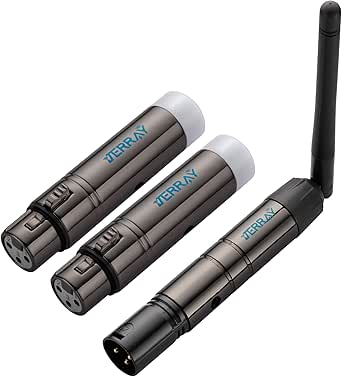 | Best Compact Starter Set | Wireless frequency: 2.4 GHz ISM | Frequency hopping: 126 channels | Group IDs: 7 | VIEW LATEST PRICE | See Our Full Breakdown |
| CHINLY 2.4G Wireless DMX512 Transmitter and 7 Receivers |  | Best for Multi-Fixture Coverage | Model: SR5540 | Protocol: DMX512 | Operating frequency: 2.4 GHz ISM | VIEW LATEST PRICE | See Our Full Breakdown |
| JERRAY Wireless DMX512 Kit with 1 Transmitter and 3 Receivers |  | Best Balanced Expansion Kit | Wireless frequency: 2.4 GHz ISM | Frequency hopping: 126 channels | Independent groups: 7 | VIEW LATEST PRICE | See Our Full Breakdown |
| Donner DMX512 2.4 GHz Wireless DMX Controller Set with Transmitter and 7 Receivers |  | Best for Buyers Who Can Verify the Bundle | Model: EC803+EC825X7 | Protocol: DMX512 | Wireless frequency: 2.4 GHz ISM | VIEW LATEST PRICE | See Our Full Breakdown |
| JERRAY 8-Piece Wireless DMX512 Transmitter and Receiver Set |  | Best Only After Contents Are Confirmed | Protocol: DMX512 | Wireless frequency: 2.4 GHz ISM | Frequency channels: 126 with automatic frequency hopping | VIEW LATEST PRICE | See Our Full Breakdown |
| Donner DMX512 Wireless DMX Controller with 1 Transmitter and 7 Receivers |  | Best for Multi-Fixture Coverage | Protocol: DMX512 | Frequency: 2.4 GHz | Package contents: 1 transmitter, 7 receivers, 8 power adapters | VIEW LATEST PRICE | See Our Full Breakdown |
| CHINLY 2.4 GHz Wireless DMX512 Kit with 1 Transmitter and 3 Receivers |  | Best Starter Kit | Protocol: DMX512 | Frequency: 2.4 GHz ISM | Package contents: 1 transmitter, 3 receivers, 4 adapters, 1 specification sheet | VIEW LATEST PRICE | See Our Full Breakdown |
| 2.4 GHz Wireless DMX512 Transmitter and 7 Receivers |  | Best for Seven-Receiver Value | Protocol: DMX512 | Frequency: 2.4 GHz ISM | Package contents: 1 transmitter, 7 receivers, 7 power adapters | VIEW LATEST PRICE | See Our Full Breakdown |
| Donner Wireless DMX512 Transmitter and Receiver Kit – 1 Transmitter, 7 Receivers with Built-in Battery and Light Dome for LED Stage Lighting Control (8 pcs) |  | Best for Reduced Receiver Power Cables | Protocol: DMX512 | Package contents: 1 transmitter, 7 receivers, 8 power adapters | Receiver battery: Built-in rechargeable battery | VIEW LATEST PRICE | See Our Full Breakdown |
| Rockville ROCKFORCE W4 384-Channel Wireless DMX Lighting Controller with MIDI |  | Best for Programmable DJ Shows | Channels: 384 | Wireless frequency: 2.4 GHz | Frequency hopping: 126 channels | VIEW LATEST PRICE | See Our Full Breakdown |
| FENIXFIT Wireless DMX512 Transmitter and 7 Receivers |  | Best for Multi-Fixture Setups | Protocol: DMX512 | Included: 1 transmitter and 7 receivers | Frequency band: 2.4 GHz ISM | VIEW LATEST PRICE | See Our Full Breakdown |
| CHINLY 8-Piece DMX512 Wireless Receiver Set with Built-in Battery and Transmitter for LED Stage Lighting |  | Best for Cable-Free Fixture Placement | Model: SR5602 | Included: 1 transmitter and 7 receivers | Receiver battery: Built-in lithium-ion batteries in 7 receivers | VIEW LATEST PRICE | See Our Full Breakdown |
| Donner 2.4 GHz Wireless DMX512 Transmitter and Receiver Set |  | Best for a Single Fixture Link | Model: TS-WDMX01A | Included: 1 transmitter and 1 receiver | Protocol: DMX512 | VIEW LATEST PRICE | See Our Full Breakdown |
| Lixada 2.4G Wireless DMX512 Transmitter and Receiver |  | Best for Group and Power-Level Selection | Protocol: DMX512 | Wireless frequency: 2.4 GHz | Frequency channels: 126 | VIEW LATEST PRICE | See Our Full Breakdown |
| Donner Wireless DMX512 Controller with 1 Transmitter and 3 Receivers |  | Best for a Small Multi-Light Rig | Model: EC803+EC956x3 | Included: 1 transmitter, 3 receivers, 4 power adapters | Wireless protocol: DMX512, 2.4 GHz | VIEW LATEST PRICE | See Our Full Breakdown |
| wireless DMX transmitters for DJ light | Protocol | Frequency hopping |
|---|---|---|
| JERRAY Wireless DMX Lighting C | — | 126 channels |
| CHINLY 2.4G Wireless DMX512 Tr | DMX512 | — |
| JERRAY Wireless DMX512 Kit wit | — | 126 channels |
| Donner DMX512 2.4 GHz Wireless | DMX512 | 126 channels |
| JERRAY 8-Piece Wireless DMX512 | DMX512 | — |
| Donner DMX512 Wireless DMX Con | DMX512 | 126 channels |
| CHINLY 2.4 GHz Wireless DMX512 | DMX512 | — |
| 2.4 GHz Wireless DMX512 Transm | DMX512 | 126 channels |
| Donner Wireless DMX512 Transmi | DMX512 | 126 channels |
| Rockville ROCKFORCE W4 384-Cha | — | 126 channels |
| FENIXFIT Wireless DMX512 Trans | DMX512 | 126 channels |
| CHINLY 8-Piece DMX512 Wireless | — | — |
| Donner 2.4 GHz Wireless DMX512 | DMX512 | — |
| Lixada 2.4G Wireless DMX512 Tr | DMX512 | — |
| Donner Wireless DMX512 Control | — | — |
More Details on Our Top Picks
JERRAY Wireless DMX Lighting Controller, 1 Transmitter and 2 Receivers
For a DJ wiring a small rig, this JERRAY set keeps the receiver count practical: one transmitter and two receivers cover a console-to-fixture link plus one additional light position. Its seven groups and automatic hopping across 126 channels give it more room to separate lighting setups than a basic single-link kit. The stated range reaches up to 1,000 ft, though placement and clear signal paths still matter at a venue. Compared with the JERRAY three-receiver kit, this one is easier to match to a modest setup but leaves less room to expand. All three units need power adapters, so it is a poor fit for locations without convenient outlets; unlike battery-equipped alternatives in the roundup, it cannot be placed freely without power access.
Pros:- Includes one transmitter and two receivers for a small multi-fixture setup
- Supports seven independent groups
- Automatic frequency hopping across 126 channels
- Stated wireless range of up to 1,000 ft
Cons:- All units require power adapters; there are no built-in batteries
- Two receivers limit expansion compared with the JERRAY three-receiver kit
- The stated range may not reflect performance through venue obstructions
Best for: Mobile DJs with a console and up to two DMX lighting positions who want to reduce cable runs without managing a larger receiver bundle.
Not ideal for: DJs setting up many separated fixtures or working where outlets are scarce, because the kit has only two receivers and every unit needs external power.
- Wireless frequency:2.4 GHz ISM
- Frequency hopping:126 channels
- Group IDs:7
- Wireless range:Up to 1,000 ft
- Package contents:1 transmitter, 2 receivers, 3 power adapters
- Power:Requires power adapters; no built-in battery
Our verdict“Choose this JERRAY kit for a compact, outlet-accessible DJ lighting rig that needs wireless control at two receiver locations.”
CHINLY 2.4G Wireless DMX512 Transmitter and 7 Receivers
When a DJ needs receivers spread across a larger lighting rig, the CHINLY’s seven-receiver bundle is its main advantage. One transmitter can send DMX512 data to several fixture positions, reducing the cable runs that make wide stages awkward to wire. Its 126-channel frequency hopping and seven selectable ID groups offer useful ways to manage wireless links, while the stated range is up to 400 m in visible line of sight. That range should be treated as a clear-path specification, not a promise through walls or crowded equipment areas. Compared with the JERRAY two-receiver set, CHINLY suits broader coverage but takes more setup coordination: transmitter and receivers need matching IDs. The description lists eight adapters, so external power is part of the installation rather than an afterthought.
Pros:- Includes one transmitter and seven receivers for multiple fixture locations
- Supports seven selectable ID groups
- Automatic frequency hopping across 126 channels
- Uses 3-pin XLR connectors and includes eight adapters
Cons:- The stated 400 m range is for visible line-of-sight conditions
- Receivers and transmitter need matching ID settings
- Requires external AC power for the units
Best for: DJs and small production crews placing DMX fixtures across a wide stage or event space and needing up to seven receiver points.
Not ideal for: Compact mobile setups with only one or two fixtures, or venues where receivers cannot maintain a clear line of sight and convenient AC power.
- Model:SR5540
- Protocol:DMX512
- Operating frequency:2.4 GHz ISM
- Frequency channels:126 with automatic frequency hopping
- Selectable ID groups:7
- Communication range:Up to 400 m in visible line of sight
- DMX connector:3-pin XLR
- Set contents:1 transmitter, 7 receivers, 8 adapters
Our verdict“Pick CHINLY when receiver count matters more than a compact kit and your fixture locations can maintain suitable signal paths.”
JERRAY Wireless DMX512 Kit with 1 Transmitter and 3 Receivers
This JERRAY kit sits between a small starter bundle and a seven-receiver system: three receivers can cover a few fixture positions without leaving a large set of spare units to store. Its 2.4 GHz link uses 126-channel frequency hopping and offers seven independent groups, which helps DJs keep separate wireless lighting links organized. The stated line-of-sight range is up to 400 m, and the 3-pin XLR connections suit common DMX512 equipment. Compared with the JERRAY two-receiver option, the extra receiver gives more flexibility for a small stage; compared with the CHINLY seven-receiver set, it is less suited to a distributed rig. It is AC-powered, so outlets are required at the transmitter and receiver locations. This carries DMX lighting data only, not audio.
Pros:- Includes three receivers for a modest multi-zone lighting setup
- Supports seven independent groups
- Automatic hopping across 126 channels
- Includes four power adapters and 3-pin XLR connectors
Cons:- Requires AC power at the transmitter and receiver locations
- Transmits DMX lighting data only, not audio
- Three receivers provide less coverage than the CHINLY seven-receiver set
Best for: Mobile DJs running a small stage with three wireless fixture zones who want more receiver capacity than a starter kit without a seven-receiver bundle.
Not ideal for: Performers needing battery-powered placement, audio transmission, or enough receivers to cover a large, widely distributed lighting rig.
- Wireless frequency:2.4 GHz ISM
- Frequency hopping:126 channels
- Independent groups:7
- Communication distance:Up to 400 m line of sight
- Connectors:3-pin XLR male and female
- Power:AC-powered; no batteries
- Included:1 transmitter, 3 receivers, 4 power adapters
- Warranty:1 year
Our verdict“Choose this JERRAY kit for a small stage that needs three wireless DMX receiver points and has outlets available at each position.”
Donner DMX512 2.4 GHz Wireless DMX Controller Set with Transmitter and 7 Receivers
The Donner set lists seven selectable ID groups and automatic frequency hopping across 126 channels, features that can help organize wireless DMX links in a busy DJ lighting setup. Its metal construction and 5 V DC, 500 mA power specification also give buyers concrete installation details. The key issue is a mismatch in the listing: the title says seven receivers, but the included-components data says one transmitter and three receivers. That makes it harder to rank as a dependable seven-point solution than the CHINLY kit, whose set contents explicitly list seven receivers. I would treat receiver quantity as unconfirmed until the seller clarifies it. Like the JERRAY kits, this Donner requires external power and supports DMX512 devices only, so it is not a battery-free placement option.
Pros:- Supports seven selectable ID groups
- Uses automatic frequency hopping across 126 channels
- Specifies 5 V DC, 500 mA power
- Metal construction
Cons:- Receiver quantity is inconsistent: title says seven, included-components data says three
- Requires an external power adapter and has no built-in battery
- Compatible only with devices marked DMX512
Best for: DJ buyers who want Donner’s listed frequency-hopping and group features and can confirm the receiver count with the seller before ordering.
Not ideal for: Anyone who must plan a seven-receiver installation with certainty, since the product title and included-components listing conflict.
- Model:EC803+EC825X7
- Protocol:DMX512
- Wireless frequency:2.4 GHz ISM
- ID groups:7
- Frequency hopping:126 channels
- Power:5 V DC, 500 mA
- Material:Metal
- Included components:Title lists 1 transmitter and 7 receivers; details list 1 transmitter and 3 receivers
Our verdict“Consider this Donner only if you confirm the actual receiver count and need a powered 2.4 GHz DMX512 system.”
JERRAY 8-Piece Wireless DMX512 Transmitter and Receiver Set
This JERRAY listing advertises an eight-piece DMX512 set with 2.4 GHz transmission, seven configurable ID groups, and automatic hopping across 126 channels. Those wireless features suit DJ lighting where long DMX cable runs are inconvenient, but the package description creates a substantial buying uncertainty: the title promises eight pieces while the product details list only one receiver and one power adapter. That is far less complete than the JERRAY three-receiver kit, whose included components are clearly specified. The listed system also requires external power and has no built-in batteries, so it does not solve placement constraints at outlets. I would not plan a multi-fixture setup around the advertised piece count unless the seller confirms exactly what is included.
Pros:- Supports DMX512 lighting control over 2.4 GHz
- Offers seven configurable ID groups
- Automatic frequency hopping across 126 channels
- Designed to reduce the need for long DMX cable runs
Cons:- Package contents conflict: title says eight pieces, details list one receiver and one adapter
- Requires power adapters and has no built-in battery
- No wireless range is specified in the supplied product data
Best for: A DJ willing to verify the exact transmitter, receiver, and adapter count with the seller before relying on the kit for a specific setup.
Not ideal for: Buyers who need a confirmed multi-receiver bundle or a ready-to-install system, because the advertised eight-piece count conflicts with the listed contents.
- Protocol:DMX512
- Wireless frequency:2.4 GHz ISM
- Frequency channels:126 with automatic frequency hopping
- Configurable ID groups:7
- Power:Requires power adapter; no built-in battery
- Weight:1.96 lb
- Dimensions:6.69 × 6.3 × 3.15 in
- Package contents:Title describes an 8-piece set; product details list 1 receiver and 1 power adapter
Our verdict“Buy only after confirming the package contents; the JERRAY three-receiver kit is a clearer choice for a defined setup.”
Donner DMX512 Wireless DMX Controller with 1 Transmitter and 7 Receivers
For a DJ rig with several compatible fixtures spread across a stage or room, I’d shortlist this Donner because it bundles seven receivers and rechargeable receiver batteries. That setup can reduce both DMX cable runs and the need to place every receiver beside a power outlet. It also offers seven selectable groups and automatic hopping across 126 channels, useful when multiple wireless setups share a venue. Compared with the CHINLY 2.4 GHz Wireless DMX512 Kit, this set supplies four more receivers and rechargeable units, while CHINLY is the smaller starter package. The tradeoff is that the Donner transmitter has no built-in battery, and the stated 500 m range applies to visible conditions, not every club layout. Buy it for receiver count, but only if your fixtures support DMX512.
Pros:- Includes seven rechargeable receivers for distributing control to multiple compatible fixtures.
- Seven selectable wireless groups support separate lighting setups.
- Automatic frequency hopping across 126 channels is designed to help manage interference.
- Eight power adapters are included.
Cons:- The transmitter has no built-in battery and needs external power.
- The 500 m range is stated for visible conditions and may not reflect obstructed venues.
- Works only with DMX512-compatible equipment.
Best for: DJs with multiple DMX512 fixtures who want seven receiver points and rechargeable receivers for setups where power outlets are limited.
Not ideal for: Mobile DJs seeking a fully battery-powered transmitter, or anyone using lights without DMX512 compatibility.
- Protocol:DMX512
- Frequency:2.4 GHz
- Package contents:1 transmitter, 7 receivers, 8 power adapters
- Wireless groups:7
- Frequency hopping:126 channels
- Communication range:Up to 500 m in visible conditions
- Receiver battery:Rechargeable
- Transmitter battery:No built-in battery
Our verdict“Choose this Donner when seven receiver points and rechargeable receivers matter more than having a battery-powered transmitter.”
CHINLY 2.4 GHz Wireless DMX512 Kit with 1 Transmitter and 3 Receivers
I’d pick this CHINLY kit for a DJ who wants to cut the first few DMX cable runs without buying receivers for an entire lighting rig. Its three receivers suit a compact setup, and the seven selectable ID groups help keep separate wireless systems organized. Automatic hopping across 126 channels is shared with the larger Donner kits, so the main distinction here is the smaller receiver bundle, not a different wireless approach. The listed 400 m range is for clear line of sight; walls, people, and venue structures can reduce practical reach. You’ll also need to match the transmitter and receivers to the same ID value before use. Compared with Donner’s seven-receiver set, CHINLY asks less of a buyer’s setup and storage, but it leaves less room to expand without adding compatible receivers.
Pros:- Three receivers provide a practical starting point for a compact lighting rig.
- Seven selectable ID groups support separate wireless setups.
- Automatic frequency hopping uses 126 channels.
- AC 100–240 V operating voltage suits a range of power environments.
Cons:- The stated 400 m range applies to clear, visible line-of-sight conditions.
- Transmitter and receivers must use the same ID value.
- The three-receiver bundle may be limiting as a rig grows.
Best for: A mobile DJ moving from wired DMX to wireless control for a small rig with up to three receiver locations.
Not ideal for: DJs with many fixtures already spread across a large venue, or buyers who want receivers with built-in batteries.
- Protocol:DMX512
- Frequency:2.4 GHz ISM
- Package contents:1 transmitter, 3 receivers, 4 adapters, 1 specification sheet
- Communication range:Up to 400 m in visible conditions
- Frequency channels:126 with automatic frequency hopping
- Selectable ID groups:7
- Operating voltage:AC 100–240 V
- DMX connector:3-pin male
Our verdict“Choose this CHINLY kit to add wireless DMX to a small DJ setup without starting with a seven-receiver bundle.”
2.4 GHz Wireless DMX512 Transmitter and 7 Receivers
This kit is a straightforward choice when the priority is getting seven receivers in one package for a DMX512 lighting rig. It shares the 2.4 GHz band, 126-channel automatic hopping, and seven selectable groups found in the Donner and CHINLY options, so its appeal is mostly the receiver count and conventional 3-pin male DMX connection. Its listed 400 m line-of-sight distance is shorter than the 500 m visible-condition claim for the Donner seven-receiver set; neither figure promises the same reach through a crowded venue. Unlike that Donner, this kit specifies corded power with no built-in batteries, and it includes seven adapters for the receiver units. I’d favor it for a fixed or powered DJ setup, but skip it if cable-free power at each receiver is part of the plan.
Pros:- Includes one transmitter and seven receivers for multi-fixture coverage.
- Automatic frequency hopping spans 126 channels.
- Seven selectable ID groups allow separate wireless setups.
- Seven power adapters are included.
Cons:- All units require external power; there are no built-in batteries.
- The 400 m distance is specified for line-of-sight conditions.
- Compatibility is limited to DMX512 equipment.
Best for: DJs with seven DMX512 fixture locations and accessible power who want a multi-receiver wireless kit with 3-pin DMX connections.
Not ideal for: Performers working where receiver power outlets are scarce, or buyers who need rechargeable receiver batteries.
- Protocol:DMX512
- Frequency:2.4 GHz ISM
- Package contents:1 transmitter, 7 receivers, 7 power adapters
- Frequency hopping:126 channels
- Selectable ID groups:7
- Communication distance:Up to 400 m line of sight
- DMX connector:3-pin male
- Power:Corded; no built-in battery
Our verdict“Choose this kit for seven wireless receiver points when every unit can be connected to external power.”
Donner Wireless DMX512 Transmitter and Receiver Kit – 1 Transmitter, 7 Receivers with Built-in Battery and Light Dome for LED Stage Lighting Control (8 pcs)
For a DJ placing receivers around a stage where power sockets are inconvenient, this Donner’s strongest distinction is its built-in rechargeable receiver batteries. The seven receivers also have light domes, and the set is described as supporting up to seven individual group IDs and automatic hopping across 126 channels. Compared with the 2.4 GHz Wireless DMX512 Transmitter and 7 Receivers, it is the more appealing fit when reducing receiver power leads matters; that alternative explicitly requires external power. The battery advantage does not extend to the transmitter, which still needs external power, and the stated 500 m range is for visible conditions. The product data lists eight power adapters but does not specify the frequency or connector details here, so I’d verify those against the fixtures and venue plan before choosing it.
Pros:- Seven receivers have built-in rechargeable batteries.
- Light domes are included on the receivers.
- Automatic frequency hopping across 126 channels is designed to help limit interference.
- Seven group IDs support separate wireless setups.
Cons:- The transmitter has no built-in battery and must be powered externally.
- The 500 m range applies to visible conditions.
- Only compatible with equipment that supports DMX512.
Best for: DJs with DMX512 LED fixtures who need rechargeable receivers to place units away from convenient power outlets.
Not ideal for: Buyers who need a battery-powered transmitter, or who require detailed connector and frequency specifications before purchase.
- Protocol:DMX512
- Package contents:1 transmitter, 7 receivers, 8 power adapters
- Receiver battery:Built-in rechargeable battery
- Transmitter battery:No built-in battery
- Wireless groups:Up to 7 individual group IDs
- Frequency hopping:126 channels
- Communication range:Up to 500 m in visible conditions
- Material:Metal
Our verdict“Choose this Donner when rechargeable receiver power is more useful than a battery-powered transmitter or a fully specified connection setup.”
Rockville ROCKFORCE W4 384-Channel Wireless DMX Lighting Controller with MIDI
The ROCKFORCE W4 is a different kind of pick: rather than adding wireless links to an existing controller, it combines a 384-channel lighting controller with a built-in 2.4 GHz transmitter. Its sliders, programmable scenes and chases, MIDI support, and wired DMX in/out make it suited to DJs who want hands-on show control as well as wireless fixture links. It supports up to 24 intelligent lights and 25 receivers, far beyond the one-transmitter/seven-receiver kits from Donner and CHINLY. That extra control brings a learning curve: programming banks, scenes, and chases takes more setup than using a simple wireless transmitter kit. The unit is also a 4U rack-mountable controller, not a compact dongle-style link, and its built-in music triggering may not offer the precision of dedicated audio control.
Pros:- 384 channels support up to 24 intelligent lights at 16 channels per light.
- Built-in 2.4 GHz wireless transmitter supports up to 25 receivers.
- MIDI, manual override, programmable scenes, and chases add show-control options.
- Wired DMX in/out and 4U rack mounting support installed or rack-based setups.
Cons:- Programming banks, scenes, and chases requires familiarity with DMX control.
- The 20.7-inch-wide, 6.2-pound rack unit is less convenient than a small wireless link.
- Music-synced effects may offer less control than dedicated audio triggering.
Best for: DJs with DMX programming experience who want a rack-based controller with wireless transmission, MIDI, and programmable scenes for a larger lighting rig.
Not ideal for: Beginners seeking a simple transmitter-and-receiver kit, or mobile DJs who need a compact controller with minimal programming.
- Channels:384
- Wireless frequency:2.4 GHz
- Frequency hopping:126 channels
- Maximum lights:24
- Maximum receivers:25
- Programmable banks:30 banks of 8 scenes
- Chases:6 chases with 240 scenes
- Mounting:4U rack-mountable
- Connections:Wired DMX in/out
Our verdict“Choose the ROCKFORCE W4 if you need a full programmable lighting controller with wireless DMX, not just a wireless transmitter kit.”
FENIXFIT Wireless DMX512 Transmitter and 7 Receivers
For a DJ rig that needs several fixtures connected without long DMX runs, the seven included receivers make this FENIXFIT set a more complete starting point than the single-receiver Donner TS-WDMX01A. It supports seven wireless groups, so separate lighting zones can be organized without buying extra receivers just to cover the listed fixtures. Its 126-channel automatic frequency hopping is intended to help maintain a link in busy wireless environments, while the stated range reaches up to 1,600 feet under suitable conditions. The zinc alloy construction and pre-linked units add practical appeal for quick setup. The tradeoff is that the transmitter and receivers use the shared 2.4 GHz band, and the maximum range is not a guarantee for a crowded or obstructed venue. Choose it for receiver count, not a promise of flawless long-distance coverage.
Pros:- Seven receivers cover multiple DMX fixtures from one transmitter.
- Seven wireless groups support separate lighting networks.
- 126-channel automatic frequency hopping is designed to reduce interference.
- Pre-linked units and zinc alloy construction suit quick setup and repeated handling.
Cons:- The stated 1,600-foot range depends on conditions and may not reflect performance in an obstructed venue.
- The 2.4 GHz band can be shared with other wireless equipment.
- The seven-receiver bundle may be more than a compact DJ setup needs.
Best for: DJs or small production crews connecting several DMX fixtures across separate lighting zones who want a pre-linked set with seven receivers.
Not ideal for: Buyers who need a proven range through walls or in congested wireless venues, or who only need to link one fixture and would not use the extra receivers.
- Protocol:DMX512
- Included:1 transmitter and 7 receivers
- Frequency band:2.4 GHz ISM
- Transmission distance:Up to 1,600 ft
- Frequency hopping:126 channels
- Wireless groups:7
- Material:Zinc alloy
- Warranty:Lifetime
Our verdict“Choose the FENIXFIT if you need seven ready-to-use receivers for a multi-fixture rig, but not if your priority is a verified range in difficult venue conditions.”
CHINLY 8-Piece DMX512 Wireless Receiver Set with Built-in Battery and Transmitter for LED Stage Lighting
The CHINLY’s key advantage over the FENIXFIT seven-receiver set is not receiver count; both include seven. It is the built-in batteries in all seven receivers, which let a DJ place compatible fixtures without running power adapters to each receiver. The listed operating time is up to eight hours after roughly two hours of charging, a useful fit for event-length use. Seven group IDs and 126-channel frequency hopping provide ways to separate networks and manage interference, while the stated line-of-sight range is up to 400 m. The transmitter, however, has no built-in battery and must remain externally powered, so this is not a fully untethered system. Setup also calls for matching ID codes. Compared with the more straightforward pre-linked FENIXFIT, CHINLY makes more sense when receiver placement freedom matters enough to accept charging and group configuration.
Pros:- Seven built-in receiver batteries remove the need for separate receiver power adapters.
- Receivers are rated for up to eight hours of operation per charge.
- Seven selectable group IDs help separate wireless networks.
- 126-channel automatic frequency hopping is designed to help resist interference.
Cons:- The transmitter has no built-in battery and needs external power.
- Receivers require matching ID-code setup with the transmitter.
- The 400 m range is specified for line-of-sight use, not obstructed venues.
Best for: Mobile DJs placing DMX fixtures where receiver power outlets are scarce and who can charge receivers and configure group IDs before a show.
Not ideal for: Performers seeking a completely battery-powered transmitter-and-receiver system or a kit that needs minimal setup before use.
- Model:SR5602
- Included:1 transmitter and 7 receivers
- Receiver battery:Built-in lithium-ion batteries in 7 receivers
- Receiver runtime:Up to 8 hours
- Charging time:About 2 hours
- Communication distance:Up to 400 m line of sight
- Frequency:2.4 GHz ISM
- Channels and groups:126 frequency-hopping channels; 7 group IDs
Our verdict“Pick CHINLY when battery-powered receivers will simplify fixture placement, and skip it if you need the transmitter to run without a power connection.”
Donner 2.4 GHz Wireless DMX512 Transmitter and Receiver Set
When the job is simply to connect one DMX fixture wirelessly, this one-transmitter, one-receiver Donner avoids the extra hardware in the FENIXFIT or CHINLY seven-receiver kits. It carries standard DMX512 data over 2.4 GHz and uses 126-channel automatic frequency hopping plus seven selectable ID groups to help manage interference and separate networks. That makes it a focused choice for a basic console-to-fixture link or a small rig that may expand later with compatible units. Its small set contents are also easier to justify when multiple receiver outputs are unnecessary. The tradeoff is limited reach within the package: only one receiver is included, and neither unit has a built-in battery, so both need external power. It also works only with fixtures marked for DMX512, unlike a general wireless control solution.
Pros:- One transmitter and one receiver suit a simple single-fixture link.
- 126-channel automatic frequency hopping is designed to reduce interference.
- Seven selectable ID groups support separate wireless networks.
- Metal housings and a compact listed weight suit portable rigs.
Cons:- Only one receiver is included, so multi-fixture setups need additional compatible receivers.
- Neither unit has a built-in battery; external power adapters are required.
- Compatibility is limited to devices marked DMX512.
Best for: DJs who need one wireless DMX link between a controller and a single compatible fixture and already have suitable power nearby.
Not ideal for: Buyers controlling several fixtures from one purchase or performers who need battery-powered receivers for locations without convenient outlets.
- Model:TS-WDMX01A
- Included:1 transmitter and 1 receiver
- Protocol:DMX512
- Wireless frequency:2.4 GHz ISM
- Frequency channels:126 with automatic frequency hopping
- Selectable ID groups:7
- Material:Metal
- Power:Requires power adapters; no built-in battery
Our verdict“Choose this Donner for one straightforward DMX512 fixture link, but select a multi-receiver kit if you need to control several lights at once.”
Lixada 2.4G Wireless DMX512 Transmitter and Receiver
The Lixada stands apart from the Donner TS-WDMX01A by offering 16 ID groups rather than seven, plus four selectable power levels. That extra group choice can help DJs coordinating several wireless DMX networks in the same venue, while power selection gives more control over the transmitter’s output. It still uses 126 frequency-hopping channels and is described as sending data in real time, so its core job is familiar: carry DMX512 lighting control without a cable between console and fixture. The product data does not list a wireless range, receiver count, battery arrangement, or detailed compatibility beyond DMX512. Those omissions make it harder to judge fit for a larger rig than the Donner one-receiver kit or the seven-receiver FENIXFIT. This is a feature-choice pick, not the clearest option for buyers who need firm deployment details.
Pros:- Sixteen ID groups offer more network choices than the Donner TS-WDMX01A’s seven.
- Four selectable power levels allow output adjustment.
- 126 frequency-hopping channels are intended to help reduce interference.
- Designed to send DMX512 control data without a cable between console and fixture.
Cons:- No specific wireless range is provided in the product data.
- Receiver count and battery or power arrangement are not specified.
- Compatibility details beyond DMX512 are limited.
Best for: DJs managing multiple wireless DMX networks who value 16 group choices and adjustable transmission power more than a published range or bundled receiver count.
Not ideal for: Buyers who need a stated operating distance, confirmed receiver quantity, or clear power and compatibility details before planning a rig.
- Protocol:DMX512
- Wireless frequency:2.4 GHz
- Frequency channels:126
- ID groups:16
- Selectable power levels:4
- Weight:13.7 oz
- Package dimensions:6.1 × 6.02 × 2.05 in
Our verdict“Choose the Lixada for its expanded group and power selections, but favor a better-documented kit if range and receiver planning are priorities.”
Donner Wireless DMX512 Controller with 1 Transmitter and 3 Receivers
This Donner set fills the gap between the single-receiver TS-WDMX01A and seven-receiver bundles such as the FENIXFIT: it includes three receivers, enough for a modest DJ lighting rig without committing to a larger kit. The receivers have rechargeable built-in batteries, which can make fixture placement easier when power outlets are limited. It also supports seven wireless groups and 126-channel automatic frequency hopping, with a stated communication distance of up to 500 m in visible range. That distance is a line-of-sight claim, so venue walls and wireless congestion can affect results. The main limitation is at the control end: the transmitter has no built-in battery and needs external power. It is also restricted to equipment marked DMX512. Compared with CHINLY’s seven battery-powered receivers, this Donner is the more modest bundle for DJs who need a few wireless fixtures, not a full stage.
Pros:- Three receivers suit a small multi-light rig.
- Built-in rechargeable receiver batteries reduce dependence on nearby outlets.
- Seven wireless groups and 126 frequency-hopping channels support network separation and interference management.
- The listed communication distance is up to 500 m in visible range.
Cons:- The transmitter has no built-in battery and requires external power.
- The 500 m distance is specified for visible range and may not hold in obstructed venues.
- Works only with devices marked DMX512.
Best for: Mobile DJs running a small DMX512 setup of up to three receiver-side fixtures who want rechargeable receivers without buying a seven-receiver bundle.
Not ideal for: Lighting crews covering many fixtures, or DJs who need a battery-powered transmitter or compatibility beyond equipment marked DMX512.
- Model:EC803+EC956x3
- Included:1 transmitter, 3 receivers, 4 power adapters
- Wireless protocol:DMX512, 2.4 GHz
- Wireless groups:7
- Frequency channels:126 with automatic frequency hopping
- Communication distance:Up to 500 m visible range
- Receiver battery:Rechargeable built-in battery
- Transmitter battery:No built-in battery
Our verdict“Pick this Donner for a compact three-fixture wireless rig with rechargeable receivers, and choose a seven-receiver set if your setup needs broader coverage.”

How We Picked
I ranked these wireless DMX options for DJ-lighting use by the practical problems they solve: how many fixtures each package can serve, whether the product adds a useful control feature, and how easily a DJ can fit it into a portable rig. A kit with seven receivers can be a better match for a multi-light setup than a smaller set, but only if the buyer has enough compatible fixtures and a plan to power every receiver. I also treated built-in batteries and MIDI control as meaningful differentiators rather than assuming that every kit serves the same job.
The order reflects versatility, package scale, and use-case clarity, not a claim that one radio system will perform identically in every venue. Product names and package counts can be similar, so buyers should confirm the exact included transmitter and receiver quantities, power requirements, connector fit, and documentation before ordering. I gave priority to options with a clear role for a DJ rig, while retaining smaller kits and specialized choices for readers whose needs differ from a multi-fixture setup.
Factors to Consider When Choosing Wireless DMX Transmitters For DJ Lights
Before choosing a kit, map how DMX will travel from your controller to every light. I’d use these factors to avoid buying extra receivers you cannot use or a small package that leaves fixtures needing cables.
Count fixtures and receiver endpoints
Count the fixtures that need to receive wireless DMX, not just the number of lights in the room. Some fixtures can pass DMX along to another unit by cable, while others may need their own receiver; check the fixture’s DMX input and output before deciding. A seven-receiver package can simplify a distributed rig, but unused receivers add little value to a two-light setup. Also account for spares if a receiver failure would interrupt a show. Match the package count to your wiring plan, then confirm each listed receiver is included in the exact bundle you are buying.
Check fixture compatibility and DMX connections
Wireless DMX replaces a cable link; it does not remove the need for compatible DMX fixtures, correct addressing, or a working controller. Confirm the transmitter and receiver use the connector type your fixtures accept, and check whether adapters would be needed. Read the manufacturer’s instructions for DMX mode and channel settings, especially when fixtures from different brands share a universe. Do not assume that a wireless kit will make a proprietary lighting system behave like standard DMX. A little compatibility checking before purchase can prevent a setup where the radio link works but the lights still do not respond as expected.
Plan power at every receiver
Each receiver needs a power plan, even when the transmitter is powered at the controller end. Check how the receiver is powered and whether the package includes the necessary cables or adapters. Battery-equipped models can reduce dependence on nearby outlets, but they add charging and runtime management to show preparation. For a stationary booth with convenient power, a conventional powered receiver may be easier to maintain. For lights placed around a room, compare the freedom of battery operation against the need to charge and monitor several units.
Treat venue radio conditions as part of the setup
A wireless DMX kit’s stated radio band does not guarantee the same results in every venue. DJ booths often share crowded spaces with Wi-Fi routers, phones, and other wireless equipment, while walls and large objects can affect the signal path. Place the transmitter where it has a clear route to the receivers rather than burying it behind a rack or near dense cabling. Test the full rig at the venue before guests arrive, with fixtures in their intended positions. For critical shows, keep a wired fallback plan instead of relying on an untested wireless link.
Pay for a specialized feature only if it fits your workflow
Extra control features matter when they solve a problem in your existing setup. The ROCKFORCE W4’s MIDI angle may suit a DJ who wants lighting actions connected to MIDI gear, but it is less relevant if a standard DMX controller already handles the show. A large receiver bundle makes sense when it replaces several separate purchases or simplifies a spread-out lighting rig. Avoid selecting a package only because it has more pieces or a longer feature list. Spend attention on the control method you will use, the units you need, and the setup you can support during a live event.
Compare bundles by exact contents, not headline names
Several products in this roundup have similar names but different receiver counts or added features. Before ordering, verify the exact number of transmitters and receivers, whether a battery or light dome is included, and what accessories come in the box. Check the product listing and manual for operating instructions and any compatibility notes rather than inferring details from a near-identical model name. This matters especially when buying replacement units or expanding an existing kit. Keeping a written inventory of your current transmitter, receivers, and fixtures can make package comparisons much clearer.
Frequently Asked Questions
Do I need one wireless DMX receiver for every DJ light?
Not always: the answer depends on whether a fixture can pass its DMX signal onward through a wired output. If several compatible lights are connected in a DMX daisy chain, one receiver at the start of that chain may serve them. Lights in separate positions without a practical cable path may need individual receivers. Check each fixture’s DMX input and output, then sketch the signal route before choosing a bundle. That plan is more reliable than buying based only on the total number of fixtures.
Can I mix receivers from different wireless DMX kits?
Do not assume that receivers from different brands or product families will pair with one another. Wireless DMX products can use different pairing methods or implementations even when their names refer to the same general DMX standard. Check the manuals for an explicit compatibility statement, including whether a receiver can pair with your particular transmitter. If you are expanding a system, buying matching units from the same kit family is usually the simpler route. Test any mixed setup before relying on it at a performance.
Is a seven-receiver bundle a better choice than a three-receiver kit?
A seven-receiver bundle is only a better fit when your lighting layout can use the extra endpoints or you want compatible spares. For a small booth with a few nearby fixtures, a three-receiver kit may be easier to manage and may leave fewer unused units. The larger bundle can make sense for lights spread around a room where cable runs are inconvenient. Compare the full package contents and receiver power needs, not only the headline count. Your fixture layout should decide the bundle size.
Should I choose battery-powered receivers for mobile DJ work?
Battery-powered receivers can help when lights sit far from convenient outlets or when you need a tidier mobile setup. They also create extra tasks: charging units, checking runtime, and keeping a backup plan for a long event. If your fixtures already have accessible power nearby, a battery may add less practical value. Check how the battery is charged and what the maker says about operation before building a show around it. For frequent gigs, include charging and storage in your gear routine.
When is a MIDI-capable wireless DMX controller worth choosing?
MIDI control is useful when your DJ workflow already relies on MIDI hardware or software and you want lighting actions connected to that setup. It is less compelling if you control lights through a conventional DMX desk and do not plan to add MIDI programming. Before choosing a MIDI-focused product, confirm which MIDI connections or control functions it supports and how they fit your existing equipment. The extra feature does not replace checking receiver count, fixture compatibility, or power requirements. Choose it for a defined workflow need, not just because the feature is present.
Conclusion
For a general DJ rig that needs to serve several wireless fixtures, I’d make the Donner 2.4 GHz set with seven receivers my best overall starting point, while checking the exact package contents and power needs before ordering. For a value-minded buyer who only needs a handful of endpoints, compare the smaller JERRAY or Donner three-receiver kits rather than paying for unused receivers. Beginners should favor a straightforward transmitter-and-receiver bundle sized to their fixture layout and spend time confirming DMX settings before a show. For a premium or specialized workflow, the Rockville ROCKFORCE W4 is the distinctive pick when MIDI control matters; it is not the automatic choice for a basic rig. If power access is the main constraint, look closely at the battery-equipped Donner and CHINLY options. My final rule is to choose by receiver count, control method, and venue setup—not by a similar product name alone.
Halloween Picks
halloween
As an affiliate, we earn on qualifying purchases.