TL;DR
Get ready for Prime Big Deal Days — try Prime free
Exclusive member deals on October 6–7, plus fast free delivery. Cancel anytime.
Start your free trialAs an affiliate, we earn on qualifying purchases.
Outdoor sound needs roughly 2–4 times the power of indoor setups due to open space. Proper speaker placement, weather protection, and clear mic setup are key for good sound and legal compliance. A simple plan ensures volunteers can run the system confidently.
Outdoor sound needs 2–4× more power than indoor to reach the same audience.
Elevate and angle speakers to maximize coverage and minimize feedback.
Weather protection is non-negotiable—use covers, IP-rated gear, and shade.
Microphone placement behind speakers prevents feedback; wireless mics simplify mobility.
Know your local noise laws and aim sound away from neighbors to stay in good standing.
Setting Up a Portable Speaker System for Outdoor Church Events
Open air has no walls to reflect sound — so outdoor setups demand roughly 2–4× the power of indoor ones. Clear, reliable coverage comes from sizing the system correctly, elevating and angling speakers, weather-proofing the gear, and keeping microphones behind the speakers. This guide turns that into a simple plan any volunteer team can run with confidence.
Five rules before you run a single cable
Most outdoor church sound fails on clarity, not loudness — muffled vocals, wind noise, and feedback. These five principles prevent nearly all of it.
Size for open air, not the room
Outdoor sound needs 2–4× more power than indoor to reach the same audience. Underpowered systems distort and sound muffled at distance.
Elevate and angle the speakers
Stands at 6+ feet, angled inward and slightly downward, maximize coverage and keep sound from being absorbed by front-row bodies.
Protection is non-negotiable
Covers, tarps, canopies, shade, and IP-rated gear. Rain, humidity, dust, and direct sun are the top killers of outdoor audio equipment.
Mics stay behind the speakers
Never place microphones in front of speakers. Wireless UHF mics simplify mobility, and windscreens are essential outdoors.
Know your noise ordinances
Amplified sound outdoors often requires permits and obeys time-of-day limits — even on church property. Aim speakers away from neighbors.
Write a simple volunteer plan
A one-page setup checklist — power, stands, mic check, soundcheck — lets any volunteer team run the system confidently, service after service.
How much power does your crowd actually need?
Without walls to reflect and reinforce audio, wattage requirements jump dramatically. Speech intelligibility — not raw volume — is the goal: enough clean power to stay clear at the back row without distortion.
Why the gap? Open air lacks reflective surfaces, so sound energy disperses instead of reinforcing. Budget 5–10 watts per person for speech-focused events; full-range music pushes requirements higher. Always add 20% headroom to your total wattage draw.
Single battery all-in-one PA
One unit on a stand usually suffices — built-in mixer, Bluetooth, wireless mic receiver included.
Pair of powered 12–15″ speakers
Tripod stands, stereo or dual-mono spacing; add a subwoofer if music with full-range content is planned.
Distributed speakers or delay stacks
Column array systems or multiple spaced speakers for even coverage — or professional rental with a sound technician.
Battery, generator, or mains?
Calculate total wattage draw — speakers, mixer, wireless receivers, streaming gear — then add 20% headroom. Check real-world battery runtime at performance volume, not the manufacturer’s idle figure.
| Source | Runtime | Noise | Clean power for audio | Best for |
|---|---|---|---|---|
| Battery (Li-ion) | 6–12 hrs per charge | ✓ Silent | ✓ Excellent | Most services; quick setup; sensitive environments |
| Inverter generator | Continuous (fuel-limited) | ~ Low background hum | ✓ Good (cleaner than conventional gas) | Extended gatherings; no mains access; large events |
| Mains power | Unlimited | ✓ Silent | ~ Depends on circuit quality | Recurring events at venues with reliable access |
| Hybrid setup | Battery + generator backup | ~ Hum only when generator runs | ✓ Good | Large or recurring events needing fast setup plus endurance |
The setup sequence that kills feedback before it starts
Feedback — the shrill ringing loop when mics pick up speaker output — is the number-one live sound headache outdoors. Position and gain-staging prevent it; think of sound as a gentle wave spread evenly across the field, not a single loud boom.
Elevate on stands
Sturdy tripod stands at 6+ feet. Drivers above head level travel farther and stay clear.
Angle inward & down
Aim toward the audience, slightly downward, for even front-to-back coverage.
Space a stereo pair
For wide areas, two evenly spaced speakers beat one central box — no dead zones.
Mics behind speakers
Never in front. Directional mics and careful gain staging close the loop on feedback.
Soundcheck & adjust
Test positions before the event; monitor levels and EQ on the fly during it.
Wireless UHF microphones
Handheld and headset/lavalier mics with frequency coordination avoid interference and give speakers full mobility across the field.
Graphic EQ & feedback suppressors
Many portable PAs now include auto-feedback reduction modes — they save hours of troubleshooting in challenging environments.
Windscreens are must-haves
Wind noise ruins live audio and recordings and can trigger feedback. Windsocks on every mic, every time.
Watch wind, trees & terrain
Outdoor reflections and uneven ground create dead zones and phase cancellation — adjust spacing based on real-world acoustics.
Keep rain, sun — and complaints — at bay
Weather is the biggest threat to outdoor sound gear, and noise ordinances apply even on church property. Both are manageable with a short checklist.
Shield the electronics
- Covers, tarps & pop-up canopies for rain contingency — a sudden shower can fry unprotected electronics.
- Elevate gear off wet ground — never run cables through mud or puddles.
- IPX4+ rated speakers resist splashes and dust; worth it for recurring outdoor use.
- Shade the gear — batteries and amplifiers degrade fast in direct sun.
- High humidity degrades speakers over time; dry and store equipment properly after events.
Stay in good standing
- Check local noise ordinances and event permit requirements for outdoor amplified sound.
- Respect time-of-day limits — morning services often face stricter thresholds.
- Aim speakers away from homes; column arrays offer controlled vertical coverage that reduces spill.
- Go easy on the subwoofer — low frequencies travel farthest and generate the most complaints.
- Balance power with placement — clarity without annoyance keeps neighbors on your side.
“More power isn’t about volume — it’s about maintaining sound quality over distance, so everyone hears clearly from the front pew to the back lawn.”The goal: even coverage, zero feedback, no complaints
How to size your outdoor PA system for any crowd
Outdoor sound behaves fundamentally differently from indoor sound. Without walls to reflect and contain audio, your system needs roughly 2–4 times the power used indoors for the same audience size. For example, a congregation of 100 people might only need a 50-watt speaker indoors, but outdoors, you’ll want at least 150–200 watts to reach everyone clearly. When planning, consider the audience size and space. If you expect about 200 people, a pair of 12–15″ powered speakers in stereo or dual-mono is a solid choice. For larger fields with 500+ attendees, look into column array systems or multiple speakers spaced apart to cover every corner evenly. Think of it like a spotlight—more power and better placement ensure everyone hears the message, whether they’re in the front pew or the back lawn.
Choosing the right power level is crucial because underpowered systems will struggle to fill the space, resulting in muffled or inconsistent sound that can frustrate both the audience and volunteers. Conversely, excessively powerful systems can cause distortion and may violate local noise regulations if not managed carefully. Balancing power with proper placement and volume control ensures clarity without annoyance. Remember, more power isn’t just about volume—it’s about maintaining sound quality over distance and avoiding distortion, which can make the message unintelligible. The goal is a balanced system that provides even coverage, so everyone hears clearly without overwhelming noise or feedback issues.
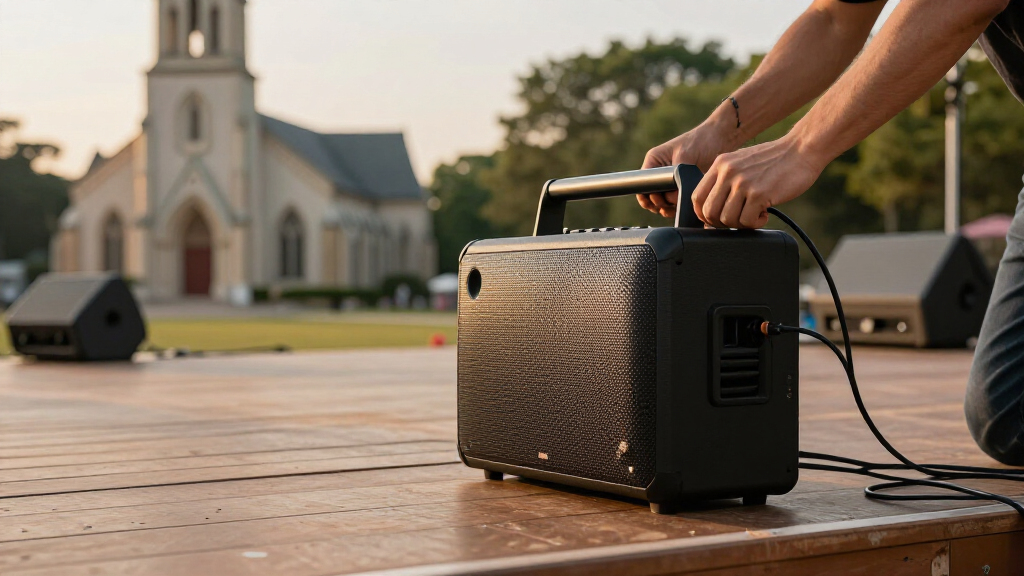
outdoor portable PA speaker system
As an affiliate, we earn on qualifying purchases.
As an affiliate, we earn on qualifying purchases.
Power options: battery, generator, or mains?
Choosing your power source is key. Battery-powered systems are the most common for outdoor church events—they’re portable, quiet, and reliable. Modern lithium-ion packs can run 6–12 hours on a single charge, enough for most services. If mains power is unavailable, a small inverter generator produces cleaner power and reduces noise compared to traditional gas generators, but it still adds some background hum. For large or recurring events, consider a hybrid setup: a battery system for quick setup and a generator for extended use. Always calculate your total wattage draw—your speakers, mixer, wireless mics, and any streaming gear—and add 20% headroom to prevent overloads or premature battery drain.
Understanding the tradeoffs between power options is essential. Battery systems offer clean, quiet operation ideal for sensitive environments and quick setups, but their runtime limits might require additional batteries or charging stations for longer events. Generators provide continuous power, making them suitable for extended outdoor gatherings, but they introduce noise and require fuel management. Mains power is ideal if you have reliable access, ensuring consistent voltage and less maintenance. Selecting the right power source depends on your specific venue, frequency of events, and logistical considerations. Weighing these factors ensures your setup is both effective and sustainable, avoiding interruptions or damage to your equipment.
weatherproof wireless microphone for outdoor events
As an affiliate, we earn on qualifying purchases.
As an affiliate, we earn on qualifying purchases.
Positioning speakers for maximum coverage and clarity
Proper placement of your speakers makes or breaks your outdoor sound quality. Elevate speakers on sturdy stands at least 6 feet high—sound travels farther and is less muffled when drivers are above head level. Angle speakers slightly inward toward the audience, aiming downward for the best coverage. For large areas, set up two speakers in stereo, spaced evenly apart, so sound reaches every corner without dead zones. Avoid placing speakers behind microphones—feedback is the enemy. Think of your setup like a gentle wave, spreading sound evenly across the field, not a single loud boom in one spot. This way, everyone, from front to back, gets clear, intelligible audio.
Effective speaker placement isn’t just about height and angle—it’s about understanding how sound propagates outdoors. Sound waves diminish with distance, and environmental factors like wind, trees, or uneven terrain can cause reflections or dead zones. Placing speakers at optimal heights and angles helps mitigate these issues, ensuring consistent volume and clarity throughout the venue. When spacing speakers correctly, you minimize the risk of sound overlap that can cause phase cancellation or feedback. Testing different positions before the event and adjusting based on real-world acoustics can significantly improve clarity, making sure your message reaches everyone without distortion or dead spots.
As an affiliate, we earn on qualifying purchases.
How to prevent feedback and loud ringing sounds
Feedback is the number-one live sound headache outdoors. It happens when microphones pick up sound from speakers and create a loop—loud, shrill, and uncontrollable. To stop it, keep microphones behind speakers, never in front of them. Use wireless mics with UHF frequencies—these are less prone to interference and easier to coordinate. Employ graphic EQ settings or built-in feedback suppressors—many portable PAs now feature auto-feedback reduction modes. Windscreens and windsocks are must-haves outdoors—they cut wind noise that can cause feedback or muffled sound. Think of feedback as a ringing alarm—prevention and quick adjustments keep your service peaceful and clear.
Understanding feedback is about more than just placement—it’s about the environment and equipment interaction. Outdoor conditions like wind or nearby reflective surfaces can exacerbate feedback issues. Using directional microphones, which pick up sound mainly from one direction, reduces the chance of picking up speaker output. Proper gain staging—setting the microphone and system levels carefully—ensures the system isn’t overly sensitive, which can trigger feedback. Regularly monitoring sound levels during the event and adjusting EQ settings on the fly helps maintain clarity. Investing in feedback suppression technology can save hours of troubleshooting and keep your service running smoothly, even in challenging outdoor environments.
battery-powered portable sound system for church
As an affiliate, we earn on qualifying purchases.
As an affiliate, we earn on qualifying purchases.
Weather-proofing your gear: keep rain and sun at bay
Weather is the biggest threat to outdoor sound gear. A sudden rain shower, high humidity, or scorching sun can fry electronics or degrade speakers over time. Use waterproof covers, tarps, or pop-up canopies to shield your equipment. Elevate gear off wet ground—never run cables on mud or puddles. Consider IP-rated speakers (like IPX4+), designed for outdoor use—they resist splashes and dust. Shade amplifiers and batteries from direct sun to keep them cool and extend lifespan. Think of your setup as a fragile garden—protection keeps everything blooming smoothly, no matter what the weather throws at you.
Proper weather-proofing isn’t just about covering equipment; it’s about understanding environmental risks and planning accordingly. Rain can cause short circuits, and UV exposure can degrade plastics and rubber parts over time. Using protective covers and choosing IP-rated gear reduces these risks, but also consider the placement—avoid low-lying areas prone to flooding or puddles. For prolonged events, set up portable shade structures or tents over critical components, and ensure proper ventilation to prevent overheating in direct sun. Regularly inspecting and maintaining weatherproof enclosures extends your gear’s lifespan and prevents unexpected failures, ensuring your outdoor service remains uninterrupted regardless of weather conditions.
Legal and neighbor tips: keeping it friendly and legal
Outdoor sound isn’t just about loudness—local regulations matter. Many areas have noise ordinances, especially during evenings. Always check if you need a permit—some towns require one for amplified sound beyond a certain volume or time frame. Aim your speakers away from neighboring homes to avoid complaints, especially with bass-heavy subwoofers that travel far. Keep the volume at a reasonable level, and consider using directional speakers to focus sound where it’s needed. Being aware of local laws and respecting neighbors keeps your church’s outdoor events running smoothly without hassles or fines. Think of it as being a good neighbor—loud, but reasonable.
Understanding and respecting legal boundaries is vital for maintaining good community relations. Noise ordinances are in place to prevent disturbances, but they vary widely by location. Failing to obtain necessary permits can lead to fines or even shutdowns, which disrupt your community’s spiritual activities. Using directional speakers and aiming sound away from homes reduces noise spillover, demonstrating respect for neighbors. Setting volume limits, especially during late hours, shows consideration and helps avoid complaints. Establishing clear communication with local authorities and neighbors before events fosters goodwill and ensures your outdoor services are a positive experience for all involved. Being proactive about legal compliance and neighbor relations keeps your church’s outreach efforts harmonious and sustainable.
Budget tiers: what you get at different price points
Starting with a tight budget? A single battery-powered all-in-one system like the JBL EON One Compact (~$700) or Bose S1 Pro (~$600) can handle small services up to 100 people. For a bit more, around $1,500–$4,000, you can buy two powered speakers, stands, a small mixer, and wireless mics—perfect for medium-sized gatherings up to 500. For larger, frequent outdoor events, consider column array systems like the Bose L1 Model 2 (~$1,700) or JBL EON One MK2 (~$1,400). These deliver even coverage and quick setup but need a bigger budget. Think of your gear like a tool kit—more investment means easier, clearer sound over bigger spaces.
It’s important to recognize that higher-priced systems often offer better durability, sound quality, and ease of use, which can save time and frustration during setup and operation. While budget options may suffice for small events, they might struggle with clarity and volume in larger spaces or under challenging weather conditions. Investing in mid-range or higher-end gear ensures you have reliable performance, especially if outdoor services are frequent or large. Carefully assessing your typical event size, location, and future needs helps determine the best investment level, balancing initial cost against long-term benefits. This strategic approach ensures your church can consistently deliver clear, effective sound without constantly upgrading or troubleshooting.
Frequently Asked Questions
How many watts do I need for 200 people outdoors?
For 200 people outside, aim for around 150–200 watts of power per speaker, using at least two speakers in stereo or dual mono. This provides enough volume and clarity across open space, especially when placed on stands and angled properly.
Choosing the right wattage is essential because underpowered systems will struggle to fill large outdoor areas, leading to muffled sound and frustration. Too much power, however, can cause distortion or violate noise regulations if volume is not carefully managed. The key is to select a system that balances sufficient power with appropriate placement and volume control, ensuring clear, even sound coverage without overwhelming the environment. Properly powered and positioned speakers will deliver a consistent audio experience, keeping your congregation engaged and your message heard clearly across the open air.
Can I use a regular speaker for outdoor church events?
Regular indoor speakers typically lack weather resistance and may not handle the outdoor environment well. For outdoor use, choose weather-rated (IPX4+), portable powered speakers designed for open-air conditions to ensure durability and consistent sound quality.
Using indoor speakers outdoors can lead to equipment damage and poor sound performance. Outdoor speakers are built with rugged enclosures and weatherproof features that withstand rain, humidity, and dust. Investing in specialized outdoor speakers reduces the risk of failure and ensures your sound system remains reliable in various weather conditions. Additionally, outdoor speakers often have better dispersion patterns suited for open spaces, providing clearer, more even coverage. This thoughtful choice prolongs your gear’s lifespan and guarantees your message reaches everyone, rain or shine.
How long will a battery-powered PA last during a service?
Most lithium-ion portable PAs deliver 6–12 hours of runtime at moderate to high volume. Always check the manufacturer’s specs and test your setup beforehand to ensure your system can last through the entire event without surprises.
Understanding battery life is crucial for planning your event without interruptions. Factors such as volume level, use of wireless mics, and environmental conditions affect how long a battery lasts. Running equipment at higher volumes or with multiple wireless mics can drain batteries faster, so it’s wise to have spare batteries or charging options available. Properly managing power consumption—such as lowering volume during less critical moments—can extend operational time. Planning for longer events by selecting systems with higher capacity or portable power backups ensures your message remains uninterrupted, even in remote locations without power access.
What’s the best way to avoid feedback outdoors?
Keep microphones behind the speakers, use wireless mics with UHF frequencies, and apply feedback suppression features or graphic EQ settings. Windscreens and windsocks are also essential to prevent wind noise from triggering feedback.
Feedback outdoors can be more challenging due to environmental factors like wind, reflections, and ambient noise. Using directional microphones minimizes the pickup of unwanted sounds and reduces feedback risk. Proper gain staging—setting the input levels correctly—ensures the system isn’t overly sensitive, which could trigger feedback. Employing feedback suppression technology, such as automatic notch filters, can quickly identify and eliminate problematic frequencies. Windshields and windsocks help reduce wind noise that can cause false feedback triggers. Combining these techniques creates a stable sound environment, enabling clear communication even in unpredictable outdoor conditions.
Do I need a permit for outdoor amplified sound?
Yes, many localities require permits for outdoor amplified sound—especially if you’re using large speakers or operating late into the evening. Check your town’s regulations beforehand to avoid fines or having your event shut down.
Securing the necessary permits demonstrates respect for local laws and community standards. Failure to obtain permits can result in fines, shutdowns, or complaints that disrupt your service. Early communication with local authorities allows you to understand specific volume limits, restricted hours, or other restrictions. Using directional speakers and setting sound levels within legal limits further demonstrates good community relations. Planning ahead ensures your outdoor event proceeds smoothly, maintains your church’s reputation, and fosters positive relationships with neighbors and officials. Being proactive about legal requirements is a critical part of responsible event planning.
Conclusion
Setting up a portable outdoor PA isn’t just about turning up the volume. It’s about choosing the right gear, placing it wisely, and protecting it from the elements. When done right, your message will be clear, loud, and respectful of the neighborhood. Think of it as planting seeds—you’re creating a sound foundation that will grow and flourish with every outdoor service. So, gear up, plan smart, and let your voice carry across the open sky.Fall yard work Picks
leaf blowers
As an affiliate, we earn on qualifying purchases.