TL;DR
Prime for Young Adults — start your free trial
Fast free delivery, streaming and member deals for eligible 18–24 year olds.
Try it freeAs an affiliate, we earn on qualifying purchases.
Choosing a battery-powered PA system depends on your event size, portability needs, and sound quality. Recent advances offer longer battery life and seamless wireless streaming—making these systems versatile for outdoor, emergency, or mobile use.
Match the wattage of your PA system to your typical event size—more power for outdoor festivals, less for small gatherings.
Prioritize portability if you’ll be moving often—compact, lightweight units with handles or wheels make setup easier.
Battery life varies from 4 to 12 hours; plan for longer events by choosing systems with extended runtime and backup options.
Versatile inputs like Bluetooth, multiple mic channels, and media slots greatly increase your system’s flexibility.
Weather-resistant models protect your gear during outdoor gigs and save you from last-minute surprises.
How to Select a Battery-Powered PA System
Choose for the event you actually run: match sound coverage to the crowd, runtime to the schedule, and portability to the route between your vehicle and the stage. The best system is not simply the loudest—it is the one that stays clear, connected, and powered until the last announcement.
Key insight: Modern lithium-ion systems can deliver up to 12 hours of runtime, enabling all-day outdoor and mobile events without dependable mains power.
Match output to audience, noise and distance
Wattage influences headroom and coverage, but clarity also depends on speaker design, placement and environmental noise. Outdoors, sound dissipates faster and usually needs extra headroom.
Small gathering
Meetings, backyard ceremonies and presentations for roughly 20–50 people need intelligibility more than brute force.
Wedding or market
Music, speeches and shifting crowd noise call for more headroom, separate source control and dependable wireless playback.
Festival or dance event
Open air, larger audiences and music with strong dynamics require additional output—and often a link to a second speaker.
Runtime is a range, not a promise
High volume, bass-heavy playback, wireless features and device charging can reduce operating time. Build a margin into every event plan.
Add at least 25% headroom
For an eight-hour program, target ten hours of realistic runtime or carry a compatible spare battery. Never plan around the maximum laboratory figure alone.
Build the system around your operating reality
Prioritize the column that matches your most demanding recurring event—not a rare edge case that adds weight and cost every other day.
| Decision factor | Basic mobile use | Versatile event use | Demanding outdoor use |
|---|---|---|---|
| Power output | 50–100W | ✓100–150W | 150–200W+ |
| Battery target | 4–6 hours | ✓8–10 hours | 10–12 hours + backup |
| Portability | ✓Carry handle | ✓Under 15 lb / wheels | ~More weight likely |
| Source inputs | 1 mic + Bluetooth | ✓2–3 mic/line + media | Multiple channels + line-out |
| Weather protection | ✗Often absent | ~Preferred | ✓Rugged / IP-rated |
| Best fit | Talks and small parties | Weddings, markets, mobile DJs | Festivals and remote sites |
Five things to verify before buying
- Useful runtime at your normal volume
- Enough inputs for simultaneous sources
- Line-out or wireless linking for expansion
- Weight, handle position and wheel quality
- Weather rating, warranty and battery support
Bluetooth streaming
Speeds setup and removes cables, though range and interference should be tested at the venue.
Built-in EQ
Helps preserve speech clarity and control harshness when outdoor acoustics or noise change.
Multiple channels
Keeps microphones, instruments and music sources connected without constant cable swaps.
Weather resistance
An IP54-rated enclosure can resist dust and light rain, but it is not permission to operate in unsafe weather.
From event brief to reliable sound
Use the same sequence for every purchase comparison. It prevents attractive extras from obscuring the essentials.
Count people and map the space
Set wattage and headroom
Add schedule safety margin
Count every input and output
Check transport and resilience
The winning balance is enough output, realistic runtime and effortless deployment.
What size and power output do you really need?
Knowing the right wattage is step one. For small gatherings of 20-50 people, a system with 50-100W can do the job. But if you’re planning outdoor festivals or larger crowds, aim for 150W or more. For example, a Disco Flight Portable PA with 100W can comfortably cover a backyard party, but a 200W setup is better for outdoor markets or dance events.
Power isn’t just about volume. It influences clarity and coverage. Too little, and your sound gets lost, making it difficult for everyone to hear clearly, especially in noisy outdoor environments. Too much, and you risk distortion or unnecessarily draining your battery quickly, which can leave you without sound midway through your event. Matching your system’s wattage to your typical venue size helps ensure your sound is clear and sufficient without overtaxing your equipment or battery life. This balance is crucial because it directly impacts the quality and reliability of your performance, especially in unpredictable outdoor settings where acoustics can be challenging.
battery powered PA system with Bluetooth
As an affiliate, we earn on qualifying purchases.
As an affiliate, we earn on qualifying purchases.
How portable should your system be?
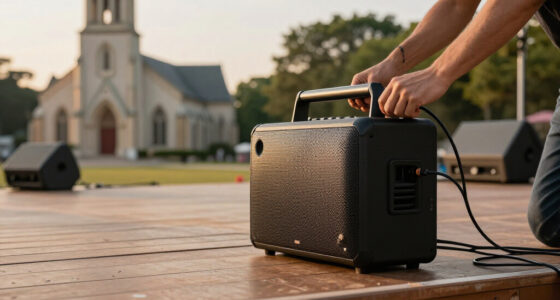
Portability is king when you’re on the move. Look for compact designs under 15 pounds, with integrated handles or wheels. For instance, a Disco Flight Portable PA measures roughly 14x10x8 inches, weighing just under 12 pounds—easy to carry or fit into a small car trunk.
Consider your setup routine. If you frequently switch locations, a lightweight, one-piece unit saves time and effort, reducing fatigue and streamlining your process. Conversely, larger or heavier systems might offer more power or features but can slow you down and make transport cumbersome. For multi-event days, a system with a sturdy handle and optional wheels can significantly reduce physical strain, enabling you to focus more on your performance than on logistics. The tradeoff often lies in balancing power and size—smaller, lighter systems may have less output or fewer features, so prioritize based on your typical event needs and mobility requirements.
portable outdoor PA system with long battery life
As an affiliate, we earn on qualifying purchases.
As an affiliate, we earn on qualifying purchases.
What about battery life and recharge time?
Battery life matters—especially for outdoor or multi-hour events. Most systems offer 4 to 12 hours of playback. For example, a Disco Flight Portable PA with a 10,000mAh battery can run about 8-10 hours at moderate volume, providing ample time for most events without needing a recharge. However, longer events or multiple performances may require careful planning around recharging schedules or backup batteries.
Recharge times vary significantly among models; many systems recharge in 3-4 hours, which means you need to plan ahead if you’re doing back-to-back gigs. Investing in systems with faster recharge capabilities or additional spare batteries can help maintain your performance schedule. Proper management of battery health—such as avoiding full discharges or storing batteries in cool environments—also plays a critical role in ensuring your gear remains reliable over time. This proactive approach prevents unexpected power failures and extends overall lifespan, which is especially important when you’re relying on a single battery for extended outdoor use.
weather-resistant battery powered PA system
As an affiliate, we earn on qualifying purchases.
As an affiliate, we earn on qualifying purchases.
Which features make your life easier?
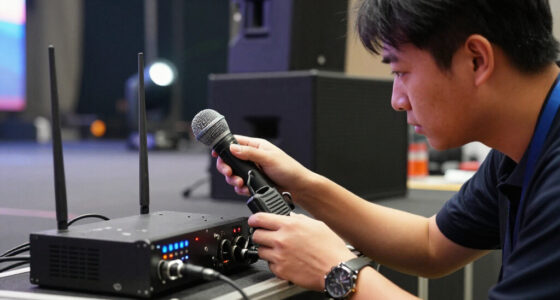
Look for systems with versatile inputs—microphones, instruments, Bluetooth, media slots. For example, a Disco Flight Portable PA with Bluetooth and multiple mic inputs lets you handle speeches, music, and announcements seamlessly. Built-in EQ controls help tailor sound on the fly, especially outdoors where acoustics vary and environmental noise can affect clarity.
Wireless streaming is a bonus—stream playlists directly from your phone to avoid messy cables, which reduces setup time and increases flexibility. Durability features like weather-resistant enclosures can save your gear from rain, dust, or accidental bumps during outdoor gigs. These features not only enhance convenience but also expand your system’s usability across different scenarios, making your investment more versatile and reliable.
compact battery powered speaker for events
As an affiliate, we earn on qualifying purchases.
As an affiliate, we earn on qualifying purchases.
How do input/output options influence your setup?
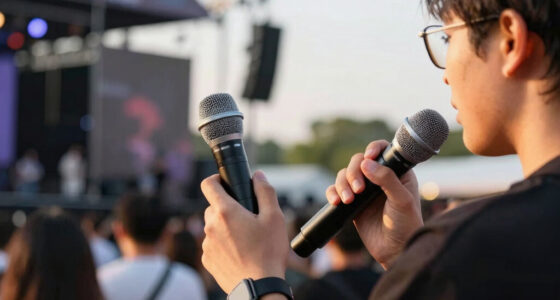
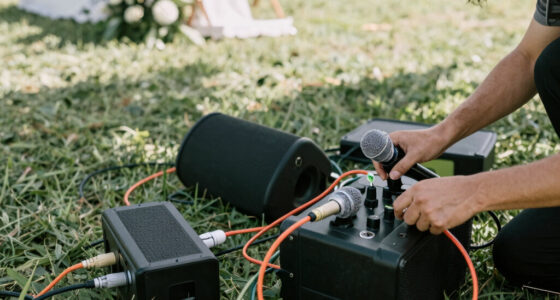
Multiple input/output ports increase flexibility. A typical system might have 2-3 mic/instrument inputs, Bluetooth, and a line-out to connect additional speakers or recording devices. For instance, if you’re DJing and also doing speeches, having separate inputs prevents conflicts and allows simultaneous use of multiple sources, which is often essential in complex event setups.
Check compatibility with your existing gear. A Disco Flight Portable PA designed to fit into standard DJ controllers or small speakers ensures seamless integration without extra adapters or fuss. This flexibility minimizes setup time, reduces potential points of failure, and allows you to adapt quickly to changing event needs, ensuring consistent sound quality regardless of configuration.
Should you worry about weather resistance?
Weather resistance can be a game-changer for outdoor events. Look for systems with rugged, weatherproof enclosures if you plan to perform outside frequently. For example, a system rated IP54 withstands dust and light rain, preventing damage during unexpected showers, and giving you peace of mind during unpredictable weather conditions.
Even if you mostly indoor, outdoor events can come up unexpectedly. Investing in weather-resistant gear protects your investment and reduces last-minute stress. Plus, a durable build often means better shock absorption during transport, safeguarding your system from bumps and drops that could impair performance or longevity.
What’s the best way to match your system to your event?
Follow a simple process: 1) Assess your typical venue size and audience to determine necessary power and coverage, 2) Decide on portability needs based on how often you’ll move locations, 3) Prioritize battery life for longer events or remote setups, 4) Choose feature set based on your applications—such as Bluetooth, multiple inputs, or weather resistance—and 5) Match wattage accordingly, ensuring you have enough headroom without excessive power that wastes battery life. For a street performer, a small, 50W system with 6 hours of battery may suffice, but for a wedding DJ, a 150W system with multiple inputs and Bluetooth makes more sense.
Remember: It’s better to have a little extra power than struggle with insufficient volume, which can compromise your performance. Additionally, considering future needs and potential expansion helps avoid early upgrades—buying slightly larger systems now can save you money and hassle later.
Compare popular features side by side
| Feature | Disco Flight Portable PA | Alternative Model A | Alternative Model B |
|---|---|---|---|
| Power Output | 100W | 80W | 150W |
| Battery Life | 10 hours | 8 hours | 12 hours |
| Weight | 11 lbs | 12 lbs | 14 lbs |
| Inputs | 2 mic, Bluetooth, line-in | 1 mic, Bluetooth | 2 mic, line-in, Bluetooth |
| Weather Resistance | Yes (IP54) | No | Yes (IP65) |
Frequently Asked Questions
How long does the battery last on a typical portable PA system?
Most systems deliver between 4 and 12 hours of operation, depending on volume settings and usage. For full-day outdoor events, look for models with at least 8 hours of runtime, like some Disco Flight units that offer up to 10 hours at moderate volume. Understanding battery life helps you plan your setup and avoid interruptions during critical moments, especially when access to power sources is limited or unavailable.
Can I connect multiple microphones or instruments to a battery-powered PA?
Yes, many systems come with 2 or more mic/instrument inputs. For example, a Disco Flight Portable PA with two mic inputs and additional media options can handle both speeches and live music simultaneously, which is essential for versatile events. The ability to connect multiple sources expands your creative options and ensures you’re prepared for various performance scenarios, but be mindful of input levels and potential feedback issues that can arise with multiple microphones.
Is Bluetooth connectivity reliable for streaming audio?
Modern systems generally offer stable Bluetooth connections, with ranges up to 30 feet. While interference from other wireless devices can occasionally cause issues, most outdoor or casual setups experience minimal problems. Reliable Bluetooth streaming allows quick, cable-free playback from your devices, simplifying setup and reducing clutter. However, for critical performances, consider wired connections or higher-end models with advanced wireless protocols to ensure consistent audio quality.
What size or wattage should I choose for my event?
For small indoor gatherings or speeches (up to 50 people), 50W–100W systems are enough. For outdoor festivals or larger crowds, aim for 150W or higher to ensure your sound reaches everyone clearly and loudly. Selecting the appropriate wattage ensures your audience hears you clearly without distortion, and helps manage battery consumption effectively—overpowered systems can drain batteries faster, while underpowered ones may leave your sound lacking.
Are battery-powered PA systems suitable for professional use?
Absolutely. Many high-end models provide professional-grade sound quality, robust durability, and multiple features tailored for live performances. They are designed to perform reliably in demanding settings like weddings, outdoor concerts, and corporate events. Investing in professional-grade gear ensures your performance remains consistent, and that your equipment can withstand the rigors of frequent use and transport, providing peace of mind for serious performers and event organizers.
Conclusion
Choosing the right battery-powered PA system hinges on understanding your event’s size, mobility needs, and feature preferences. With recent tech leaps—longer-lasting batteries, wireless streaming—you can find a setup that keeps your sound crisp and reliable, no matter where you perform. Focus on matching specs to your typical gigs, and you’ll avoid the headache of underpowered gear or cumbersome setups.Fall Picks
fall essentials
As an affiliate, we earn on qualifying purchases.